Get Full Government Meeting Transcripts, Videos, & Alerts Forever!
Get email alerts on the Public Works Facility topic
No spam. Unsubscribe anytime.
Acton officials seek voter approval to borrow for new public works facility
Summary
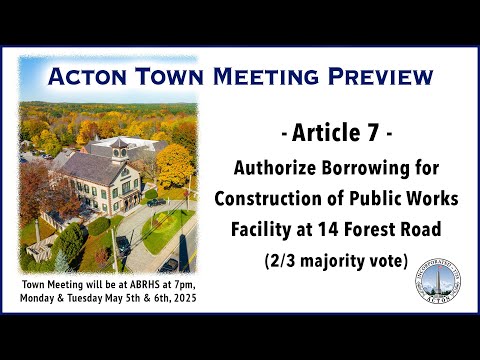
Dean Chatter, vice chair of the Select Board and chair of the Department of Public Works Building Committee, presented Article 7 asking voters to authorize borrowing to build a new Town of Acton public works facility and said the proposal will require a debt-exclusion vote on the April ballot and a two-thirds vote at town meeting.
Dean Chatter, vice chair of the Select Board and chair of the Department of Public Works Building Committee, presented Article 7 asking voters to authorize borrowing to build a new Town of Acton public works facility and described the votes required to move the project forward. He said the borrowing must first be approved by a debt-exclusion question on the April ballot (a simple majority required) and then by a two-thirds vote at town meeting to finalize the borrowing.
Chatter told attendees the existing public works building, built in 1969 and originally planned at roughly 30,000 square feet but later reduced to about 19,000 square feet, is “in bad shape, mechanically, structurally, and it's just undersized.” He said the town has many more roads, sidewalks and stormwater responsibilities now than in 1969, and that the building lacks adequate locker rooms, facilities for female employees, safe storage for fuels and toxic materials, sufficient workshop space and mechanic bays large enough to service modern equipment.
Chatter described safety and code concerns in parts of the existing facility, saying some mezzanines are not properly sprinklered and “do not meet building code or OSHA codes.” He said poor air quality, fumes migrating from work areas to offices, and undersized mechanic bays that prevent lifting and properly servicing equipment are recurring problems. He noted the mechanics bays are used to service not only public works equipment but also fire trucks, police cruisers and inspectional vehicles based out of town hall.
On costs, Chatter said project estimates have changed as the design team pursued value engineering. He gave a range of figures: in November the new-construction cost estimate was “almost $38,000,000,” value engineering later reduced direct construction “to just about $30,000,000,” and when soft costs (architectural fees, inspections, equipment and similar items) are included the total project estimate moved from about $47,000,000 to roughly $38,000,000. Chatter said the figure used for taxpayer-impact calculations in his presentation was $35,200,000, which he estimated would cost the average single-family household about $275 per year and the average condominium about $160 per year.
Chatter said the project has proceeded through prior steps: a feasibility study completed in 2021, a Select Board-authorized feasibility review committee, and a May 2023 town meeting approval of $1,225,000 for design work. He said that design appropriation was approved by a three-quarter majority on a clicker vote in May 2023 and that the Select Board, the Department of Public Works Building Committee and the Green Advisory Board have endorsed the current plan.
On energy systems, Chatter said the town evaluated multiple heating and cooling options. He said a gas-fired system was included only for comparison and would violate the town’s stretch energy code (adopted at town meeting), that air-source heat pumps appeared efficient but not the right economic choice, and that the project team plans to use a ground-source heat pump system. He said the proposed design would use about 30 wells on-site and compared that to the town’s existing systems: about eight wells at the North Acton Fire Station and roughly 67 wells at the Boardwalk Campus in West Acton, as reported in his remarks.
Chatter explained the construction sequencing decision: the original plan considered phased construction to keep operations on-site, but the town determined it could save money by temporarily relocating operations, demolishing the entire existing building and constructing the new facility at the same site in a single phase.
Looking ahead, Chatter said the next formal steps are the April debt-exclusion ballot question and separate town meeting action requiring a two-thirds vote to approve borrowing. He closed by asking for support for the project and noting further design and payback details are available on the town website.