Get Full Government Meeting Transcripts, Videos, & Alerts Forever!
Get email alerts on the Special Education Facility topic
No spam. Unsubscribe anytime.
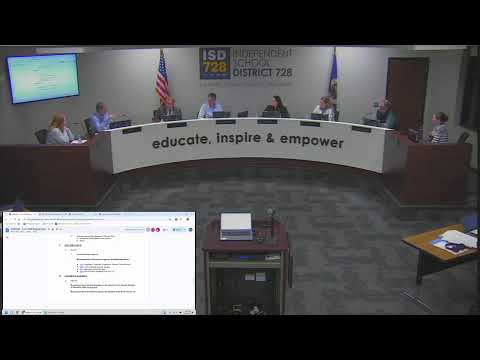
Elk River board weighs Level 4 special-education facility, orders demographic study to guide long-term choices
Summary
The ISD 728 school board on April 14 discussed options for a dedicated Level 4 special‑education facility and ordered a third‑party demographic study to inform a community task force's recommendations.
The ISD 728 school board on April 14 discussed competing options to serve students with high behavioral and intensive special‑education needs while confronting rapid enrollment growth on the district's south side.
The facilities committee recommended hiring a third‑party demographic firm to update long‑range enrollment projections, and presented high‑level cost estimates for repurposing existing buildings or building new space for Level 4 (the district’s most intensive special‑education setting) and alternative learning center (ALC) programs.
The board and staff said the demographic study will inform a community task force that begins meetings this fall and is expected to return recommendations in late 2025 or early 2026. Superintendent Olmos said executive cabinet is ready to present a new school‑perceptions survey at a work session in May and that the district will allow parents to opt their children out of the survey ahead of distribution.
Committee chair Director Steinbrecher said boundary adjustments alone will not provide a durable solution. “Boundary lines alone cannot be used as a solution for this growth,” Steinbrecher told the board, summarizing the committee’s review of maps and attendance zones. Director Weiss and other board members pressed for external validation of the committee’s assumptions before limiting the task force’s scope.
What the board heard and when
- Demographic study: The facilities committee recommended hiring “Hazel” (third‑party demographic work, referenced as Hazel Reinhart in discussion). The cost estimate given was about $10,000–$15,000. The district staff said they expect results by mid‑summer to inform the task force.
- Task force timeline and outreach: The committee said the district website and communications related to a community task force will go live April 28, with a press release and social media outreach planned; the task force orientation is slated to begin Sept. 11 and continue with multiple meetings through early January 2026.
- Student counts and program sizing: Staff presented current counts and high‑level projections for the district’s Level 4 programs. The board was told the district currently serves roughly 69 students in Level 4 programs, with a figure presented of 88 for a future snapshot that staff cautioned is “volatile” and subject to identification and enrollment changes. Planners estimated a dedicated facility could be sized initially for about 200 students with capacity to grow to roughly 300.
- Cost estimates (high level): The facilities presentation offered preliminary, budgetary ranges: a light renovation of an existing building roughly $950,000; a heavier renovation $7,000,000; a full renovation $14,000,000; remodeling an existing Ivan Sands site about $18,000,000; and new construction on a new site roughly $20,000,000. Staff noted ALC space currently does not qualify for lease‑levy funding while some other projects might. The board was told the district has about $24,000,000 in lease‑levy capacity that could be applied to capital work and that any use of those dollars affects other projects.
How the board is handling options
The facilities committee recommended the task force focus on a range of realistic choices rather than treat boundary changes as the primary fix. Committee materials and discussion indicated that moving attendance boundaries could offer only a short‑term relief (board and staff described it as a three‑to‑five‑year window in many scenarios) and would likely require repeat adjustments as growth continues; several board members disagreed on how restrictive the task force’s scope should be and asked that the external demographic study be completed before the board precludes options.
Board members pressed for clarity about which Level 4 students currently lack legally required placements versus students who are served within existing programs; staff said some programs (Journey, Focus and the 18–22 program) currently operate in district facilities but that a consolidated Level 4 facility would better meet a range of needs.
Next steps and context
Staff and board members said the Hazel demographic study will be used alongside the task force’s community input to develop options for the board. The facilities committee emphasized the work is at a “100,000‑foot” level and that more detailed scoping and line‑item budgets will follow. If the board chooses to pursue major capital work, staff said a referendum would be required for new construction and that lease‑levy dollars are finite.
The board did not vote on a preferred capital option at the April 14 meeting; committee members said they expect to return with additional data for the board and public as the demographic work and task‑force process proceed.