
Retailers seek parity as H.390 would broaden license suspension authority for alcohol infractions
Get AI-powered insights, summaries, and transcripts
Subscribe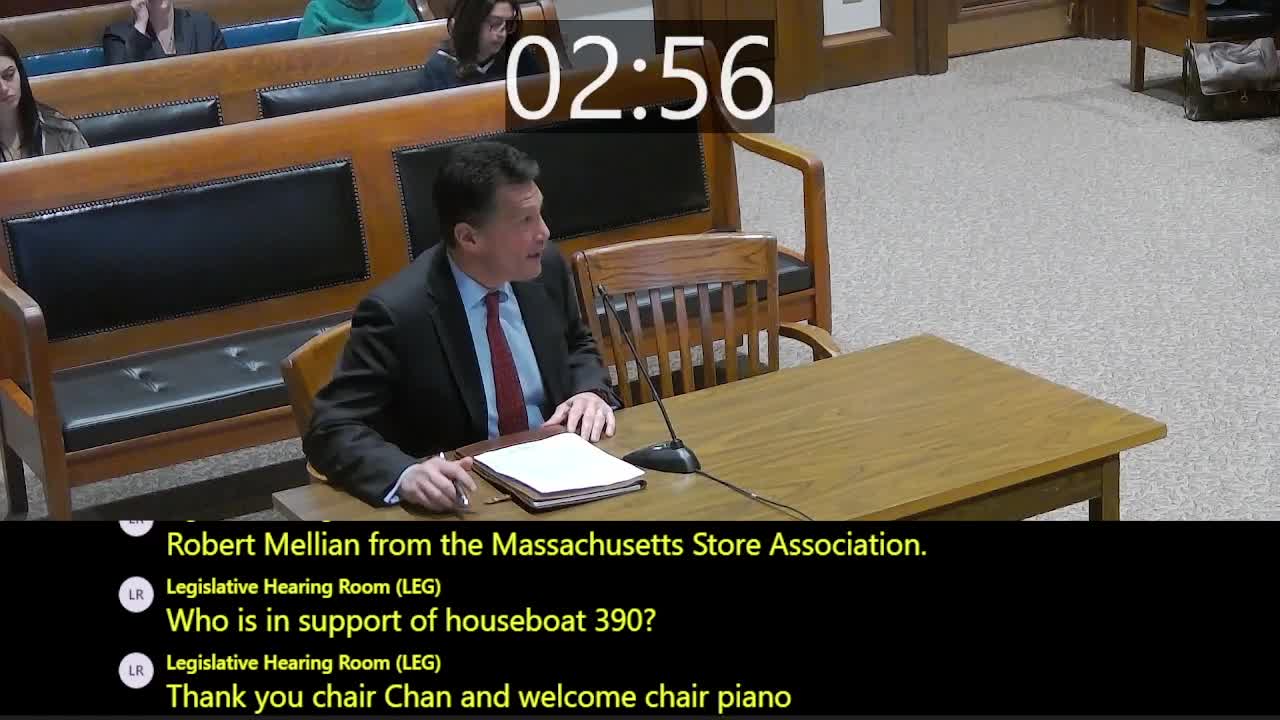
Summary
The Massachusetts Package Stores Association told the committee H.390 would extend suspension authority to all retail activity at stores found guilty of illegal alcohol sales, arguing the change restores parity across retail tiers and strengthens deterrence.
Rob Melian, executive director and general counsel for the Massachusetts Package Stores Association, testified in support of House Bill 390, which would alter how suspensions for illegal alcohol sales apply to retailers.
Melian said the bill would make suspension of the Section 15 license apply to a retailer's entire business activity when found guilty of illegal alcohol sales, restoring how suspensions worked before out‑of‑state multichannel retailers expanded sales in Massachusetts. “The penalty actually, essentially, becomes the original penalty for illegal sales, which previously resulted in closing the store down,” Melian said.
He told the committee that enforcement currently operates at both local licensing-authority and state ABCC levels; published ABCC decisions show a range of infractions across store types. Melian said compliance checks and published ABCC decisions indicate many infractions involve outlets that had not recently completed beverage‑alcohol training, and he argued multichannel retailers are less likely to participate in training and may be less deterred by fines that are small relative to their overall sales.
Committee members raised questions about collateral effects if a grocer or large supermarket were closed for an alcohol violation—closing stores that provide essential groceries could harm neighborhoods where residents rely on local markets. Melian responded that suspensions commonly result in negotiated fines in lieu of closures, and that repeat offenders are most at risk of closure. The committee did not vote on H.390 during the hearing.