
Self-storage industry urges law clarifications to address abandoned units and e-signatures
Get AI-powered insights, summaries, and transcripts
Subscribe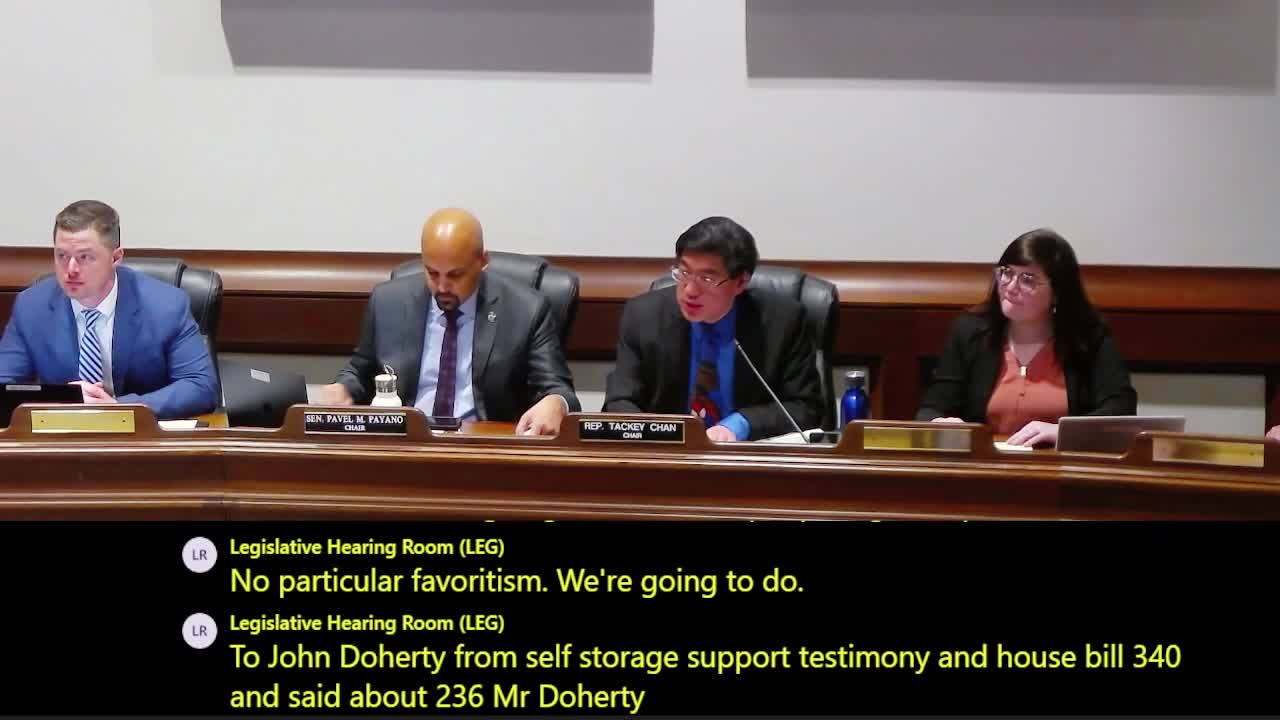
Summary
Industry representatives told the Joint Committee on Consumer Protection and Professional Licensure that pending bills H.340/S.236 would clarify when operators may begin abandonment procedures, recognize electronic rental agreements and address tenant transfers after facility sales.
Joe Doherty, senior vice president and chief legal and legislative officer for the Self Storage Association, testified in support of House Bill 340 and Senate Bill 236 before the Joint Committee on Consumer Protection and Professional Licensure.
The bills would amend Massachusetts law to clarify three circumstances, Doherty said: when a rental agreement ends but a renter has not removed possessions; that rental agreements may be delivered and signed electronically; and situations when a renter uses a unit for more than 30 days but has not returned a signed contract after a facility sale. “The current law doesn't address circumstances where the tenant has just not removed it at the end of a rental agreement,” Doherty said.
Doherty told the committee the self-storage industry employs about 200,000 people nationally and about 2,500 in Massachusetts at roughly 650 locations. He described the bills as “clarifications” rather than changes to consumer protections and said existing notice requirements under Massachusetts General Law Chapter 105A and applicability of Chapter 93A claims would remain intact. “This legislation doesn't change any of those notice requirements or other consumer protections and does not change the applicability of Chapter 93A claims either,” Doherty said.
Supporters said the changes would align the statute with industry practices adopted since the law was last revised, including electronic contracting and procedures for handling units after tenancy ends. Committee members did not take formal action during the hearing.
The committee will retain the testimony for consideration when it takes up H.340 and S.236 in a later session.