Get Full Government Meeting Transcripts, Videos, & Alerts Forever!
Get email alerts on the Tax Foreclosure Sales topic
No spam. Unsubscribe anytime.
City attorneys, DCD outline new state requirements for tax-foreclosed property sales
Summary
Milwaukee officials told the Judiciary & Legislation Committee that 2023 Wisconsin Act 207 and the U.S. Supreme Court's Tyler v. Hennepin County decision require the city to change how it lists and sells tax-foreclosed properties and provide a statutory right for certain former owners to repurchase properties prior to sale.
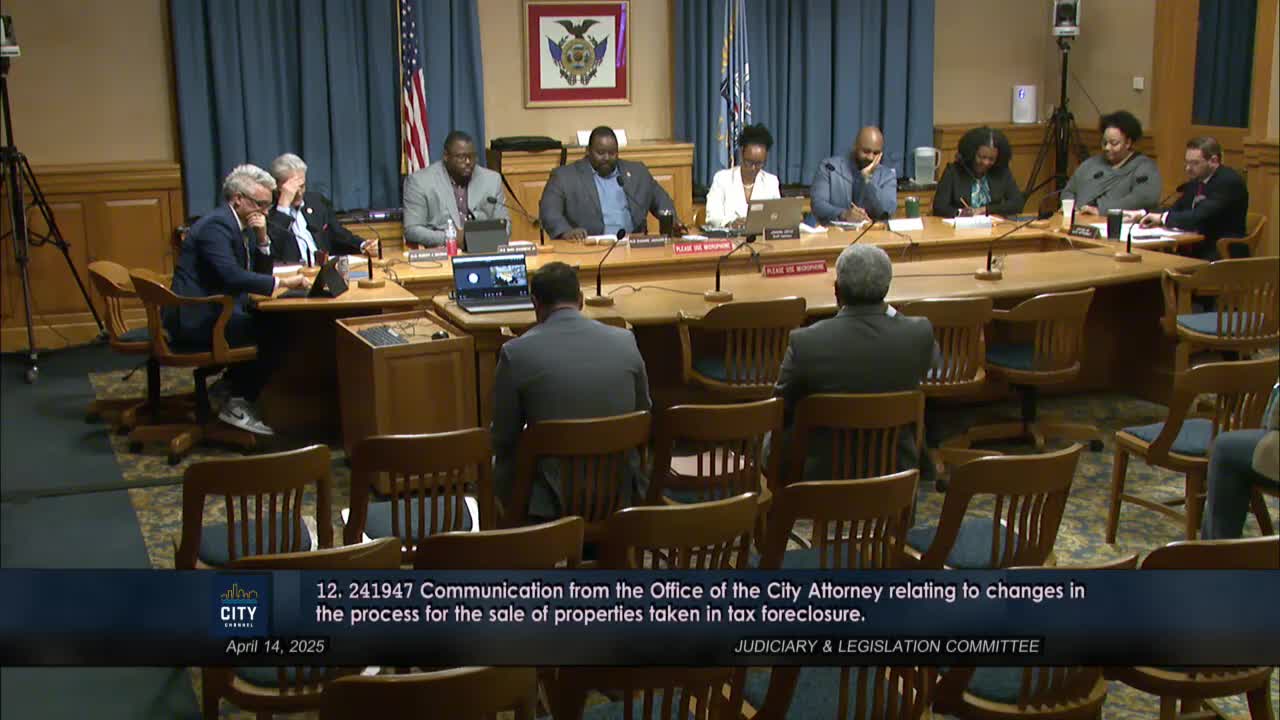
City officials told the Milwaukee Common Council's Judiciary & Legislation Committee on April 14 that state law and a U.S. Supreme Court ruling have forced changes to how the city lists and sells properties acquired through tax foreclosure.
The city attorney, Evan Lehi, said the Supreme Court's Tyler v. Hennepin County decision requires jurisdictions to return any surplus proceeds from tax-foreclosed property sales to the prior owner. He said the Legislature then enacted changes, most recently 2023 Wisconsin Act 207, that remove Milwaukee's prior exemption and add a public-listing requirement and a statutory right for certain former owners to repurchase properties prior to sale. "There are two major changes to how we operate: a listing requirement ... and a statutory right of the former owner to repurchase," Lehi said.
That statutory right, officials said, applies to single-family owner-occupants: if an owner-occupant comes forward before the property is sold and pays what is owed (taxes and recoverable municipal fees), the city would be required to allow repurchase. City staff told the committee that other categories ' such as investor-owned rentals ' are treated differently under the statute and do not automatically receive that statutory repurchase right.
Department of Neighborhood Services and the treasurer's office staff described operational consequences. The treasurer's representative said recoverable costs can include back taxes, reinspection fees, water bills and other municipal expenditures incurred while the city held the property. Dave Misky of the Department of City Development (DCD) said DCD has not yet listed some properties subject to the new law because the city is still revising multiple ordinances and coordinating internal processes.
Committee members raised concerns about several practical impacts: that the city's historic practice of holding parcels for future redevelopment or assembling scatter-site parcels could be undermined if an eligible bidder meets certain thresholds during the statutorily required listing period; that investor purchasers could outbid owner-occupants during the initial statutory listing; and that the city's existing programs and preferences (for owner-occupant sales, priority sale rules, or a 500-foot priority rule) will need rewriting to comply with state law.
Officials said properties acquired before the statute's effective date (April 2024) are effectively grandfathered, but properties acquired after that date fall under the new listing and sales rules. DCD staff told the committee some properties foreclosed since the effective date have been publicly listed in compliance with the statute, while others remain pending ordinance updates. City staff said they plan one-on-one briefings with aldermen and then to bring revised ordinances forward in the next council cycles.
The committee did not adopt final ordinance language. Alderman Coggs moved to hold the communication to the call of the chair, and the item was held for further work and follow-up briefings with aldermen and staff.
Why it matters: the changes shift who can regain title, alter the city's discretion over resale and redevelopment, and could affect revenue the city previously retained from property sales. The committee asked staff for clearer timelines, staff training, and more detailed ordinance redlines before formal legislation is requested from sponsors.
Next steps: city attorney and DCD said they will schedule aldermanic briefings, circulate redline ordinance drafts and return to this committee in a forthcoming cycle.