Get Full Government Meeting Transcripts, Videos, & Alerts Forever!
Get email alerts on the Lead Poisoning topic
No spam. Unsubscribe anytime.
Toledo officials outline enforcement plan, timeline for amended ‘Lehi Safe’ lead ordinance
Summary
City housing officials described amended Lehi Safe ordinance changes, enforcement responsibilities moved to the Department of Housing and Community Development, phased compliance dates and funding sources for abatement during an April 9 committee presentation.
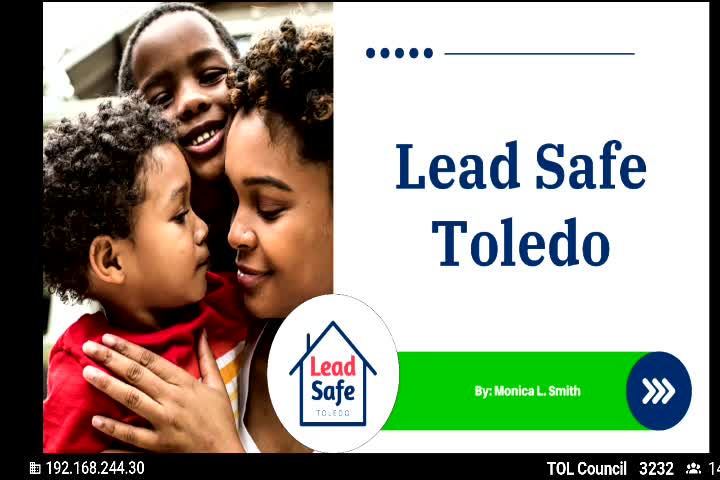
Toledo housing officials told the City Council’s Housing and Community Development Committee on April 9 that the city is prepared to resume enforcement of its Lehi Safe lead ordinance after legal challenges that paused implementation.
“Every ZIP code in the city of Toledo is high risk,” Rosalyn Clemons, director of the Department of Housing and Community Development for the City of Toledo, said during the presentation. “85% of our homes were built before 1980.”
Clemons and Tammy LaViolette, a senior attorney in the city law department, said the draft amendments move core certification and inspection functions from the health department into the Department of Housing and Community Development, an administrative change city staff say should reduce future legal vulnerability and centralize enforcement.
LaViolette described the principal change as transferring “the functions that were previously to be performed by the health department” so the city itself issues certificates and oversees local inspectors. Under the draft, the director of housing would be able to reject or bar an inspector’s certificate for poor performance; those decisions would be appealable to the nuisance abatement housing appeals board, LaViolette said.
City staff outlined the ordinance’s scope and timeline. The ordinance applies to rental properties with four or more units and family childcare homes built before 1978, the federal cutoff for residential lead-based paint. Staff gave these numerical summaries during the presentation: about 85% of Toledo’s housing stock was built before 1980; 52,980 rental units were built before 1978; and approximately 18,419 children under age six live in the city. Staff said on any given day “over 3,500 children” in Lucas County have elevated blood lead levels, using the city’s stated thresholds: the city ties its set reference value to the CDC reference value (3.5 micrograms per deciliter) and described “lead poisoning” as 10 micrograms per deciliter or greater.
The draft ordinance retains criminal enforcement through Toledo Municipal Court and keeps a conviction classified as a first-degree misdemeanor. The draft reschedules compliance dates to allow staff time to implement changes after the litigation pause; the first compliance date in the draft is December 31, 2025, and the eight-phase schedule ends June 30, 2029, with phase-in by census tracts, LaViolette said.
Clemons said the department has added staff and internal capacity to carry out the new responsibilities. She said the department is hiring a rehabilitation projects officer to review lead-safe reports and perform quality control, adding a clerical position and coordinating with code enforcement to identify applicable properties and manage notices. Clemons said the new positions are funded through the city’s general fund.
Funding for abatement and owner assistance remains a mix of competitive grants and local allocations, Clemons said. Staff said the city has used a HUD lead hazard control grant (the current award reported at $5,000,000) and a $1,050,000 lead stabilization grant from the Ohio Department of Health. The council previously allocated $250,000 from the general fund to a lead resource center, staff said. Clemons said the department will continue to apply for federal and state competitive funds but acknowledged ongoing risk if grant funding declines.
Council members asked for performance metrics and tracking. Clemons said the ordinance requires an annual report to council and staff committed to tracking compliance rates, numbers of certificates issued, and cases referred to housing court.
Councilwoman Melden Williams asked why the work was moved in-house; Clemons and LaViolette said litigation and the desire to consolidate authority motivated the transfer and that the health department will retain its public-health role for children who test positive and will continue to issue repair orders and provide case management when pediatricians report elevated blood lead levels.
City staff said they will present the amendments at the next agenda review and seek council action to restore enforcement. No formal vote was taken at the committee meeting.
Ending: Staff asked the committee for early support as the draft is advanced to the full council; they said they plan outreach and marketing to property owners ahead of the first compliance date and urged property owners who need assistance to contact the city’s lead resource team.