Get Full Government Meeting Transcripts, Videos, & Alerts Forever!
Get email alerts on the Behavioral Health Funding topic
No spam. Unsubscribe anytime.
Advocates urge county to protect culturally specific behavioral health funding and expand recovery housing
Summary
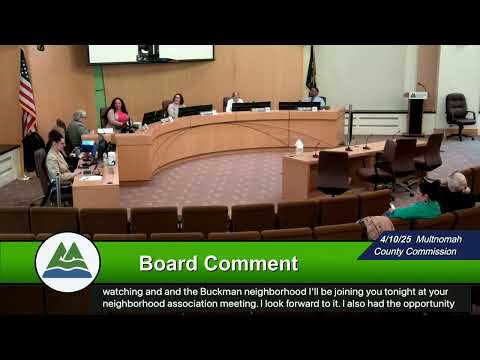
Public testimony at the Multnomah County Board of Commissioners' April 10 meeting urged the board to protect culturally specific behavioral health programs funded by Measure 110, to hire mental-health community members in county engagement offices, and to add transitional recovery housing beds to the housing continuum.
Several public commentators told the Multnomah County Board of Commissioners Thursday that local behavioral health funding cuts are jeopardizing culturally specific services and recovery housing while urging closer county attention to mental health and peer-led engagement.
Anne Casper, a longtime volunteer and peer advocate, told the board she worried that the county's Office of Consumer Engagement has shifted emphasis toward addiction-focused programming and away from mental health peer culture. "We're not quite sure what that office is doing for mental health," Casper said, and asked the board to hire people from the mental health community for the office, produce a monthly newsletter and provide training for judges on mental-health culture and language.
Devarshi (Devarshi) Bajpai, CEO of Aura Health and a person with lived experience of recovery, urged commissioners to prioritize transitional recovery housing ' a middle tier of housing between shelters and permanent supportive housing. Bajpai told the board that residential treatment is expensive and that the county needs about 2,000 transitional recovery beds but currently has roughly 500 in the Portland metro area. "If we can create this middle level of housing with transitional recovery housing, we can use our residential resources more effectively," he said.
Jose Luis Garcia, executive director of Huntos Northwest, said Measure 110 funds had helped create culturally and linguistically specific recovery programs serving Black, Brown and Indigenous communities, but he warned many of those programs face cuts. Garcia said some providers are eliminating positions and closing programs, and he urged the board to honor the county's April 8, 2021 declaration that systemic racism is a public health crisis by protecting funding for culturally specific services.
Other public speakers criticized the county's homeless response system and argued for improved data systems and mental-health investments. Several speakers asked the board to maintain funding for harm reduction services, culturally specific navigation, peer support and housing placement assistance.
The board did not take formal action on these public comments during the meeting. Commissioners acknowledged the testimony and referenced the broader budget and federal agenda discussions also on the agenda.
Provenance: Public comment on behavioral health and Measure 110 begins with Anne Casper's remarks and concludes when the clerk closed public testimony for the item.