Get Full Government Meeting Transcripts, Videos, & Alerts Forever!
Get email alerts on the Veterans And Military Funding And Policy topic
No spam. Unsubscribe anytime.
Committee advances veterans and military omnibus; includes new funding for veterans homes and recognition of Hmong SGU veterans
Summary
The Senate Commerce Committee moved Senate File 1959 forward with major investments in veterans homes and armory bonding, plus adoption of an amendment to recognize SGU/Hmong irregulars who fought alongside U.S. forces in Laos.
The Senate Commerce Committee advanced an omnibus bill for the Departments of Veterans Affairs and Military Affairs on April 10, approving operating and capital adjustments aimed at veterans homes, armory projects and assistance programs.
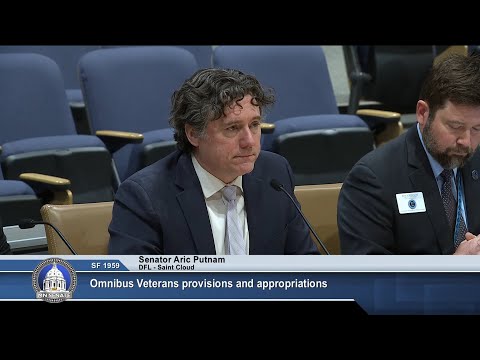
Senator Andrew Putnam, presenting the bill, said the package was designed to direct most resources to veterans homes and other pressing needs. Putnam said the committee “increased the state bonding power for state armories from $15,000,000 to $45,000,000,” clarified education assistance for spouses of deceased veterans, established no-cost gold and blue star family plaques, and included language to require accreditation for paid claims advocates who assist veterans with benefits.
Senate fiscal staff walked members through the change-item spreadsheet. The spreadsheet shows operating adjustments for the Department of Military Affairs and the Department of Veterans Affairs, and a large operating adjustment for veterans homes: about $39.17 million in the 2026–27 biennium and $51.35 million in the 2028–29 tails, according to the fiscal summary presented to the committee. Staff also described a $60,000 savings from an underspent veterans-resilience program that the committee repurposed to technical-assistance grants for veteran-service officers.
Deputy Commissioner Ben Johnson of the Minnesota Department of Veterans Affairs told the panel the agency appreciated that most governor-requested items were included, and he highlighted the importance of operating adjustments for veterans homes and services. Johnson also discussed the fiscal implications of an amendment to extend certain veterans’ recognitions to members of the special guerrilla units (SGU) who fought in Laos during the Vietnam era and their surviving spouses. He told the committee the department estimated about 900–1,000 resident SGU members could be eligible under earlier language used in the House, but the targeted language in the amendment before the committee would result in far fewer annual interment requests; he estimated about 17 interments per year from the eligible group and said most costs (burial and honor-guard stipends) would be absorbable at roughly $30,000 per year. He identified grave markers as a permissive cost that could be significant but would depend on available funding.
The committee debated and adopted an amendment (A12) to add Hmong SGU veterans and certain other irregular forces that served in Laos to a set of state recognitions and privileges; senators from both parties spoke for and against aspects of the change. Supporters said the amendment recognized long-standing service and sacrifice; some members asked whether the amendment could open the door to similar requests from other allied groups and raised concerns about parity with Minnesota National Guard members seeking benefit changes. Johnson said the department could absorb much of the recurring cost but noted the House language had included a roughly $118,000 appropriation to administer a related task force; the committee removed a task-force appointment clause from the amendment to avoid procedural conflicts.
Senators also considered an amendment (A8) to allow any veteran to seek assistance from any county veteran-service officer regardless of the officer’s employer jurisdiction; the panel adopted that amendment.
At the committee’s conclusion Senator Nick Frentz moved that the veterans and military omnibus (Senate File 1959) as amended be recommended to pass; the motion prevailed on a voice vote.
Votes at a glance: the committee adopted A12 (SGU recognition, as amended) and A8 (authorizing veterans to obtain help from any county veteran-service officer). The omnibus bill, as amended, was recommended to pass on a voice vote.