Get Full Government Meeting Transcripts, Videos, & Alerts Forever!
Get email alerts on the Public Meetings And Bylaws topic
No spam. Unsubscribe anytime.
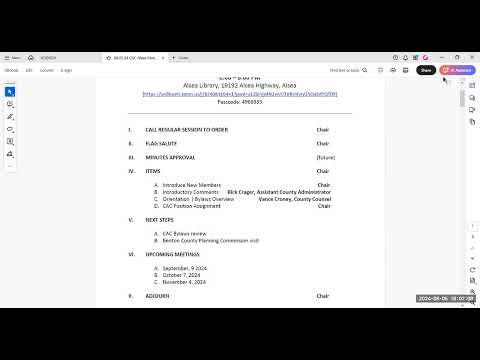
Benton County attorney briefs CAC on public-official duties, public‑meeting law and bylaws
Summary
Benton County County Attorney Vance Croni told the Alsea/L.C. Citizen Advisory Committee that members act as public officials when conducting CAC business, outlined rules on election-related advocacy and public meetings, and urged the committee to review and amend bylaws to reflect its long‑term goals.
Benton County Attorney Vance Croni told members of the Alsea/L.C. Citizen Advisory Committee on Monday that when they meet in an official capacity they are public officials and are bound by state election and public‑meeting laws.
Croni said the public‑meeting statute requires meetings be reasonably noticed, open to the public, and that minutes record who attended, votes and the "essence of what was discussed." He said recordings can serve as the official minutes but must be preserved and made available permanently.
"When you sit down and you convene your meeting as the Alsea/L.C. Citizen Advisory Committee, that hat becomes your public‑official hat," Croni said. "Election law is extremely explicit and it is unforgiving. If a public official violates election law... you are personally liable for the fine." He added the committee may discuss issues but must avoid advocating for or against candidates once filings and ballots are in play.
Croni reviewed bylaw provisions that define the committee's purpose: to provide locally informed input to Benton County planning staff, the planning commission and the board of commissioners on land‑use matters, comprehensive‑plan updates and development code changes. He also urged the CAC to identify standing items for future agendas—such as FEMA floodplain updates and wildfire preparedness—so planning staff bring relevant experts to meetings.
County staff and the committee discussed recordkeeping and virtual attendance. Croni said virtual participation is permitted but the public must be able to hear and be heard; if Zoom audio is poor, the meeting does not meet statutory requirements. Community development staff has been posting recordings and minutes to the LCCAC page, but the committee raised equipment and storage questions.
The session closed with Croni recommending that proposed bylaw changes be forward‑looking and, where possible, aligned with countywide standards so staff need not manage many divergent rule sets. The CAC agreed to begin drafting specific bylaw changes and pass them to county staff for review.
County staff said they will follow up with written guidance on notice requirements, storage of audiovisual minutes and any equipment funding options.