Get Full Government Meeting Transcripts, Videos, & Alerts Forever!
Get email alerts on the Trees And Parks Funding topic
No spam. Unsubscribe anytime.
Lago Vista discussion opens on using tree-mitigation fees for parks, and lowering protected-tree size
Summary
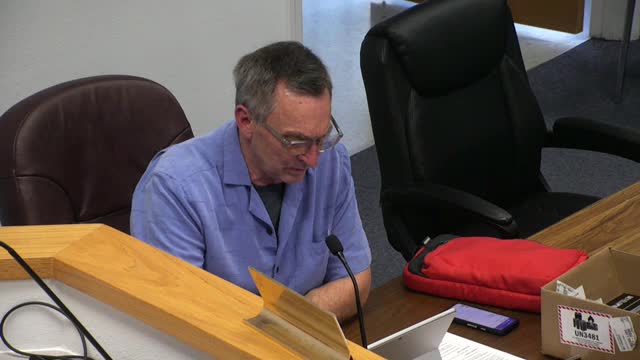
Councilmember Paul Roberts told the Parks & Recreation Advisory Committee significant sums have accumulated in Lago Vista's tree-mitigation account and asked whether some of that money should be available for parks, trails and neighborhood improvements.
Councilmember Paul Roberts told the Parks & Recreation Advisory Committee the city has been collecting tree-mitigation fees for several years and the sums now warrant discussion about whether the funds should be more directly available to parks work.
Roberts said the fees historically were booked into a general-fund bank account and that accounting for them specifically began in fiscal year 2021. He summarized incoming revenues for recent years, saying fiscal year 2021 showed about $117,000, fiscal year 2022 about $484,000 and fiscal year 2023 about $191,000, and estimated roughly $900,000 had accumulated across those years (not counting the current fiscal year). "Yes, this money while premised with the name pre mitigation fund, it actually is from a bank account balance. It's in the general fund," Roberts said.
Why it matters: Committee members framed the discussion as a potential way to direct money toward visible, local park projects (trails, pocket or neighborhood parks, planting and maintenance) instead of leaving the account under general-fund control. Members emphasized that any redirection would need to respect the city's required cash reserves, and that a large one-time appropriation could affect the city's 90-day reserve target.
Details from the ordinance and options discussed
Roberts read the ordinance language that governs how mitigation fees are to be used: collected fees "shall be placed in a special fund" and be restricted to planting of greenery, development or improvements of trails, and the development or improvement of pocket parks as determined by the city council. He noted residential properties are subject to a separate residential cap: the ordinance limits tree-mitigation charges for single-family residences to a maximum of $10,000; there is no analogous cap in the ordinance for nonresidential properties.
Committee members asked for several clarifications and possible changes: - Reduce the caliper threshold for a protected tree (the current ordinance protects trees 10 inches in diameter measured 40 inches above ground). Committee members discussed other cities' thresholds (6'8 inches was mentioned as common) and requested staff research. - Consider broadening the ordinance wording from "pocket parks" to allow use for "city-owned parks" or "neighborhood parks" so funds can be used for both small new parks and improvements to existing parks and linear trail work. - Provide a concrete list of low-cost, high-impact projects (mulch trails, picnic tables, small ADA adjustments, trail maintenance, vegetation plantings) that could be candidates for funding in 2025 and 2026.
Technical replacement rules noted
Roberts summarized replacement ratios noted in the ordinance: trees between 10 and 36 inches require replacement at a 1:1 inches-for-inches ratio using replacement trees of at least a 3-inch caliper; if replacement trees are smaller than 3-inch caliper the replacement ratio changes (1.5:1). For trees above 36 inches, the replacement ratio increases (the ordinance text was referenced; committee members asked staff to provide exact statutory language and citations).
Next steps and caveats
Committee members and staff agreed to take several next steps: (1) staff will survey other cities for typical caliper thresholds and replacement standards; (2) the committee will draft a short list of projects that could receive mitigation funds; and (3) the committee will request that the item be placed on a future city council agenda for policy direction. Paul Roberts and several committee members emphasized that any spending must preserve required general-fund reserves and that the money currently sits in the general fund, not in an unconstrained separate account.
Ending
Committee members asked staff to return with suggested ordinance language, comparative examples from other cities, a prioritized list of candidate projects, and accurate revenue totals for FY24 so discussion before any council referral is fact-based and precise.