Get Full Government Meeting Transcripts, Videos, & Alerts Forever!
Get email alerts on the Five Year Cip topic
No spam. Unsubscribe anytime.
Council reviews proposed five-year capital improvement plan covering water, wastewater, streets, drainage and airport
Summary
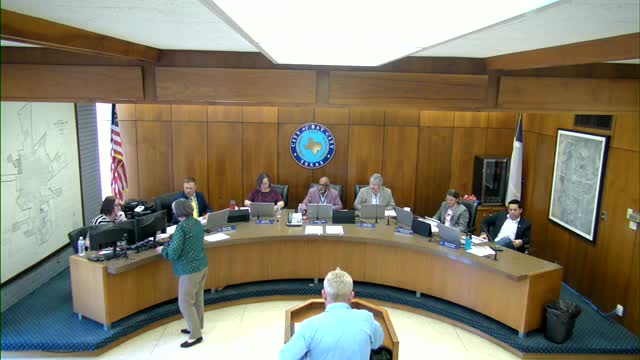
Bay City — City staff presented the proposed five-year Capital Improvement Program for water, wastewater, streets, drainage and airport projects and walked council through priorities, project timing, funding sources and grant applications.
Bay City — City staff presented the proposed five-year Capital Improvement Program for water, wastewater, streets, drainage and airport projects and walked council through priorities, project timing, funding sources and grant applications.
Crystal Mason, assistant director of public works, led the water and wastewater portion of the CIP. She reported the completed lead service line inventory found 57 service lines requiring replacement work; the city identified those as galvanized (not elemental lead) and located on the customer side of the meter, and staff proposed spreading replacements over a 10-year schedule. “It was determined there's only a 57 lines that are gonna require replacement,” Mason said, and staff intend to seek grant funding to limit direct homeowner costs.
Mason described a fire-hydrant preventive maintenance and replacement program that began this year with 30 hydrants and intends to process roughly 400 hydrants over multiple years through testing, sandblasting and painting to NFPA colors; crews also received valve-and-hydrant training to allow some in-house repairs. She presented project updates including the East Water Treatment Plant (well drilled; generator pad and storage tank work underway; substantial completion dates discussed), the Fifth Street 12-inch waterline assessment (assessment showed roughly half the line needs replacement), and a five-year tank recoating schedule tied to treatment-plant work.
On wastewater, staff proposed raising lift station monitoring to a higher priority with cloud-based wireless monitors (auto-dialers) to notify operators of pump or electrical failures, and a continuing manhole rehabilitation program budgeted at roughly $100,000 a year. The Wastewater Treatment Plant construction project remains in progress; staff said contractors are awaiting long-lead electrical components but substantial completion is expected in early 2027.
Public works also presented streets, bridges and drainage plans. Staff described multi-street “complete streets” projects (reconstruction with coordinated water, sewer, sidewalk and drainage work) for Moore Addition, Island Addition and Nichols/Norvell subdivision; preliminary estimates for Nichols/Norvell were noted as roughly $44.5 million (staff called that a very rough estimate). Bridge replacements are proceeding with a mix of funding sources including ARPA and TxDOT; staff said some bridges will require moving utilities (water and sewer) outside construction limits before letting projects.
Gabriel (drainage staff) reviewed targeted drainage projects: Del Norte subdivision drainage (Nichols and Live Oak corridors) where staff submitted hazard-mitigation grant applications and proposed a 25% local match (Del Norte estimate presented roughly $720,000, with 25% match requested), diversion-channel trash-rack installation under FEMA review, Cottonwood Creek bank restoration (submitted to TCEQ and then sent to the Restore Council for final processing), and an MITMOD-funded culvert/AVenue H project in pre-contracting review. Gabriel said the city is pursuing multiple grant opportunities and staged submissions to improve award odds.
Staff also updated the council on the Nile Valley corridor planning and phased approach, noting Phase 2 is at 30% design and later phases will require feasibility and potential right-of-way acquisitions. The railroad quiet zone effort is advancing to stakeholder outreach; HDR and city staff reported preliminary, order-of-magnitude costs (rough rule-of-thumb given in the consultant presentation: approximately $500,000 for roadway measures and $500,000 for rail measures for the Union Pacific crossing, though staff cautioned the railroad-side estimate may be low) and scheduled public outreach and a council workshop in May.
Airport manager James Mason presented the airport five-year plan included in the CIP. Staff plan design work for a runway overlay in FY25 with construction slated in 2026; ramp/apron concrete replacement and subsequent apron strengthening rounds are scheduled across 2026–2028. Mason and council discussed hangar options and phased rehabilitation; staff proposed prioritizing hydraulic/under-ramp hangar door replacements and targeted corner stabilizations to prolong existing buildings rather than an immediate full replacement that would carry multi‑million-dollar costs. Mason also raised practical steps to attract an air ambulance operator (provision of living quarters and water/septic), the status of PAPI (precision approach path indicator) lights and certification costs, and use of TxDOT ramp funds for selected airside work.
City Manager (unnamed in the transcript) closed by reminding council that this presentation is an early-stage CIP dialogue; staff plan additional budget workshops (parks, sports complex options) and public engagement steps before the proposed CIP posts in late June and public hearings later in the summer. Several councilmembers praised staff coordination across departments and encouraged continuing grant searches to reduce local match burdens.
Funding sources and grant activity: staff repeatedly referenced TWDB DWSRF funding for drinking-water projects, HAC/mitigation and FEMA/Restore funding for drainage and creek-restoration projects, and other state/federal grant sources. Staff said some grants and awards are in pre-contracting or under review and noted that some funds (including certain TWDB line items) are restricted to projects included in the original application but can be amended.
No formal council votes were recorded on the CIP presentation itself; staff asked for council direction and feedback and will return with more detailed budget items and specific contract approvals on future agendas.