Get Full Government Meeting Transcripts, Videos, & Alerts Forever!
Get email alerts on the Mental Health topic
No spam. Unsubscribe anytime.
Senate Labor Committee hears bill to fund construction-industry mental‑health outreach
Summary
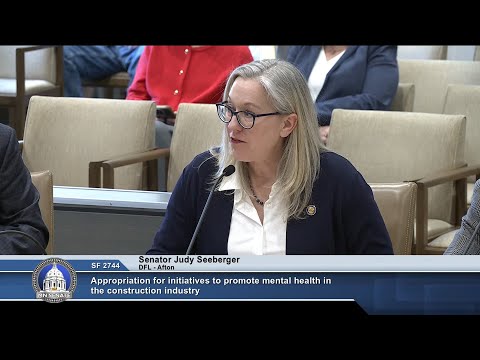
On April 8, the Minnesota Senate Labor Committee heard testimony on Senate File 2744, a bill sponsored by Senator Seeberger that would appropriate $500,000 in fiscal year 2026 and $500,000 in fiscal year 2027 to the commissioner of labor and industry to convene stakeholders and fund education, outreach and worksite strategies aimed at reducing suicide and other mental‑health harms in the construction industry.
On April 8, the Minnesota Senate Labor Committee heard testimony on Senate File 2744, a bill sponsored by Senator Seeberger that would appropriate $500,000 in fiscal year 2026 and $500,000 in fiscal year 2027 to the commissioner of labor and industry to convene stakeholders and fund education, outreach and worksite strategies aimed at reducing suicide and other mental‑health harms in the construction industry.
The bill’s supporters said construction workers face a range of industry‑specific stressors — seasonal employment, long hours, frequent travel and a workplace culture that stigmatizes help‑seeking — and that state funding could help coordinate outreach, training and rapid access to care.
"Laborers and all trades workers face a significant barrier asking for help with mental health and safety," said Joel Smith, president and business manager of LiUNA Minnesota and North Dakota, which represents more than 14,000 construction and general laborers. Smith testified that anxiety and depression were primary diagnoses among members who sought help during the COVID‑19 period and that demand for services remains high.
Brent Wilbur, chief administrative officer of Ames Construction, told the committee the industry needs to broaden its definition of safety to include mental‑health supports. "We spend a lot of time and money on physical safety," Wilbur said. "A person in the construction industry is five times more likely to die by suicide than by a worksite‑related accident." Wilbur said the Minnesota Construction Mental Health Alliance — an industry‑led group of project owners, contractors, unions and safety professionals — has begun work to embed mental well‑being across the sector.
Committee members pressed witnesses on underlying causes and how the requested money would be used. Senator Gruenhagen asked whether primary drivers of suicide were work‑related or personal; witnesses pointed to a combination of factors tied to the industry, including seasonality and unstable hours that can affect income and eligibility for hour‑based health benefits. "If they're out of work for a long period of time, seasonal or slowdowns in the industry, they lose healthcare for them and their families," Smith said.
Smith told the committee that the need can be urgent. He said he had been notified minutes before the hearing that a union member had died by suicide. "There isn't a week that goes by that I don't hear from a member, a family of a member, a contractor ... that they're either died by suicide or they're struggling," he said.
Senator Seeberger described the appropriation as a way to fund outreach, destigmatization efforts, the development of worksite strategies and grants to industry groups for related activities. The bill would direct the commissioner of labor and industry to bring together stakeholders including the Minnesota Department of Health, contractors, unions and project owners to coordinate those efforts.
Senators who spoke in support described the proposal as a bipartisan, practical step. Senator Dornick thanked the sponsor and the testifiers for raising awareness of the industry’s suicide rates. Other members noted the broader policy question of access to health care when eligibility is tied to employment status.
At the conclusion of the hearing, Chair McEwen laid Senate File 2744 over for possible inclusion in the committee’s upcoming policy or budget bill.
Details: The bill text as presented would appropriate $500,000 in each of fiscal years 2026 and 2027; additional program design and implementation details were described in testimony but not specified in the bill language submitted to the committee.