Get Full Government Meeting Transcripts, Videos, & Alerts Forever!
Get email alerts on the Corporate Practice Of Medicine topic
No spam. Unsubscribe anytime.
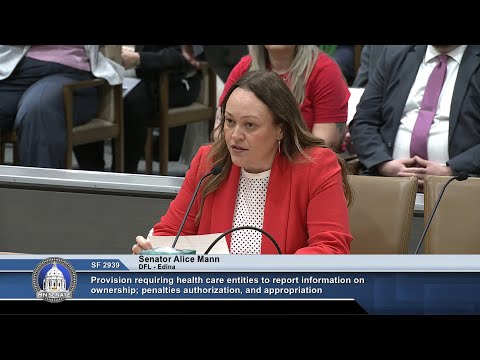
Senate panel hears testimony on bill to increase transparency and limit corporate control of medical decisions (Senate File 2939)
Summary
The Senate Health and Human Services Committee on April 8 took testimony on Senate File 2939, a bill to increase transparency and restrict corporate influence over clinical decisions, with witnesses citing local hospital service losses and staffing changes tied to consolidation and private‑equity ownership.
The Senate Health and Human Services Committee on April 8 heard testimony on Senate File 2939, a bill sponsored by Sen. Lindsey Mann that would strengthen transparency and limits around corporate ownership and financial control in health care. The hearing was informational and no committee action was taken.
Sen. Mann described the bill as a step to "reign in corporate practice of medicine," saying it would ensure entities that own or invest in health care practices do not "control or interfere with the actual clinical decisions that are being made." He said Minnesota's current corporate practice framework relies heavily on decades‑old case law and that the bill and its A1 amendment would provide statutory clarity.
Workers and advocates described concrete local impacts they attribute to consolidation and private‑equity investment. Leslie Kaup, who identified herself as a member of SEIU Healthcare Minnesota and Iowa and a longtime worker in Albert Lea, said Mayo Clinic's acquisition of facilities in the region led over several years to the loss of an intensive care unit, overnight surgical and birthing services at Albert Lea. "This bill... will protect our medical providers' rights to use their medical judgment to decide our health care," Kaup told the committee.
Anne Schwagel of the Minnesota Farmers Union said consolidation has contributed to rural service loss and cited county clusters with a single hospital providing obstetric care. Registered nurse Britney (name in record) of the Minnesota Nurses Association described staffing reductions and an algorithm‑driven staffing model at a major system she identified as Allina that she said reduced nurse staffing and harmed patient care. "This model of cutting staffing despite the impacts of services is straight out of a private equity playbook," she said.
Medical student Hunter Cantrell and physician Alita Borod offered research and clinical perspectives: Cantrell cited studies alleging links between private equity ownership and higher complication rates, higher costs and workforce instability; Borod described pharmacy closures and other service reductions tied to consolidation and vertical integration by large systems and pharmacy benefit managers.
Senators from both parties expressed concern about trends described by witnesses and interest in statutory clarity. Several members praised the A1 amendment, which Mann said is intended to protect clinician decision‑making by restricting nonclinical owners from directing medical care. Members noted exemptions in the bill intended to reduce burdens on small providers and flagged fee provisions for future discussion.
No committee vote was taken at the April 8 informational hearing; committee members said the bill will remain active and be available for consideration next session.