
Lakewood and Jefferson County officials outline expanded wildfire planning, mitigation and community outreach
Get AI-powered insights, summaries, and transcripts
Sign Up Free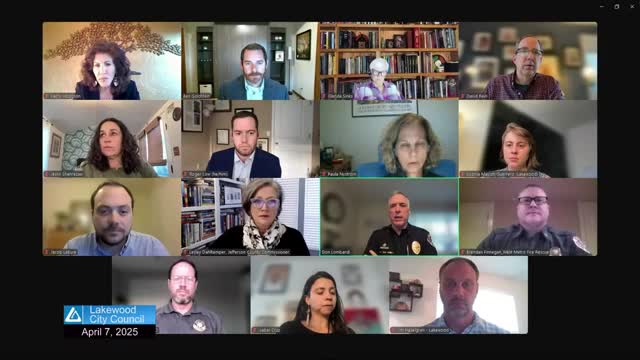
Summary
City and county officials, West Metro Fire Rescue and parks staff described updated wildfire risk maps, increased wildfire response capacity and ongoing mitigation efforts — including slash disposal, prescribed burns and community preparedness programs — during a Lakewood City Council study session.
City and county officials, fire chiefs and parks staff told the Lakewood City Council on Monday that wildfire risk across western Jefferson County has expanded into more urban corridors and that cross-jurisdictional collaboration is central to preparedness and response.
"Wildfire threat is real," Jefferson County Commissioner Leslie Dahlkemper said. "We know it's not a matter of if, but when." She and county staff outlined a multi-pronged approach that includes updated mapping and planning, fuels reduction, and public education.
The county recently completed an updated Community Wildfire Protection Plan, Brian Keating, Jefferson County fire management officer, told the council. "By Colorado state statute, the sheriff is the fire warden for the county," Keating said, and the sheriff's office leads suppression for unincorporated lands and coordinates evacuations and large-incident delegations of authority.
Keating said the county's CWPP expanded the area it classifies as wildland-urban interface (WUI) from about 76% of the county in the prior plan to roughly 91% in the 2024 update. The update included new hazard modeling and identified priority landscapes and neighborhoods for mitigation work, he said, and the county is building evacuation annexes and a consolidated public information portal as part of a "Together Jeffco" planning effort.
City parks staff described work on Lakewood open spaces and ravines. "All of this work has been funded by our existing parks operations budget," said Jim Asperin, City of Lakewood parks manager. He and Open Space Supervisor Lee Blair showed maps and photos of hand crews, volunteers and partner crews thinning brush, clearing defensible space and conducting prescribed burns where conditions and permits allow.
West Metro Fire Rescue said it has been increasing capacity for both suppression and community outreach. "Wildfire knows no boundaries," Captain Brendan Finnegan said, describing a district-level program that includes wildland-capable apparatus at multiple stations, annual specialized training (NWCG standards and RT-130 refreshers), a growing prescribed-fire program, and community-level efforts such as Firewise outreach and home-ignition-zone assessments.
Officials contrasted different mitigation approaches for mountain WUI versus urban corridors. In mountain and forested areas, the emphasis is on fuel reduction, thinning and prescribed burns to prevent crown fire behavior. In places where homes are dense, the emphasis shifts toward "home hardening" — roof, vent and siding upgrades, clearing combustible materials from 0–5 feet adjacent to structures, and removing flammable fencing — and on evacuation readiness.
Speakers described partnership tools and local programs: county slash-drop sites for yard waste, a county "Be Your Own Hero" public education campaign, West Metro's interactive risk map and a countywide Lookout Alert emergency-notification system. Keating and Finnegan both urged residents to register for lookout alert and to follow official channels for evacuation information.
Officials also discussed recent incidents that informed planning. Keating and Finnegan reviewed the Cory/Quarry-area fire response last August, noting the incident reached about 580 acres and required multi-agency coordination. "All these things, all these trainings, all these collaborations," Finnegan said, "...came together for success." They credited the county and local mutual-aid agreements with shortening what could have been a much longer, more destructive incident.
Council members asked about several related issues: how to adapt city zoning and building codes to rising WUI risk, the role of insurance and state-level policy in encouraging mitigation, enforcement and limits on fireworks during high-risk periods, and whether water-supply and infrastructure vulnerabilities (seen in other conflagrations) have been assessed locally.
Commissioner Dahlkemper and speakers described ongoing coordination with the Colorado Fire Commission and state-level code work, and noted pilot projects and data-modeling efforts to inform building-code and insurance discussions. Keating and Finnegan said county and water providers are reviewing contingency plans and scenario exercises with utilities to understand operational limits during large conflagrations.
Councilors raised community outreach needs; one council member recommended short, shareable preparedness videos. Keating said the county is working toward a one-stop countywide information portal and that the state has legislation under consideration to create a statewide resource that would link to county pages.
No formal actions or votes were recorded on the topic during the study session. Presenters encouraged continued public engagement in CWPP updates and Firewise and Ready-Set-Go programs and reiterated that when residents feel unsafe they should not wait for an evacuation order to leave.
Lakewood and county officials said they will continue to coordinate on mitigation projects, funding opportunities and public education, and that additional public engagement sessions will be scheduled as local CWPP updates and Together Jeffco planning continue.