Get Full Government Meeting Transcripts, Videos, & Alerts Forever!
Get email alerts on the School Immunization Requirements topic
No spam. Unsubscribe anytime.
Maine education committee hears hours of testimony on bills to restore vaccine exemptions and repeal school immunization rules
Summary
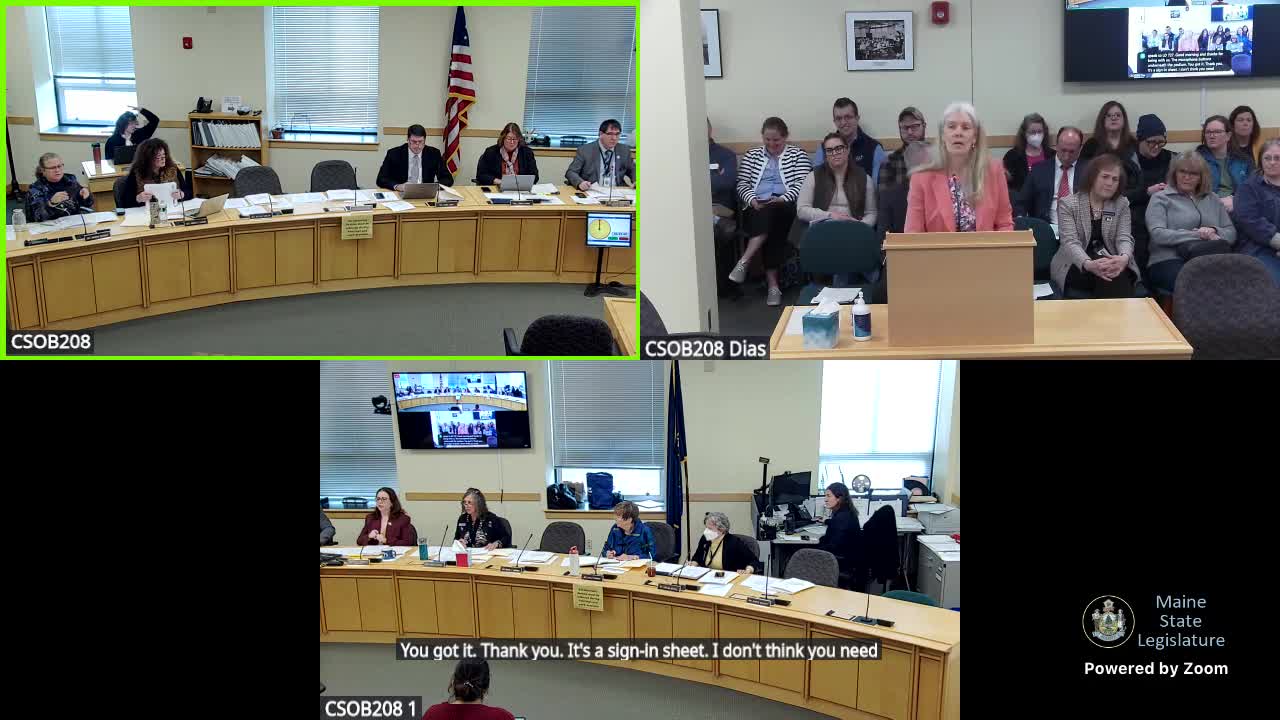
The Joint Standing Committee on Education and Cultural Affairs heard more than three hours of testimony on two bills that would roll back parts of Maine’s school immunization requirements: LD 727, described by supporters as an act to repeal certain immunization requirements for schools, and LD 174, a proposal to restore religious exemptions.
The Joint Standing Committee on Education and Cultural Affairs heard more than three hours of testimony on two bills that would roll back parts of Maine’s school immunization requirements: LD 727, described by supporters as an act to repeal certain immunization requirements for schools, and LD 174, a proposal to restore religious exemptions.
Committee members heard sharply divided testimony, with doctors and public-health officials warning the measures would raise the risk of outbreaks and parents, providers and faith-based speakers describing families and children denied school access under the current law.
The bills drew personal stories and legal claims from supporters. Representative Tracy Quent, a registered nurse and sponsor of LD 727, told the committee the measure would “repeal the stripping of religious and philosophical exemptions for school vaccine mandates,” and said she was speaking for constituents who she said have been forced into homeschooling or driven out of state. Representative Gary Drinkwater said the repeal of religious and philosophical exemptions amounted to an unlawful denial of civil rights and urged the committee to "restore the civil rights of all the health care workers and the children." Representative Bob Foley described the 37-year-old death of his infant daughter following routine shots and framed his support for restoring exemptions as grounded in that family tragedy.
Parents and small providers described social and economic harms. Dawn Murray and other parents testified their children had been excluded from school activities, sports and scholarships; Anya Frazier said her homeschooled son had been “forcibly” kept out of school and barred from team sports. Adrienne Hoffman, director of a licensed nature‑based preschool in Knox County, said her program opened in 2024 with a long wait list but had to turn away roughly 20 families and could not enroll most of the initial 47 families because they declined immunizations — a mix of religious, philosophical or personal reasons — leaving small providers and parents with few childcare options.
Opponents included the Maine Center for Disease Control and Prevention and statewide medical associations. Dr. Pottery Vah, identified in testimony as director of the Maine CDC (Department of Health and Human Services), said the bills would make Maine “an outlier” and increase the risk of preventable outbreaks. Vah cited recent national outbreaks and gave the committee figures from the state school immunization assessment, saying kindergarten measles, mumps and rubella (MMR) coverage rose from the mid-90s to about 97.4 percent after the state removed nonmedical exemptions. She warned outbreaks carry substantial human and financial costs and described hospitalizations and complications that can follow infections such as measles and pertussis.
Pediatricians and physician groups urged the committee to reject the measures. Dr. Joe Anderson, a board-certified pediatrician and advocacy chair for the Maine chapter of the American Academy of Pediatrics, said weakened protections would put children “in harm’s way” and pointed to a large measles outbreak in other states where exemption rates are higher. He said Maine’s improved school vaccination rates since the 2019 law have reduced the risk of school-based outbreaks and protected vulnerable students who cannot be vaccinated for medical reasons.
Testimony from both sides included legal and constitutional claims. Representative Drinkwater and other supporters argued denial of nonmedical exemptions violated free-exercise and equal-protection guarantees and cited court decisions and prior litigation as part of their argument. Opponents emphasized public-health data, the results of Maine’s 2019 law and a 2020 referendum in which voters upheld limits on nonmedical exemptions.
Committee members asked for data and clarification. Multiple lawmakers asked state and medical witnesses whether vaccination rates had actually increased since the law change and what the state’s enforcement practice is for new students, including students arriving from other states and countries. Maine CDC witnesses described a 90‑day window for new enrollments and said public-health nurses and school nurses work with families and schools to obtain records and provide vaccinations when needed.
No committee vote or formal action was recorded during the hearing. Several lawmakers requested additional written data and documentary sources for the committee’s work session, including school-level immunization rates and copies of legal opinions referenced in testimony.
The hearing drew a wide range of speakers: registered nurses and physicians, parents and students, early‑childhood providers, and representatives of statewide medical and public‑health organizations. Speakers repeatedly pressed the committee on two central tradeoffs: the state’s role in protecting school populations from highly contagious illnesses and parents’ claims of religious liberty and individual choice.
The committee did not indicate a timetable for a work session or vote.