Get Full Government Meeting Transcripts, Videos, & Alerts Forever!
Get email alerts on the Antisemitism Definition topic
No spam. Unsubscribe anytime.
Maine Judiciary Committee Split Over Adopting IHRA Definition of Antisemitism; Wide public testimony both for and against
Summary
Representative Abigail Griffin presented LD 13 51, asking the committee to adopt the IHRA working definition of antisemitism so investigators and prosecutors will explicitly consider antisemitic motive when warranted.
Representative Abigail Griffin presented LD 13 51 to the Joint Standing Committee on the Judiciary, proposing that Maine adopt the International Holocaust Remembrance Alliance (IHRA) working definition of antisemitism so that investigations and prosecutions would expressly consider antisemitic motive where relevant.
Why it matters: Supporters said a clear working definition would help law enforcement, prosecutors and administrators identify antisemitic motivations behind crimes and harassment. Opponents said the IHRA definition’s contemporary examples conflate legitimate criticism of Israeli government policy with antisemitism, risk chilling free speech and academic freedom, and could impose new administrative burdens if adopted into state law or the Maine Human Rights Act.
Proponents and reasoning: Jake Bennett of the Israeli American Council described the bill as a narrow measure to “define antisemitism” and said federal agencies and 33 states use the IHRA definition. Leslie Kirby, CEO of the Jewish Community Alliance of Southern Maine, told the committee that antisemitic incidents have risen nationally and in Maine since October 2023; she urged tools that make motive easier to identify and to improve victim protection.
Representative Abigail Griffin said the bill “does not create new crimes, nor does it regulate speech,” but instead provides guidance so that bias can be considered in investigations and charging decisions. Supporters argued that adopting a widely used working definition would align Maine with federal practice and enable training and consistent classification of incidents.
Opposition and concerns: The Maine Human Rights Commission’s executive director, Kit Thompson Crossman, testified against the bill. The commission said antisemitism already falls within the Maine Human Rights Act’s prohibition on religious discrimination and that staff regularly assess motives when investigating discrimination complaints. The commission added that the bill’s language — which would ask the agency to consider whether antisemitism motivated “any violation of criminal or civil law” — would push the commission outside its administrative remit and create an immeasurable workload and fiscal exposure.
Multiple Jewish Mainers, Jewish organizations and other witnesses opposed the bill on free-speech grounds and because they said the IHRA examples have been used internationally and domestically to label political speech critical of Israel as antisemitic. Several testified that the Jerusalem Declaration on Antisemitism (JDA) — a document many scholars have endorsed — is a preferable alternative. Others raised examples from campuses and other jurisdictions where critics of Israeli policy say they were disciplined or silenced after IHRA-based determinations.
Representative testimony excerpts: Jake Bennett summarized the sponsors’ view: “This bill does one thing. It defines antisemitism.” Leslie Kirby added that antisemitic incidents are at “an all-time high” nationally and urged measures to protect Jewish Mainers. By contrast, Kit Thompson Crossman said the commission opposes the bill because it “does not provide additional protections for Jewish Mainers and could lead to fewer protections by placing the burden of addressing all antisemitism in Maine on a single agency.”
Committee lines of inquiry: Members asked whether the state’s Human Rights Act already covers antisemitic acts (several witnesses said it does), whether adding a definition would materially change law enforcement practice, whether the IHRA text would chill protected speech, and whether alternative definitions (for example the Jerusalem Declaration) would be more precise and rights-protecting. Committee members also asked advocates to supply comparative information on the states that have adopted the IHRA definition, training materials, and the incidence data cited by several witnesses.
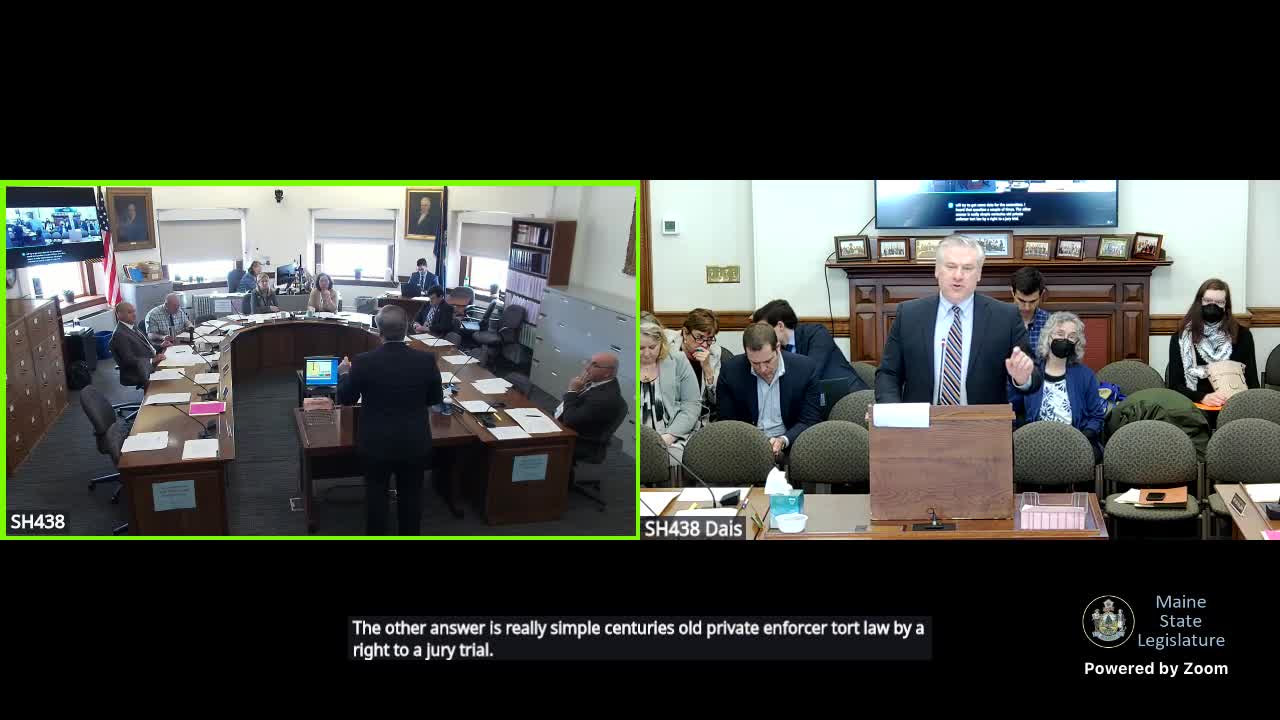
Public participation: The hearing drew dozens of online and in-room witnesses with deeply held positions on both sides. Supporters included the Jewish Community Alliance of Southern Maine and the Israeli American Council. Opponents included the Maine Human Rights Commission, individual Jewish Mainers who said the IHRA definition would be used to silence dissent, Palestinian and Arab Mainers who said the definition would chill legitimate criticism of state conduct, academics and civil liberties groups, and several Jewish legislators who said Jewish voices were not consulted in drafting the bill.
Next steps: The committee closed public testimony and said it will schedule a work session. Committee members requested additional materials: incident lists compiled by the Human Rights Commission, comparisons of other states’ implementations, training resources, and legal analyses (including how the IHRA working definition has been applied in other jurisdictions). No vote was taken at the hearing.
Ending note: Testimony reflected a sharp policy and cultural divide: proponents framed the bill as a practical tool to identify and prosecute bias-motivated crimes; opponents warned that the IHRA’s examples can be interpreted to equate political criticism of Israel with antisemitism and urged more precise alternatives or additional consultation before any change is codified.