Get Full Government Meeting Transcripts, Videos, & Alerts Forever!
Get email alerts on the Energy Grid Reliability topic
No spam. Unsubscribe anytime.
ISO New England explains responsibilities, grid pressures and future demand to Rhode Island lawmakers
Summary
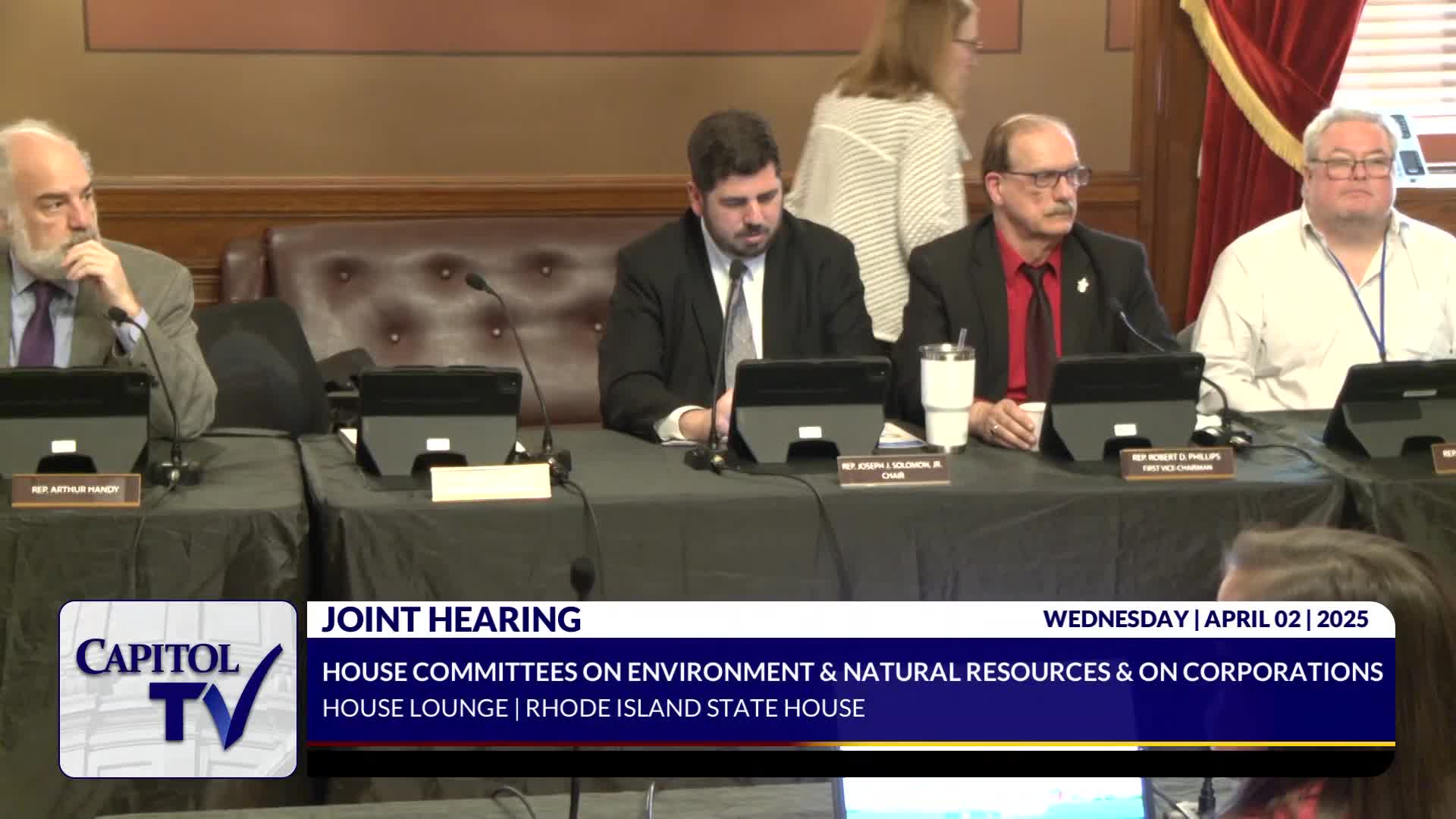
Carrie Schlichting, lead state policy adviser at ISO New England, told a joint hearing of the Rhode Island House Committee on Environment and Natural Resources and the House Committee on Corporations on April 2 that ISO New England operates the region's wholesale grid, administers markets and plans transmission while remaining technology‑neutral.
Carrie Schlichting, lead state policy adviser at ISO New England, told a joint hearing of the Rhode Island House Committee on Environment and Natural Resources and the House Committee on Corporations on April 2 that ISO New England is the region's reliability coordinator and independent system operator, responsible for operating the high-voltage grid, running wholesale electricity markets and planning longer-term transmission needs.
Schlichting said the ISO is regulated by the Federal Energy Regulatory Commission and must meet reliability standards set by the North American Electric Reliability Corporation. "We are the reliability coordinator for New England under the North American Electric Reliability Corporation," she said, and emphasized that the ISO is neutral on technology: "We are independent of companies in the marketplace, the energy marketplace, and we are neutral on technology." The ISO does not control retail distribution, own generation or decide siting for fuel infrastructure, she added.
Why it matters: Lawmakers focused on near-term system pressures — especially winter limits on natural gas supply — and longer-term planning as states pursue electrification and decarbonization goals. Schlichting presented ISO studies showing significant projected growth in regional electricity needs and described planning and market tools the ISO uses to preserve reliability.
Key points from the presentation
- ISO duties and limits: Schlichting summarized three primary ISO missions: operate the grid 24/7 from the control room in Holyoke, Massachusetts; administer FERC‑approved wholesale markets; and perform system planning (short- and long-term). She repeatedly stressed the ISO does not set state energy policy or control fuel supply, pipelines or retail distribution.
- Jurisdictional delineation: If a generating facility connects to transmission at the ISO level (for example to 345 kV or 115 kV lines), the ISO studies that interconnection and its market participation. Facilities connecting on lower-voltage, local distribution systems are studied and overseen by the local utility (in Rhode Island, Rhode Island Energy) and the state Public Utilities Commission, Schlichting said. She offered to provide engineering maps that show ISO jurisdictional lines and one-line electrical diagrams to the committee.
- Resource mix and demand projections: Schlichting reviewed recent trends and a set of multi‑scenario studies the ISO ran with New England states. She said oil and coal have largely left New England's generation fleet, and that wind, solar and batteries have grown in recent years, while natural gas is the predominant generating fuel. She cited the ISO's estimate of roughly 30,000 megawatts of installed capacity today and said one high‑growth scenario that holds current state decarbonization goals shows the region could need on the order of 60,000 megawatts by mid‑century (study horizons referenced through 2040–2050). The scenario assumptions and a range of alternate scenarios are part of ISO modeling; Schlichting offered to supply the full study and summaries.
- Natural gas and pipeline constraints: Lawmakers asked whether adding pipeline capacity would lower winter prices. Schlichting explained that New England's pipeline system was built primarily for home heating and that pipelines are congested in winter because firm contracts for heating take priority. "Because the pipeline is constrained in the winter for the region, it causes prices to really rise," she said. She noted that if additional pipeline capacity were available and used for generation, it could reduce price spikes on the coldest days but that building pipelines entails costs and regulatory decisions outside the ISO's jurisdiction.
- Transmission planning and funding: Schlichting described the ISO's role in identifying regional transmission needs and running competitive solicitations for reliability projects. She said transmission projects intended to address regional needs are paid for on a regional basis (allocated roughly by states' share of demand) and that states can also solicit transmission to meet policy goals. She cited the New England Clean Energy Connect project (imports from Hydro Québec into Maine) as an example of a transmission solution selected through a competitive process.
- Markets, reserves and balancing: Schlichting explained that different resources provide different operational characteristics (for example, nuclear as steady base load; batteries and gas plants as fast-start resources). The ISO maintains reserves and procures ancillary services to meet North American Electric Reliability Corporation reserve requirements and to manage contingencies.
- Demand response, energy efficiency and non‑transmission alternatives: The ISO counts demand-response and energy-efficiency measures as market resources and said reducing peak demand is one important way to reduce the need for new transmission and generation. She described ongoing coordination with the New England states' public utilities commissions on demand-response planning.
- Storage and interconnection queue: Schlichting said batteries are increasingly appearing in the interconnection queue; stand‑alone batteries typically charge when prices are low and discharge during peaks. She distinguished stand‑alone batteries in the queue from storage paired with wind or solar, which are categorized with those resources.
- Data centers and large step loads: Committee members asked about potential data center impacts. Schlichting said New England has seen little large data‑center growth to date and that hypothetical facilities proposed elsewhere have been on the order of 200–300 megawatts; she noted such step loads would be studied through existing interconnection and planning processes.
- Governance and funding: Schlichting described ISO governance: an independent board vetted through a joint nominating committee and an annual budget filed with FERC. She said ISO New England is funded by a regional charge collected through the wholesale market and estimated it is roughly $1.10 per customer per month on average; larger industrial customers pay more. ISO budget surpluses are applied to reduce future collections, she said.
- Emergency preparedness and imports: Schlichting said ISO operations coordinate continuously with neighboring ISOs and that New England imports power across ties, including from Québec. She described regular pre‑season briefings, emergency operating procedures, and biennial preparedness exercises conducted with Homeland Security and FEMA. The ISO has not experienced a region‑wide load shed in its history, she said.
Questions, clarifications and follow‑ups
Lawmakers pressed ISO on concrete steps and tradeoffs. Representatives asked for maps and data to identify exact jurisdictional boundaries for specific interconnections (Schlichting agreed to follow up with maps and one‑line diagrams). On the mid‑ and long‑term studies, Schlichting offered to provide the full scenarios and high/low summaries so legislators could see alternative assumptions and sensitivity to state policy choices. She cautioned that decisions about pipelines, fuel infrastructure and siting are outside the ISO's authority and would require state and federal approvals and funding decisions.
Ending
Schlichting said she will provide the committee follow‑up materials — including jurisdictional maps, the ISO's longer‑term modeling studies and summaries — and left contact information for further questions. The hearing adjourned with no formal actions taken by the committees.