Get Full Government Meeting Transcripts, Videos, & Alerts Forever!
Get email alerts on the Juvenile Corrections Contraband topic
No spam. Unsubscribe anytime.
Committee weighs making unauthorized transfer to juvenile training school a crime after DCYF request
Summary
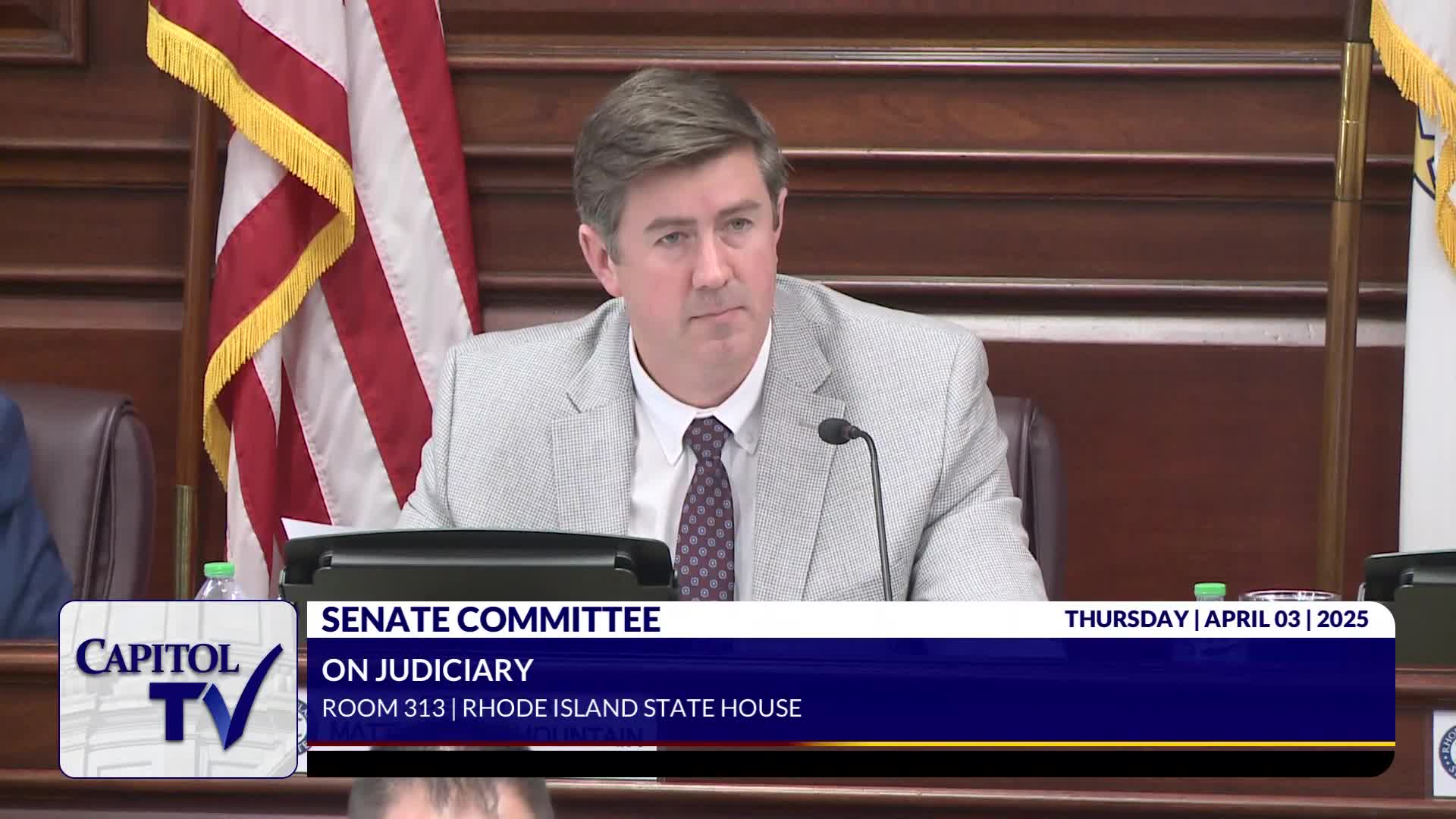
Senate Judiciary took testimony April 3 on Senate Bill 619, a measure to criminalize unauthorized transfers of items into or out of the Rhode Island Training School, the state’s secure juvenile facility.
Senate Judiciary took testimony April 3 on Senate Bill 619, a bill introduced at DCYF’s request that would make it a criminal offense to convey unauthorized articles into or out of the Rhode Island Training School, the state’s secure juvenile facility.
Lerone Myrick, executive director of the Division of Youth Development (the agency name used in testimony), told the committee the training school is a secure, 96‑bed facility with rehabilitative programs and that current statutes that criminalize bringing contraband into adult correctional facilities do not explicitly cover the juvenile facility. "The safety and security of our residents and staff is a top priority," Myrick said, and he described small clarifying changes DCYF plans to propose so the measure makes clear which facility leaders may authorize items.
The ACLU of Rhode Island testified in opposition. Madeline McGonigal said the bill as drafted would make it a felony punishable by up to 10 years for juveniles to give or receive any article without prior DCYF approval. McGonigal argued that such penalties are disproportionate when applied to minors and for minor items such as a piece of gum or a sheet of paper, and she urged lawmakers to limit criminal exposure to serious contraband (weapons, drugs) and account for the age of the person receiving items.
Committee members pressed DCYF on the agency name used in drafting. Sen. [Senator] Patilano asked whether the statutory reference to the "Division of Youth Development" corresponded to established statutory titles; Myrick said the agency rebranded about four years ago but that legal names are being reviewed so statutory language and legal references are consistent. "If we're going to charge them with a crime and make this a crime, we should probably be consistent with what agency we're dealing with," a senator said.
Witnesses said DCYF will offer clarifying amendments to avoid unintended cross-authority effects — for example, to prevent the executive director of adult corrections from being given authority to approve items at the youth facility. The committee did not adopt a final vote; after public testimony the committee moved to hold the bill for further study.
Ending: The committee held SB 619 for further study and requested draft amendment language and clarification from DCYF on agency naming and authorization provisions.