Get Full Government Meeting Transcripts, Videos, & Alerts Forever!
Get email alerts on the Economic Development topic
No spam. Unsubscribe anytime.
Greater Des Moines Partnership briefs Norwalk City Council on regional growth, talent programs
Summary
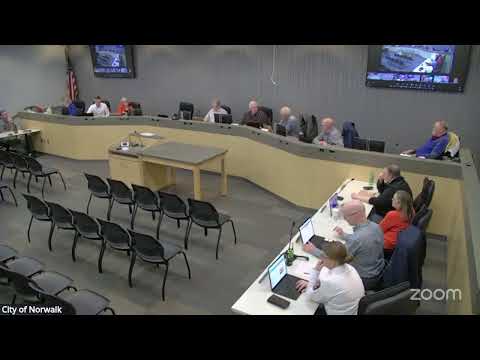
Representatives of the Greater Des Moines Partnership reported regional business growth, talent and small-business programs, and commuter patterns relevant to Norwalk during the April 3 City Council meeting.
Tiffany Tauschak, president and CEO of the Greater Des Moines Partnership, told the Norwalk City Council on April 3 that the nonprofit economic development organization now represents 12 counties and more than 6,700 regional business members, and asked the city to remain engaged with Partnership programs.
The presentation, given by Tauschak and Stacy LaVaughn, senior vice president for economic development, summarized Partnership activity through 2024, including 759 projects facilitated across the region, about 37,000 jobs created and roughly $14.7 billion in investment, figures LaVaughn cited as cumulative since the Partnership’s formation in 1999.
“The Partnership is the regional economic development and community development organization,” Tauschak said as she introduced the group and thanked Norwalk for its participation and investment. The presenters said their work focuses on economic development and talent development, supported by public policy advocacy.
Why this matters: Norwalk’s commuting and workforce patterns mean the city is integrated in a larger labor market. LaVaughn highlighted that 8.5% of Norwalk residents who are employed work in Norwalk, and 24% of people who work in Norwalk live there—figures the Partnership used to illustrate the city’s role in a regional economy and the importance of talent attraction and retention programs.
The Partnership described several programs it offers to communities and employers: DSM Intern Connection (which hosted 349 interns last year and reported nearly 75% of interns said they would consider moving to the region), Career Ready Collective for high school students, Scale DSM (a business accelerator), and Spark DSM (a business incubator). Tauschak also noted the Partnership’s marketing work and trade missions; LaVaughn said 87% of the Partnership’s leads in 2024 originated locally and that over a 10-year period roughly 17% of leads have come from the state.
Presenters and council members discussed state-level policy topics the Partnership is tracking, including property tax reform and interstate designation for I-435. Tauschak said the Partnership is continuing conversations with state legislators about pro-growth policy language and that some advocacy work occurs behind the scenes.
Council members asked about the Partnership’s legislative work and local results. The presenter offered to arrange follow-up briefings with Partnership government-relations staff who are regularly at the Capitol. Ryan Squire, identified by the presenters as an EMT executive and Norwalk resident, attended as a guest.
The council thanked the presenters and noted local businesses that have benefited from Partnership programs. The presentation concluded with an invitation to Norwalk businesses to use Partnership small-business resources and workforce initiatives.
The Partnership’s slide material, as presented, lists detailed lead-generation sources, target industries (advanced manufacturing, logistics, insurance and financial services, data centers, ag innovation and technology), and strategic priorities through 2027.