Get Full Government Meeting Transcripts, Videos, & Alerts Forever!
Get email alerts on the Land Use topic
No spam. Unsubscribe anytime.
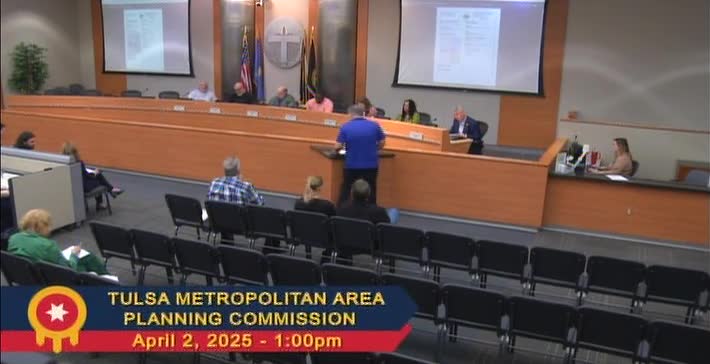
Tulsa planners approve Meadows 3 preliminary plat amid neighbor complaints about pond flooding
Summary
The Tulsa Metropolitan Area Planning Commission on a voice vote approved the preliminary subdivision plat for Meadows 3, a 37‑lot, four‑block single‑family development on about 34.01 acres, while a nearby homeowner urged the developer and county to address persistent pond flooding and sediment problems.
The Tulsa Metropolitan Area Planning Commission on a voice vote approved the preliminary subdivision plat for “Meadows 3,” a single‑family residential plat consisting of 37 lots across four blocks on about 34.01 acres, subject to Technical Advisory Committee (TAC) conditions and further county engineering review.
The vote followed an extended public comment from neighbor Matt Slavin, who told commissioners that a breached dam and construction runoff from earlier phases left his pond filled with silt and unusable. “My pond’s full of mud. I can’t access my back property,” Slavin said, describing photos he provided to the commission and asking that the developer and county address ongoing sediment and elevation concerns.
Why it matters: The discussion focused on stormwater control and construction‑phase erosion where downstream private property is already showing damage, and on how later phases of the development interact with earlier infrastructure and erosion controls. Commissioners approved the plat while emphasizing that runoff, engineering checks and contractor corrective actions are handled through Tulsa County Engineering and permitting, not by the preliminary plat approval itself.
At public comment, Slavin said the problem began after construction in “Meadows 2” and that a breached dam in 2023 led to continuous overflow and sedimentation that has persisted for more than a year. He showed time‑stamped photos and said the pond — which he said he has maintained for decades — is now “a swamp” that has killed fish and prevented normal access to the back parcel.
Alan Betchen, representing AAV Engineering, responded for the developer. He said the subdivision infrastructure was recently turned over to the county and suggested the current pond condition likely resulted from a construction‑phase sediment breach that the contractor must correct. Betchen described the regulatory standard engineers use: “we control the peak runoff rates, cubic feet per second, not total volume,” and said the development includes detention facilities and that Phase 3 will add a third detention basin intended to reduce post‑development peak runoff rates compared with predevelopment conditions.
County staff and the commission reiterated that each phase must be evaluated by Tulsa County Engineering at final plat submittal and that engineering sign‑off is required before release of final approvals. A county staff member told Slavin that engineering will review cumulative runoff and that contractors and the developer are responsible for correcting construction‑period sediment and erosion issues.
Commissioners and staff encouraged Slavin to share contact information with the applicant and Tulsa County staff so the contractor, engineer and county could follow up. The developer’s representative said he would contact the contractor and county staff to address sediment, and county staff said the resident should call Tulsa County Engineering and Tulsa County inspections for permit‑related complaints; the Department of Environmental Quality (DEQ) was also mentioned as an avenue for erosion complaints when appropriate.
The commission’s approval of the preliminary plat was explicitly made subject to the TAC conditions and all normal subdivision and development regulations; commissioners noted that final plat review and county engineering approvals would address detailed stormwater and infrastructure requirements.
The record shows the matter remains under implementation review: staff and the applicant agreed to follow up with the resident and Tulsa County Engineering to determine whether construction‑era sedimentation or contractor work caused the present pond condition and what corrective actions will be taken.