Get Full Government Meeting Transcripts, Videos, & Alerts Forever!
Get email alerts on the Tax Policy Technical topic
No spam. Unsubscribe anytime.
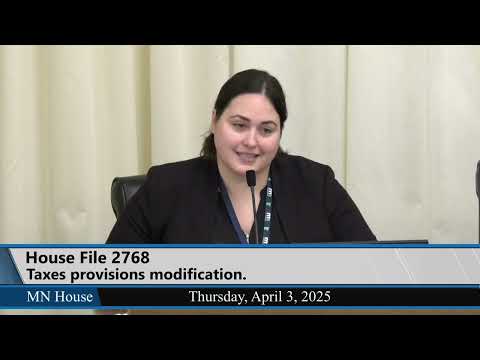
Taxes committee hears Department of Revenue policy and technical bill; amendment adopted
Summary
The Minnesota House Taxes Committee heard the Department of Revenue's policy and technical bill (House File 2768), adopted a department-requested amendment to remove two sections and laid the bill over for possible inclusion in the 2025 omnibus taxes bill.
The House Taxes Committee on April 2 heard Department of Revenue testimony on House File 2,768, the department's annual policy and technical bill, adopted an amendment to remove two inadvertently included sections and laid the bill over for possible inclusion in the 2025 taxes omnibus.
The bill, introduced for consideration by Representative Gomez and described by Joanna Behrs, legislative director at the Department of Revenue, makes numerous technical corrections across individual and business tax provisions. "The amendment just really pulls out 2 sections that were accidentally included when we put our policy and technical bill in," Behrs told the committee, saying the sections were included during federal-conformity and TCJA-expiration preparation and were not intended for inclusion this year.
The bill covers multiple topics, including technical changes to the film production tax credit, pass-through entity (PTE) tax income allocation, the Social Security subtraction for individual income taxpayers, a qualified retirement benefits subtraction, business interest expense limitation cross-references, renter's credit technical clarifications and a short-line railroad credit calculation.
Margaret Reisdorf, an attorney at the Department of Revenue, summarized Article 1: among the changes the bill would allow eligible taxpayers to use 25% of eligible film production costs paid in any consecutive 12-month period for the film production credit calculation rather than being limited to a single taxable year, and it would align the insurance premium credit deadline to match the credit's effective dates. Reisdorf said several items are purely technical and made effective retroactively to match prior substantive law changes made in 2023.
Other departmental witnesses described sales tax provisions (Article 2) clarifying the sustainable aviation fuel construction exemption period, the deposit process for sales tax on motor-vehicle replacement parts, and sourcing rules tied to nine-digit ZIP codes and certified service provider definitions. "To properly source a sale, you need a 9 digit zip code," attorney Dexter Wilson explained while summarizing the sales tax article.
Article 3 included miscellaneous technical clarifications, such as adding client-department payment protections to tax-preparer standards of conduct, changes to contested case timelines before the Office of Administrative Hearings, and removal of an estate informational return requirement that the department described as duplicative.
Committee procedure: the committee adopted the A25-50 amendment by voice vote after the Department explained the amendment removed two wrongly-included sections. "All in favor of the A25-fifty amendment, say aye," the chair called; "Aye." The chair then announced the amendment was adopted. Representative Gomez moved that House File 2,768, as amended, be laid over for possible inclusion in the 2025 taxes bill; the motion was renewed and the bill was laid over.
No committee member requested a recorded roll-call vote on the amendment or the lay-over motion during the meeting.
The committee Chair said members would have the opportunity to remove items from consideration later if unresolved issues emerged. Several committee members thanked the department for clarifications to the film production credit; Representative Lee and others noted the credit helps attract film and television production to Minnesota.
The bill will remain under committee consideration for possible inclusion in the omnibus taxes package later in the session.
Ending
Committee staff and department witnesses said they are available for follow-up questions and that the technical items are generally intended to bring statutory language into alignment with prior legislative changes or federal conformity. The committee laid the bill over for potential inclusion in the final taxes omnibus bill.