Get Full Government Meeting Transcripts, Videos, & Alerts Forever!
Get email alerts on the Social Housing topic
No spam. Unsubscribe anytime.
Portland council directs housing bureau to study social housing and alternative ownership models
Summary
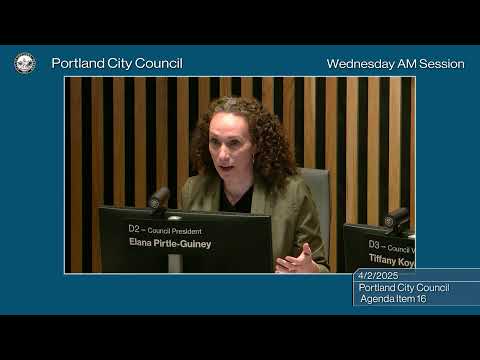
The Portland City Council voted unanimously to require the Portland Housing Bureau to deliver a study of social housing, municipal nonprofit and cooperative ownership, and financing models by May 31, 2026, with quarterly check-ins and amendments requiring the report to identify impediments such as zoning, permitting and financing gaps.
Portland City Council adopted a resolution directing the city administrator, through the Portland Housing Bureau, to study alternative housing financing and ownership models and deliver a report to council by May 31, 2026.
The resolution, introduced by Councilors Carmen Rubio (co-sponsor names included in committee materials) and supported by Councilors Jo Ann Green and Brooke Avalos, passed 12-0 after the council accepted three amendments clarifying that the study should (1) identify impediments such as zoning code, permitting processes and financing gaps; (2) include analysis of the North/Northeast project area and existing partners such as Albina Vision Trust as potential pilot opportunities; and (3) add specific 2020 U.S. Census income data for Black, Latino and Native American households into the preamble.
The resolution requires the Portland Housing Bureau to analyze social housing models, municipal nonprofit and cooperative ownership, and financing mechanisms that “efficiently leverage public subsidy to expand housing” and to include policy and programmatic recommendations. Committee staff said the bureau may use existing bureau funds and an awarded but not yet appropriated pro‑housing federal grant to support the study. Director Helmi Hissrich told the council the bureau is scoping the effort, expects to bring a scoping document back to council, and plans to provide at minimum quarterly report‑backs while aiming to deliver recommendations within roughly one year.
Why it matters: Testimony and council remarks framed the study as part of a broader response to Portland’s housing shortage and racial disparities in affordability. Speaker after speaker at a lengthy public testimony period — including tenants, nonprofit leaders and housing advocates — urged the council to explore nonmarket solutions, citing models abroad and locally that proponents say preserve affordability and long‑term community control.
What council said: In committee and on the council floor, Chair Avalos said Portland is “far behind the curve in production, financing, and affordability” and characterized the study as a step toward a unified housing plan tying funding streams and programs into a single theory of change. Director Hissrich described plans for quarterly check‑ins and said the bureau will use the awarded pro‑housing grant (to be appropriated in FY25‑26) and outside consultants for discrete components of the study while assigning internal staff to lead elements such as land banking and financing analysis.
Public testimony and engagement: More than 20 people provided oral testimony in favor of the study during the council hearing. Testifiers included representatives from the Welcome Home Coalition, Self Enhancement Inc., Albina Vision Trust and Habitat for Humanity; they urged the council to prioritize equity, accelerate timelines and use pilot sites to test models. Several speakers noted Vienna and other international examples of social housing. A coalition of tenants and housing advocates asked the council to tie the study to concrete pilot projects and to ensure broad community engagement.
Scope and next steps: The resolution sets a formal deadline of May 31, 2026, but the bureau and sponsors signaled they will provide earlier deliverables via quarterly updates and that a scoping memo with staff assignments and consultant roles will be returned to council. The adopted amendments require the report to identify impediments (zoning, permitting, financing) and to analyze opportunities within the North/Northeast preference areas and projects where community partners are already active.
What the vote was: The council adopted the resolution as amended, 12‑0.
Looking ahead: Councilors said they expect the bureau to return with a clear scope, deliverables and staffing plan; several asked that the study include realistic costing of staff time and consultant contracts. Sponsors and committee staff also signaled intent to ensure public engagement and periodic updates at committee level.