Get Full Government Meeting Transcripts, Videos, & Alerts Forever!
Get email alerts on the Museum topic
No spam. Unsubscribe anytime.
GAR Civil War Museum highlights artifacts, family research; volunteer shortages have curtailed some hours
Summary
In an interview at the GAR Civil War Museum in the Steamtown Mall, board member Hal Myers described the museum’s collection, genealogy services and outreach; Commissioner Bill Gaughan noted the site’s role in preserving local Civil War history. The museum’s expanded hours were later limited because of volunteer shortages.
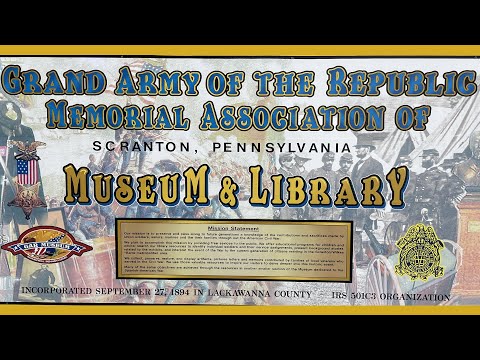
Lackawanna County Commissioner Bill Gaughan interviewed Hal Myers, a board member and past commander of the GAR Civil War Museum, at the museum in the Steamtown Mall in downtown Scranton to discuss the museum’s collection, research services and public hours.
Myers said the museum maintains a library and artifact collection tied to individual Civil War veterans and that staff and volunteers help visitors and family researchers locate soldiers’ records and burial sites. “Our main objective here is to help people find their Civil War veterans and look for Civil War veterans and do all we can to help them,” Myers said.
The museum’s holdings include personal items donated by veterans’ families, Myers said, naming examples such as a wooden artificial leg and cane, weapons that show battle damage, and a rifle stock carved by a veteran of the Battle of Bull Run. He also described a large group of artillery shells and bullets recovered by a donor and reenactor, Carl Miller, and a reenactor uniform on display. Myers noted one exhibit of prison-made clothing attributed to Ivor Tripp and described a library of records used for genealogy research.
Myers told Gaughan the museum fields requests from across the country and helps visitors locate burial places. He said roughly 142,000 unidentified soldiers remain in Civil War–era national cemeteries and that work to identify unknowns is ongoing; he also said he has contributed records to the Find a Grave database and has helped place more than 13,000 identifications there.
On public access, Myers said the museum historically kept set hours — Monday, Wednesday and Friday from 11 a.m. to 4 p.m. — and had expanded to open on some Saturdays and Sundays and additional days. “Our biggest problem was getting volunteers to come and help us, so we quit open at those times,” he said, describing how volunteer shortages led the organization to curtail some of the expanded hours.
Both speakers emphasized the museum’s educational role. Myers said many young visitors have little classroom exposure to the Revolutionary War, War of 1812 and Civil War, and that museum visits can prompt deeper interest. Gaughan underscored the museum’s connection to local history and Lackawanna County’s contribution of soldiers during and after the Civil War.
Myers provided a website for more information: garmuseum.org, and said contact information and further details about research assistance appear on the site. He encouraged people to visit to see artifacts, use the library and request help locating soldiers.
While no formal actions or votes were part of the interview, the discussion covered the museum’s collections, its genealogy and research services, its educational outreach to schools and the practical constraint of volunteer availability on public hours.