Lifetime Citizen Portal Access — AI Briefings, Alerts & Unlimited Follows
DC committee hears debate on bill to study and expand solar canopies across the district
Loading...
Summary
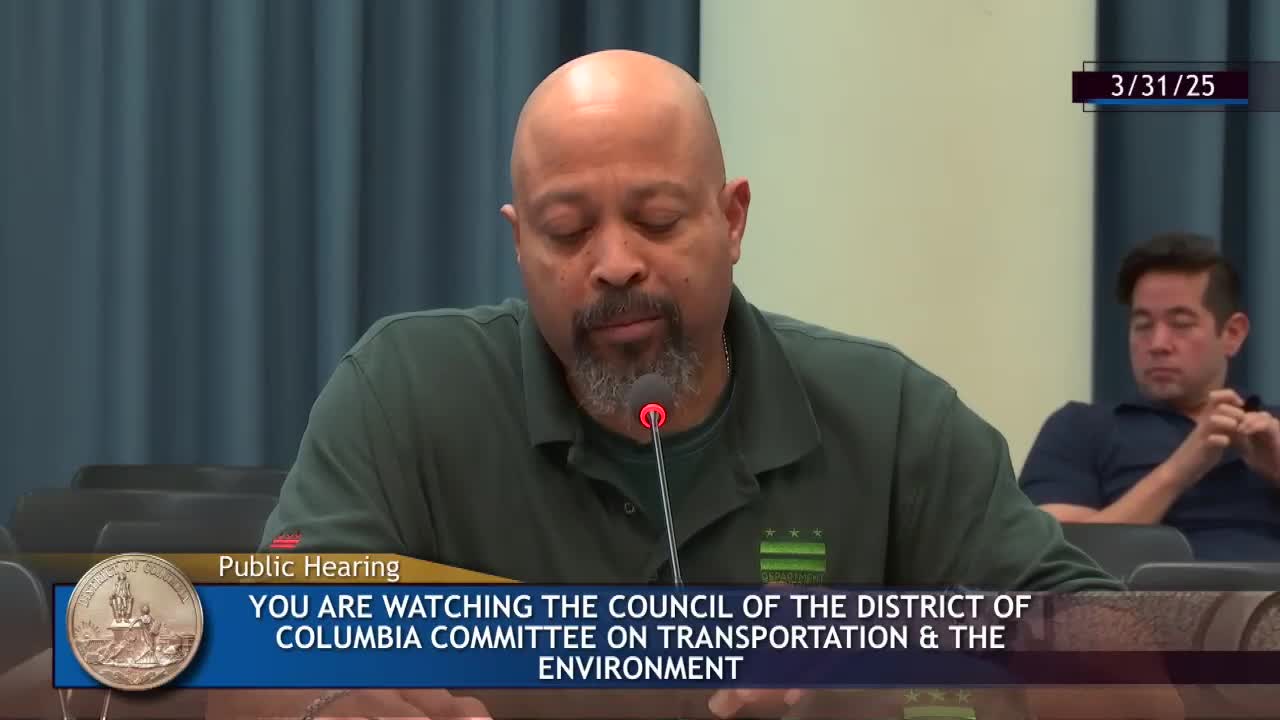
The Committee on Transportation and the Environment held a public hearing March 31 on the Solar Shade Expansion Amendment Act of 2025, which would require the Department of Energy and Environment (DOEE) to identify suitable locations across the District for solar canopy installation and would direct the inclusion of canopy funding in future capital planning.
The Committee on Transportation and the Environment held a public hearing March 31 on the Solar Shade Expansion Amendment Act of 2025, which would require the Department of Energy and Environment (DOEE) to identify suitable locations across the District for solar canopy installation and would direct the inclusion of canopy funding in future capital planning.
The bill, as introduced, would require DOEE to publish a feasibility study identifying 20 sites — including playgrounds, parks, sidewalks, bike lanes, roads and other public spaces — and would authorize grants to install solar canopies at five recommended pilot sites. The legislation would also require that the District’s capital improvement plan (CIP) include funding to install solar canopies at those locations and that new capital projects include canopy funding where feasible.
Supporters and agency witnesses said they embrace the bill’s goals but warned about costs, overlap with existing agency programs, and the need to coordinate with capital planning. “DGS fully supports carbon neutrality, including solar generation and energy efficiency across the district government portfolio,” said Jen Croft, associate director for the sustainability and energy division at the Department of General Services (DGS). Croft added that DGS “has some concerns about the language and impacts as introduced and suggestions for your consideration,” including potential duplication of existing feasibility work and the risk of diverting capital funds from other net‑zero or energy‑efficiency measures.
Richard A. Jackson, director of DOEE, said the agency supports “the goal of the Solar Shade Expansion Amendment Act” but noted financial constraints in the city’s FY26 budget and potential legal questions about mandating capital appropriation in statute. Jackson and DGS staff also highlighted practical limits: DGS reported a 2013‑onward program of rolling feasibility studies, installation of roughly 17.16 megawatts of solar PV across district properties to date, active bidding to add capacity at about 27 additional sites, and deployment plans for dozens of rooftop and canopy installations in recent years. DGS told the committee it has installed or is actively constructing solar PV at roughly 64–67 district sites and that eight of those projects are canopy installations.
Agency witnesses recommended narrowing the bill’s scope for the study, excluding sites already scheduled for modernization or removal from the District portfolio, and focusing the legislation on feasibility analysis rather than an immediate mandate to install canopies as part of the next CIP. Croft said the PPA (power purchase agreement) model DGS uses — in which private developers design, install, own and maintain systems while the District purchases the electricity at a fixed discounted rate — has yielded favorable results and shifts long‑term maintenance and replacement risk to private partners.
Officials also warned of cost volatility. Croft said that steel canopy structures “are expensive with their costs continuing to increase due to new tariffs,” and that an example canopy installation that previously cost about $800,000 could cost substantially more today. Agency witnesses raised vandalism and maintenance as additional factors that a feasibility study should address.
Committee members pressed agencies on practical tradeoffs between trees or fabric shade and permanent steel canopies, the threshold size at which a solar canopy produces meaningful electricity, and whether bundling many canopy projects would improve economics. DGS staff said the division prefers larger systems (roughly 40 kilowatts or more) to achieve favorable pricing and that canopies are more complex in a dense urban environment because of circulation, loading docks, and other site constraints. DOEE staff noted the District already has more than 200 megawatts of solar capacity overall — including rooftop and community solar — and recommended that any study examine bundled/accumulative approaches.
The committee did not take a vote at the hearing. Members indicated they will work with DOEE, DGS and other stakeholders to refine the bill language to reduce duplication, clarify the intended uses for solar generation, protect other CIP priorities, and ensure community engagement before mandating installations.
Clarifying details provided to the committee and in agency testimony included: DGS has installed about 17.16 MW of on‑site solar and has bidding underway for an additional 27 sites; DGS has installed solar at roughly 64–67 sites across the portfolio and is operating or building eight canopy projects; the bill as introduced calls for identifying 20 candidate sites and funding installations at five pilot sites; a proposed minimum study threshold of about 500 square feet of panels was discussed as a lower bound for feasibility; and DGS favors PPAs to shift operations, maintenance, and replacement liability to private owners.
The committee accepted written testimony through the council hearing management system; the record for all items in this hearing will close April 14, 2025.