Get Full Government Meeting Transcripts, Videos, & Alerts Forever!
Get email alerts on the Water Supply topic
No spam. Unsubscribe anytime.
Watermaster outlines basin recharge, drought risk and ‘pure water’ plan to Monrovia council
Summary
Kelly Gardner, the new executive officer of the Main San Gabriel Basin Watermaster, briefed the council on groundwater recharge, the role of spreading grounds and imported water, the city’s RDA contribution and the agency’s interest in purified recycled water for recharge.
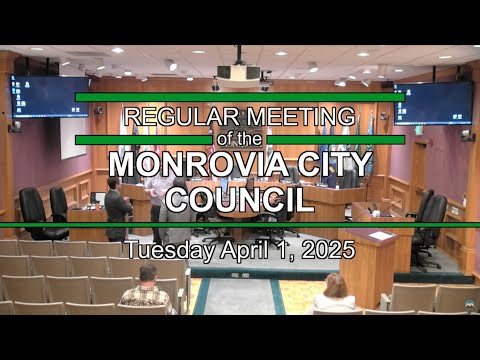
Kelly Gardner, executive officer of the Main San Gabriel Basin Watermaster, briefed the Monrovia City Council on April 1 about the basin’s recharge sources, recent rainfall shortfalls, basin operating targets and Watermaster programs to preserve groundwater supply.
Gardner described the San Gabriel Valley’s principal natural sources — runoff from the San Gabriel Mountains collected behind three dams (Cogswell, San Gabriel Dam and Morris Dam) and directed into spreading grounds — and explained how those features recharge the underlying groundwater that supplies roughly 80 percent of the region’s water through wells. She said imported water provides less than 20 percent of local deliveries but is an important element in managed recharge and drought buffering.
Key points presented - Dams and spreading grounds: Gardner explained that the three mountain dams hold water for flood control and to provide recharge, noting San Gabriel Dam’s approximate 44,000 acre‑foot capacity and that the spreading grounds south of the 605/210 interchange are the major infiltration sites used to recharge the basin. - Rainfall and recharge: She said long‑term averages show multidecadal variability; 18 of the past 27 years were below average in recorded rainfall, and this water year’s precipitation was well below last year’s totals. Gardner noted historical average natural recharge near 3,000 acre‑feet per year and called attention to a multi‑year deficit during the 2011–2020 period. - Basin levels and cyclic storage: Gardner reported the system’s key well level at 242.3 feet above mean sea level as of the most recent update. She described the Resource Development Assessment (RDA) — a $175 per acre‑foot charge Monrovia pays to Watermaster — and explained RDA funds are used to purchase imported water for cyclic storage when supplies are available. Gardner said higher water prices have reduced the RDA’s buying power and constrained the volume of imported water purchased for storage. - Pumping and demand: The basin pumped roughly 86,000 acre‑feet in the prior year and is at about 109,000 acre‑feet for the current reporting period, Gardner said, attributing the rise to warmer and drier conditions. - Pure Water/direct potable reuse: Gardner said Watermaster supports advancing purified recycled water for spreading‑ground recharge (not direct potable reuse at this time), which would allow the region to use highly treated local water for infiltration rather than discharging it to the ocean.
Gardner emphasized the Watermaster’s court‑appointed stewardship role and said the agency’s work focuses on education rather than lobbying. She also stressed water quality oversight and local partnerships — naming the upper San Gabriel Valley Municipal Water District, the Metropolitan Water District and Los Angeles County Flood Control — as essential to managing recharge and maintaining safe drinking water.
Council members and some residents asked questions about safety and bottled water standards. An audience exchange produced the remark that “it is safer to drink tap water than bottled water,” which Gardner supported by noting public water systems are subject to stringent regulation.
Why it matters The presentation framed groundwater as the San Gabriel Valley’s primary supply and underscored how multi‑year hydrology, buying power for imported water, and local programs such as cyclic storage and future purified water projects determine long‑term reliability. For Monrovia, the Watermaster’s programs — and the city’s RDA contributions — affect how much imported water can be banked in wet years and drawn during droughts.
Next steps Gardner said Watermaster will continue outreach and education for local agencies and residents; the agency will also support regional steps to advance purified recycled water for spreading ground recharge. The city manager and Watermaster staff agreed to share Watermaster outreach materials for the city’s communications.