Get Full Government Meeting Transcripts, Videos, & Alerts Forever!
Get email alerts on the Housing Affordable topic
No spam. Unsubscribe anytime.
Monrovia council approves tax-exempt financing to convert Oak Park Apartments to affordable housing
Summary
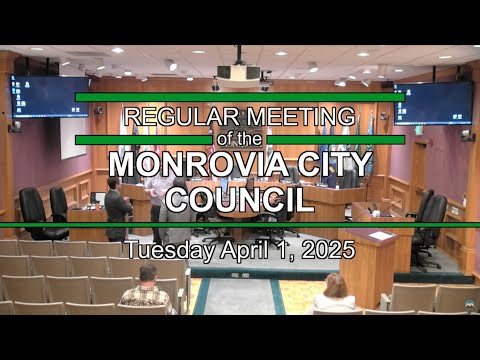
Monrovia City Council on April 1 held a TEFRA public hearing and approved Resolution No. 2025‑17 allowing the California Statewide Communities Development Authority to issue tax‑exempt bonds to buy and convert Oak Park Apartments into a fully income‑restricted property.
Monrovia City Council on April 1 held a public TEFRA hearing and adopted Resolution No. 2025-17 allowing the California Statewide Communities Development Authority (CSCDA) to issue tax-exempt multifamily housing revenue bonds for the Oak Park Apartments, a 156-unit complex at the Primrose/Olive/Colorado block.
The action authorizes the CSCDA to proceed with a bond issuance (aggregate principal not to exceed $65 million) that would enable a nonprofit/developer partnership led by Foothill Affordable Housing Foundation and Post Real Estate Group to acquire, refinance and rehabilitate Oak Park and restrict all 156 units at affordable income levels. City Manager Dylan Feek told the council that the hearing and council resolution are required by federal law but that “the city is not being requested to issue the bonds. We are not being…responsible or liable for payment of the bonds.”
Why it matters: the proposal would convert existing market-rate units into a 100 percent income‑restricted property, keeping the site’s 55 senior‑restricted units intact while reducing rents for current residents. Supporters said the plan reduces the environmental and traffic impacts associated with an alternate redevelopment proposal for the site and would preserve housing stock amid regional post‑fire displacement.
Key details and council discussion - Project site and scale: Oak Park consists of 156 units constructed in 1977–78 on roughly 2.7 acres at 125 West Olive Avenue / 150 West Colorado Boulevard (corner of Primrose/Olive). The owners had previously proposed a six‑story, 296‑unit redevelopment for the parcel. - Affordability conversion: Under the proposed ownership, 31 units (about 20 percent) would be designated very low income (≤50% AMI) and 125 units (about 80 percent) would be designated low income (≤80% AMI). The 55 existing senior‑restricted units will remain restricted. - Tenant protections and capital plan: The developer has pledged no displacements or evictions of current tenants as part of the acquisition. The project would provide roughly $350,000 in rent reductions in year one for tenants who benefit from the new income restrictions. Upfront capital expenditures of $1.8 million were described for exterior and interior repairs and landscaping, with another $1.8 million planned over the following 10 years. - Taxes and fiscal impacts: Feek said current property tax payments from the site provide under $20,000 annually to the city general fund and about $360,000 annually to the successor agency (redevelopment successor). If the property obtains a welfare property tax exemption tied to the affordability covenants, the parcel would receive a substantial (approximately 90%) property tax reduction; Feek said the largest fiscal impact would fall on the successor agency, not the city general fund. - Federal and state process: The hearing satisfied the Tax Equity and Fiscal Responsibility Act (TEFRA) public notice and hearing requirement for tax‑exempt private activity bond financings. Feek emphasized the council’s action was to permit the CSCDA to proceed with the bond issuance; the bonds remain a CSCDA obligation and do not create city liability.
Public comments and objections During the hearing, members of the public spoke both for and against the conversion. One speaker in favor urged the city and the developer to establish a waiting list for people interested in moving into the property. Two residents, Tom Dewar and Lynn Lewis, spoke in opposition, expressing concern about concentrating low‑income housing so close to downtown and commenting on the cumulative impacts of increased development and traffic in the area. Feek and council members addressed those concerns by noting the alternative redevelopment proposal would have substantially greater density and traffic consequences and that the conversion preserves existing housing rather than causing displacement.
Vote and outcome Council adopted Resolution No. 2025‑17 authorizing the CSCDA to issue the bonds. Roll call: Belden — Yes; Jimenez — Yes; Spicer — Yes; Mayor Pro Tem Dr. Kelly — Yes; Mayor Becky Shevlin — Yes. The motion passed unanimously.
Next steps CSCDA and the project team will complete the bond financing and the acquisition closing. The council was notified the federal tax‑exempt financing typically imposes IRS affordability requirements (a 15‑year minimum under federal rules or the longer of that period and any period while bonds remain outstanding) and that the bonds on this transaction may run up to 40 years. The project team will return with implementation details and tenant transition information as the acquisition and rehabilitation proceed.