Get Full Government Meeting Transcripts, Videos, & Alerts Forever!
Get email alerts on the Judiciary Budget topic
No spam. Unsubscribe anytime.
Rhode Island judiciary tells House subcommittee governor—s budget slashes operating funds; seeks pay, interpreter investments
Summary
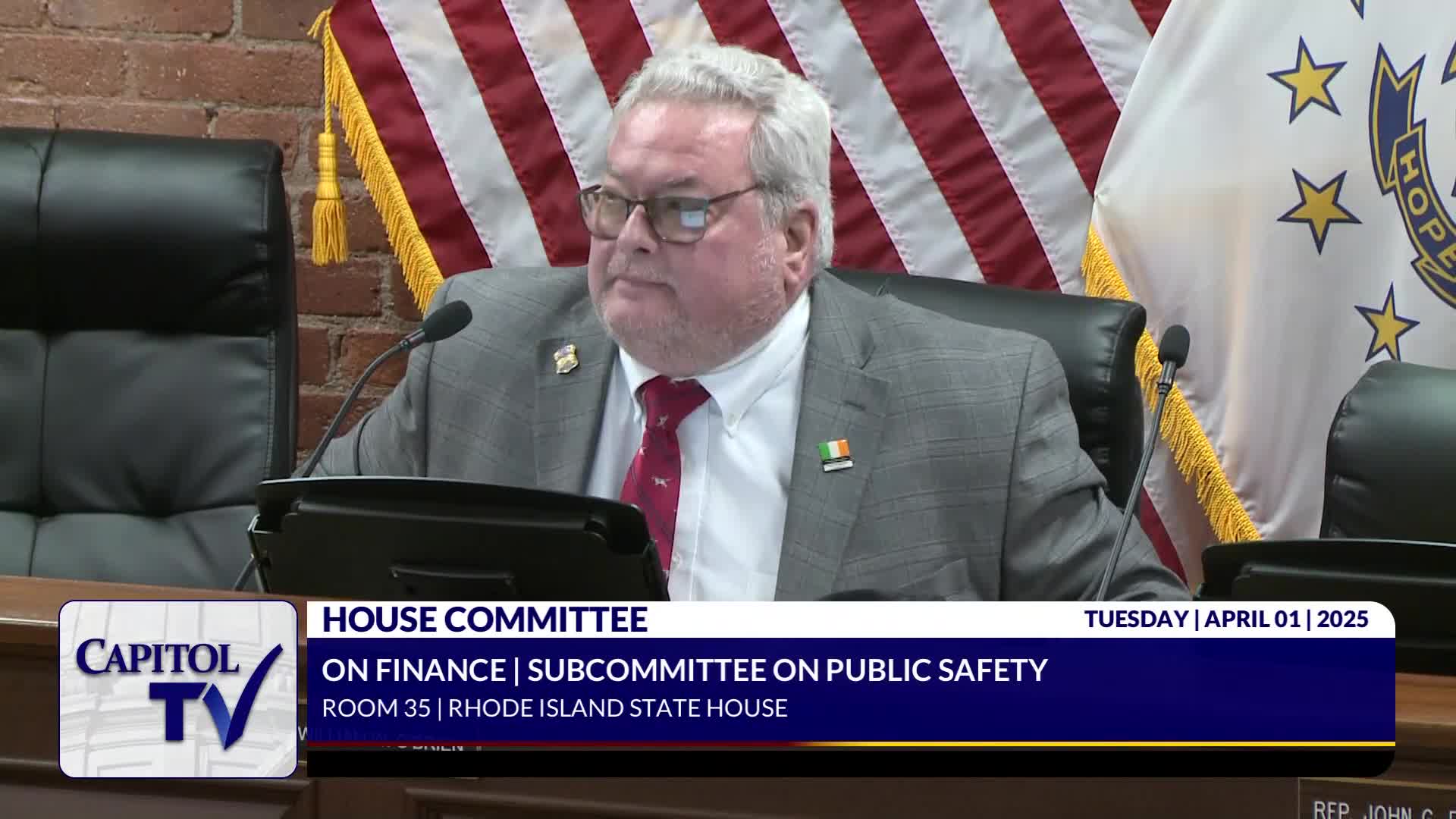
At an April 1 House Subcommittee on Public Safety hearing, state court officials said the governor—s FY2026 recommendation would cut the judiciary—s operating budget and urged lawmakers to restore funds to implement pay-schedule changes, hire interpreters and preserve court operations.
At an April 1 meeting of the Rhode Island House Subcommittee on Public Safety, state court officials warned that the governor—s recommended fiscal 2026 budget would sharply reduce the judiciary—s operating funds and asked lawmakers to restore money to implement staff pay changes and expand language-access services.
The request matters because the judiciary said reductions would affect court operations, indigent defense, juror services and language access for non-English speakers, including Cape Verdean Creole and Portuguese speakers who the courts said are increasingly using court services.
Ethan, a member of House fiscal staff, opened the presentation with a summary of the budget figures the administration submitted. He said the governor recommends $159.2 million for the judiciary for fiscal 2026, about $11.3 million more than enacted, and he described a separate comparison in which the governor—s recommended total for a portion of the judiciary—s request was $121.0 million, $15.1 million more than enacted and $6.6 million more than the judiciary requested. Ethan also described several categories within the budget and the governor—s unidentified operating reductions.
Julie Hamill, the state court administrator, told the panel the judiciary—s own submission to the governor identified three principal budget components: salary and benefits, operating costs and assistance and grants (primarily indigent defense). She said the judiciary had requested $12.5 million for operations for FY2026 but that the governor—s recommendation funds operations at $6.7 million, a cut Hamill summarized as "a 40% reduction" and later characterized more precisely as a 46% cut relative to the request. "Simply put, the judiciary cannot withstand a 40% reduction to its operating budget," Hamill said.
Hamill and other court officials outlined how the money is used: building and maintenance, utilities, juror fees, software maintenance, and programs that support juries and litigants. They said 84% of the judiciary—s budget is general revenue-supported and that nearly 80% of spending is staffing-related, so personnel adjustments drive costs.
On personnel, the judiciary requested pay-schedule reforms that include a minimum pay grade of $48,600, a one-step increase for many roles, and a longer progression of 12 annual pay steps at 2.5% each rather than the traditional 4–5 steps. The judiciary also requested funding to settle clerk educational incentives and up to three years of retroactive payments for eligible clerks. Hamill said the judiciary has been prepared to implement those initiatives but that a statewide personnel system rollout has delayed implementation.
Indigent defense and court-appointed counsel were prominent items in the hearing. Hamill said the judiciary budgets a $7.7 million indigent defense line; Ethan told the committee the governor included $8.0 million for private court-appointed attorneys when the public defender—s office has conflicts, about $2.0 million more than enacted in both the current year and FY2026. Hamill said the number of indigent defense cases has increased 9.1% since FY2018 while the number of attorneys participating on appointment panels has declined about 19.3%.
Court security and language access drew questions. Hamill said the judiciary relies on the Capitol Police and the Division of Sheriffs for courthouse security but that persistent sheriff shortages have caused daily delays and, in some cases, court hearings to proceed without courtroom security. To address hallways and other gaps, the judiciary has contracted with the Providence Police Department for supplemental courthouse security at an annual cost of about $230,000.
Language access requests rose 27% in 2024, the courts said, totaling more than 11,000 requests across 33 languages. The judiciary is seeking two full-time positions for the court interpreters office: one dedicated interpreter for Cape Verdean Creole and Portuguese and an administrative assistant to handle the volume of requests. Hamill said the courts currently employ 10 staff interpreters (eight full time, two seasonal), all Spanish-speaking, and that the proposed hires respond to demonstrated demand: in 2024 there were roughly 9,194 Spanish requests, 330 Cape Verdean and 360 Portuguese requests.
The judiciary also described an increase in self-represented litigants: more than 36,000 matters in 2024 involved at least one self-represented party. The courts opened a court-based resource center in the Noel Judicial Complex in Warwick in November 2024 that has assisted over 500 people to date.
House members asked clarifying questions about restricted receipts, interpreter staffing choices and data contracts. Hamill said some restricted-receipt accounts (for example, the workers' compensation court fees) carry forward and are used for their intended purposes rather than reverting to the general fund. On technology and privacy, Hamill said the judiciary terminated certain license agreements with electronic data brokers out of privacy concerns and that staff would follow up with legislators to explain the administration—s decision in more detail.
Hamill closed by saying the judiciary has historically managed its budget without operating deficits and is willing to accept reductions in a down budget year, but that it could not absorb a $5.7 million cut to operating funds without shifting cuts elsewhere. She asked to meet with House fiscal staff to discuss possible amendments to the court—s request. No formal votes were taken at the hearing.
The hearing next steps include potential follow-up meetings between court leadership and House fiscal staff as lawmakers consider the judiciary—s FY2026 appropriation in the budget process.