Get Full Government Meeting Transcripts, Videos, & Alerts Forever!
Get email alerts on the Animal Welfare Veterinary Practice topic
No spam. Unsubscribe anytime.
Assembly panel advances ban on non‑therapeutic cat declawing in California
Summary
AB 867 would prohibit elective declawing of cats except when medically necessary; veterinarians’ groups raised concerns about legislative regulation of medical procedures and public disclosure of veterinarians’ names, while animal‑welfare groups urged passage.
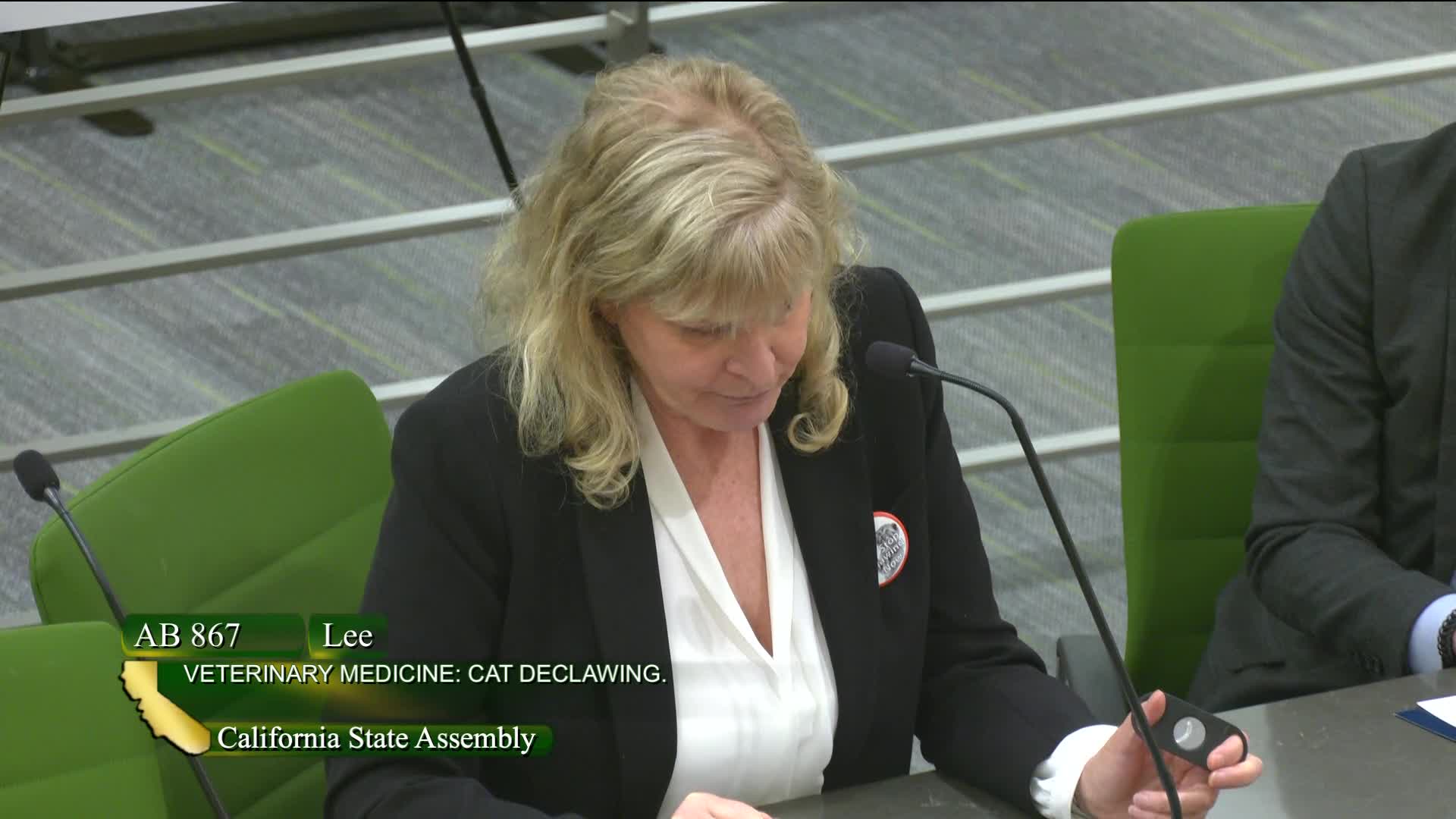
Assemblymember Laura Friedman Lee presented AB 867 to ban non‑therapeutic declawing (onychectomy) of cats in California, allowing the surgery only when performed by a veterinarian for the animal’s medical benefit.
Lee described declawing as a disfiguring surgery that removes a cat’s final toe joint and urged that it not be performed for human convenience. "This is a common sense bill that says that a permanent disfiguring surgery cannot be performed on cats for any other reason other than the health of the actual patient," Lee said.
Jennifer Conrad of the Paw Project, a veterinarian and nonprofit representative, testified that declawing is the “amputation of the last bone in a cat's toe” and is associated with predictable acute pain and longer‑term behavioral issues. She cited literature and polling that place declaw prevalence in the U.S. near the low‑to‑mid 20 percent range and said many declaw procedures are performed on very young kittens.
Animal‑welfare groups including the Paw Project, Animal Legal Defense Fund and Humane World for Animals supported the ban. The California Veterinary Medical Association and some veterinarians opposed aspects of the bill. The CVMA’s written and oral testimony argued the measure regulates a surgical procedure within the scope of veterinary medicine and raised concerns about provisions that would require veterinarians to file paperwork with the Veterinary Medical Board, which the CVMA said could expose practitioners to public targeting via public records.
The author and supporters urged passage, saying the procedure is not standard preventive care and is increasingly banned by veterinary practices and corporations. The committee recorded AB 867 as passed to Appropriations; the clerk’s roll indicated the bill was reported out with 11 yes votes.
Why this matters: The bill would change the legal permissibility of a common veterinary procedure and touches on veterinary practice standards and public‑records questions about reporting by veterinarians.
What’s next: AB 867 advanced to the Appropriations Committee; proponents and veterinary groups said they would work on technical amendments regarding scope and reporting provisions.