Get Full Government Meeting Transcripts, Videos, & Alerts Forever!
Get email alerts on the Operations Management topic
No spam. Unsubscribe anytime.
Housing Authority centralizes DNS complaints, creates QC post and tightens property-management standards
Summary
Housing Authority staff said March 5 they centralized DNS complaint intake under a new quality-control role and introduced a property-management “Call to Action” to reduce fines and shorten maintenance turn times.
Staff told the board March 5 they have centralized the agency’s response to Department of Neighborhood Services complaints, created a dedicated quality-control position and begun enforcing new property-management standards intended to reduce fines and speed maintenance work.
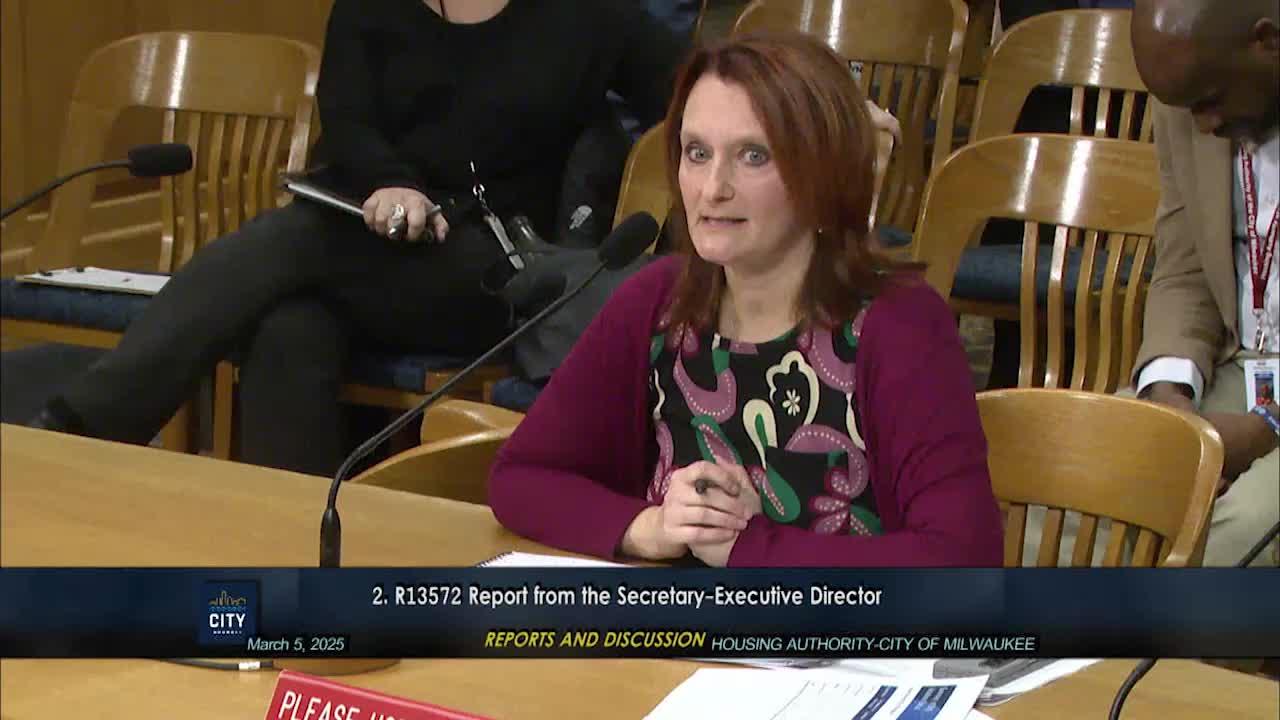
Chief Operations Officer Dina Hunts said a newly created position — staffed by Millie Nieves — will monitor DNS work orders rather than the agency relying on broad e-notify alerts that captured many items not actually assigned to HACM. Hunts said the centralized inbox and a single staff point of contact allow the housing authority to dispatch maintenance more quickly, request extensions where needed, and reduce duplicate tracking. "We are going to have one central email for them to work through," Hunts said, describing the change.
Hunts reported fines derived from DNS records and coordinated with Millie Nieves: $7,003.66 for orders and $4,004.77 for garbage fines. She said the goal is to avoid fines going forward through improved tracking and communication.
Hunts also described a new property-management meeting and a document titled “A Call to Action,” which she said establishes refreshed standards for prioritization, customer service, data-driven reporting, use of Yardi, and one‑on‑one coaching with property managers. She said the authority is redesigning standard operating procedures, measuring turn times from vacant unit to “unit ready” and from “unit ready” to lease-up, and coordinating maintenance and property management more closely.
On public safety, Chief Marlon Davis said his team is improving how calls and incident categories are reported and that the department has begun a lighting survey after resident complaints, with an outside contractor providing cost information for higher-visibility exterior lighting. Davis said the public-safety reports are drawn from calls for service and officer-initiated activity; he noted that “all alarms” in the report includes smoke, fire, medical and sprinkler activations and that some high counts in particular developments reflect frequent cooking-related smoke alarms rather than structural fires.
Davis also confirmed that the public-safety dispatch center takes after-hours maintenance calls and enters maintenance work orders into Yardi to ensure issues can be tracked to completion.
What it means: The agency is moving to centralize complaint intake and tracking, reduce fines and standardize property-management practices. Lighting improvements and clearer after-hours maintenance routing are intended to address resident safety and satisfaction.
Next steps: Hunts said staff will continue monthly property-management meetings, circulate meeting agendas, finish SOP documentation and work with maintenance on targeted turn‑time reductions. The lighting-systems estimate will be developed with the maintenance team and property managers for prioritized sites.