Get Full Government Meeting Transcripts, Videos, & Alerts Forever!
Get email alerts on the Senate Resolution Jan6 topic
No spam. Unsubscribe anytime.
Minnesota Senate reopens debate on Jan. 6 resolution; upholds chair on germaneness after unrelated amendments
Summary
The Minnesota Senate on April 1 reopened debate on Senate Resolution 15, a resolution directed at the Jan. 6, 2021, attack on the U.S. Capitol and related presidential pardons, and denied efforts to broaden the measure with unrelated amendments.
The Minnesota Senate on April 1 reopened debate on Senate Resolution 15, a resolution directed at the Jan. 6, 2021, attack on the U.S. Capitol and related presidential pardons, and denied efforts to broaden the measure with unrelated amendments.
Senators spent more than an hour debating the scope of the resolution after the chamber voted to take the matter from the table. Senator Murphy moved that Senate Resolution 15 be taken from the table; the motion prevailed and debate resumed. The author of the resolution identified it as a statement condemning the January 6 attack and related pardons.
The debate turned to procedure and scope after two minority-party senators offered amendments that members and the presiding officer ruled out of order as not germane to the resolution. Senator Gene Gruenhagen offered the A34 amendment, which would have added language condemning the Biden administration’s border policies and alleged harms tied to immigration enforcement. Senator Karin Weber offered the A17 amendment, which criticized a public remark by Governor Tim Walz about a particular stock and urged reproach because of the state’s investments. Both amendments were described on the floor as addressing matters outside the resolution’s stated subject.
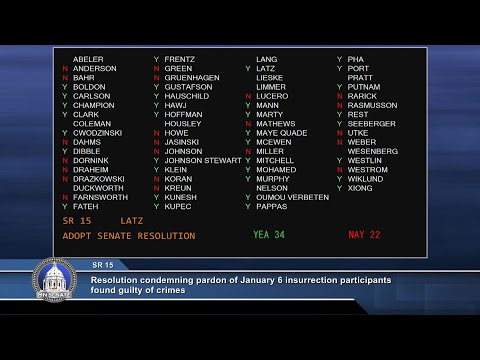
Senators pressed the question of germaneness. Senator Klein raised a point of order under the chamber’s Rule 35.2 that the A34 amendment was not germane to the resolution as drafted. Senator Rasmussen appealed the presiding officer’s ruling. The Senate cast a roll-call vote on the appeal; the tally reported on the floor was 34 ayes and 24 noes, upholding the president’s ruling that the amendments were not germane.
Critics on the floor repeatedly framed the resolution and the process as partisan. Senator Rasmussen said, “This is simply partisan political theater,” and urged colleagues to focus on the chamber’s other business. Several Republicans and some Democrats said the session’s time would be better spent addressing a contested state budget, repeatedly referenced on the floor as a $6,000,000,000 deficit. Senator Groen said the Senate should avoid importing national partisan fights into state business and called the resolution “counterproductive.”
Supporters of the resolution framed it as a necessary statement about the events of January 6 and their consequences. The author urged the chamber to condemn the attack on the Capitol and express support for law enforcement; the author said the conduct of January 6 was “un‑American” and noted that officers were injured or killed during the events. Several senators who spoke for the resolution said they opposed pardons tied to the January 6 prosecutions.
The floor record shows the following formal actions during the SR 15 sequence: a motion to take SR 15 from the table (moved from the floor and granted by voice), the reporting of the A34 and A17 amendments to the resolution, and a roll-call vote (34–24) upholding the presiding officer’s ruling that the offered amendments were not germane. A motion that “Senate Resolution 15, as amended, be recommended to pass” was made on the floor; debate continued afterward and a final passage tally for that motion does not appear in the transcript provided.
Several members noted precedents and outside rulings during debate. A senator on the floor referenced a recent U.S. Supreme Court decision and its holdings about the reach of some criminal charges arising from January 6; another senator cited Article 88 of the Uniform Code of Military Justice as the reason a member could not vote on a partisan matter while subject to that code. Members also exchanged assertions about national pardons, prosecutions, and other federal actions; those claims were offered as debate points and not resolved on the Senate floor.
The Senate went under call for a portion of the debate to ensure members’ presence for votes. After further discussion, the session moved on; the transcript ends before a final roll-call result on the resolution’s recommendation to pass is recorded. The chamber at various points emphasized that members were limited in speaking time for the matter because it was a resolution and not a special order.
The debate reopened an item that had been considered in prior days, and several speakers said the matter had been debated on the floor in a previous session. Members on both sides said they preferred to focus on the state budget and committee work; others said issuing a formal statement on the events of January 6 was appropriate.
Votes at a glance
- Appeal of the presiding officer’s ruling on germaneness (related to amendments A34/A17): upheld, 34 ayes, 24 noes (roll-call reported on the floor). - Motion to take Senate Resolution 15 from the table: moved on the floor and granted (voice vote). - Motion that “Senate Resolution 15, as amended, be recommended to pass”: moved on the floor; final passage vote not specified in the transcript provided.
The Senate resumed other business after the debate; the transcript provided ends before the final disposition of the resolution was recorded.