Get Full Government Meeting Transcripts, Videos, & Alerts Forever!
Get email alerts on the Policing Use Of Force topic
No spam. Unsubscribe anytime.
Santa Barbara Police report 109 use-of-force incidents in 2024; supervisors review every case
Summary
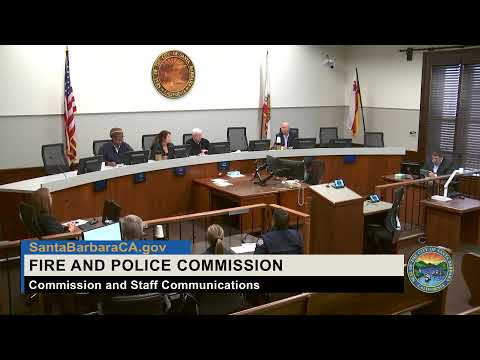
At a Santa Barbara Police Commission meeting, the Police Department presented its 2024 use-of-force review, reporting 109 incidents out of 53,715 calls for service and describing procedures for supervisor and multi-level review.
The Santa Barbara Police Department told the Police Commission that it recorded 109 use-of-force incidents in 2024 out of 53,715 calls for service and that supervisors are required to respond to and document every use of force.
The department said the cases are routed through multiple levels of review and that supervisors must debrief officers after every use-of-force incident to identify training and procedural improvements.
The report — presented by Sergeant Mike Brown of the department’s Professional Standards Unit — described how officers apply the legal standard for force and summarized the department’s categories of force, de-escalation expectations and data for 2024. "For this year, we had a hundred 9 incidents of use of force, and that's out of 53,715 calls for service," Sergeant Mike Brown said. "That means that 99.8% of our calls of service did not require use of force." Brown also described the department’s reliance on California Penal Code §835a(b) and Graham v. Connor (1989) to evaluate whether force was objectively reasonable.
The presentation said the department uses an electronic records system (Blue Team, produced by VersaTerm) to document each incident. A field supervisor begins a Blue Team report at the scene, then it is routed to a commander, an assistant chief and a community accountability reviewer for layered review. Training officer Jay Duffy reviews reports to recommend training or briefings when trends are identified.
The department provided a numeric breakdown for 2024: 10 control holds/grappling uses; 3 baton/impact strikes; 1 K-9 bite; 2 leg restraints; 1 pepper-spray dispersal; 10 uses of personal weapons (hands/feet/strikes); 74 takedowns; 4 taser deployments; and 4 uses of a restraining wrap device. The presentation compared those figures to 2023 and said takedowns and several other categories rose slightly in 2024. Sergeant Brown reported 34 subject encounters with no injury, 18 with complaints of pain, 55 with minor injuries and 2 with serious injuries. For officers, 70 incidents recorded no injury, 8 recorded complaints of pain, 28 minor injuries and 1 serious injury; the department reported 2,048 lost work hours related to those injuries.
Department policy sections cited in the presentation include policy 300.1 (use of force), 300.2 (duty to intercede) and the de-escalation guidance at 300.3; speakers said those provisions mirror statutory requirements and that de-escalation (voice, neutrality, respect and trust) is built into training.
Commissioners asked about transparency and reporting. Commissioner Jones asked whether Blue Team data are shared outside the department; staff said Blue Team is an internal records system but that out-of-policy findings become internal affairs investigations and that certain serious injuries are reported to the state Department of Justice. Miss Anderson, the community accountability reviewer who meets regularly with department leadership, said she reviews use-of-force incidents and policy-violation allegations and helps ensure an outside perspective is part of the review process.
Department leaders emphasized training and supervision as tools to reduce force. The assistant chief and training staff described increased field supervision, mandatory sergeant response to each use-of-force call, in-house de-escalation training, and ongoing reviews that resulted in changes to techniques and training curricula.
The commission did not take any formal vote on policy changes at the session; the presentation was informational and followed by commissioner questions.