Get Full Government Meeting Transcripts, Videos, & Alerts Forever!
Get email alerts on the Human Services Eligibility topic
No spam. Unsubscribe anytime.
Oregon Eligibility Partnership outlines $952 million budget request, warns of staffing and timeliness pressures
Summary
Department of Human Services officials gave the Joint Ways and Means Subcommittee an overview of the Oregon Eligibility Partnership’s budget, performance measures and operational challenges, including a federal timeliness target and ongoing SNAP accuracy issues.
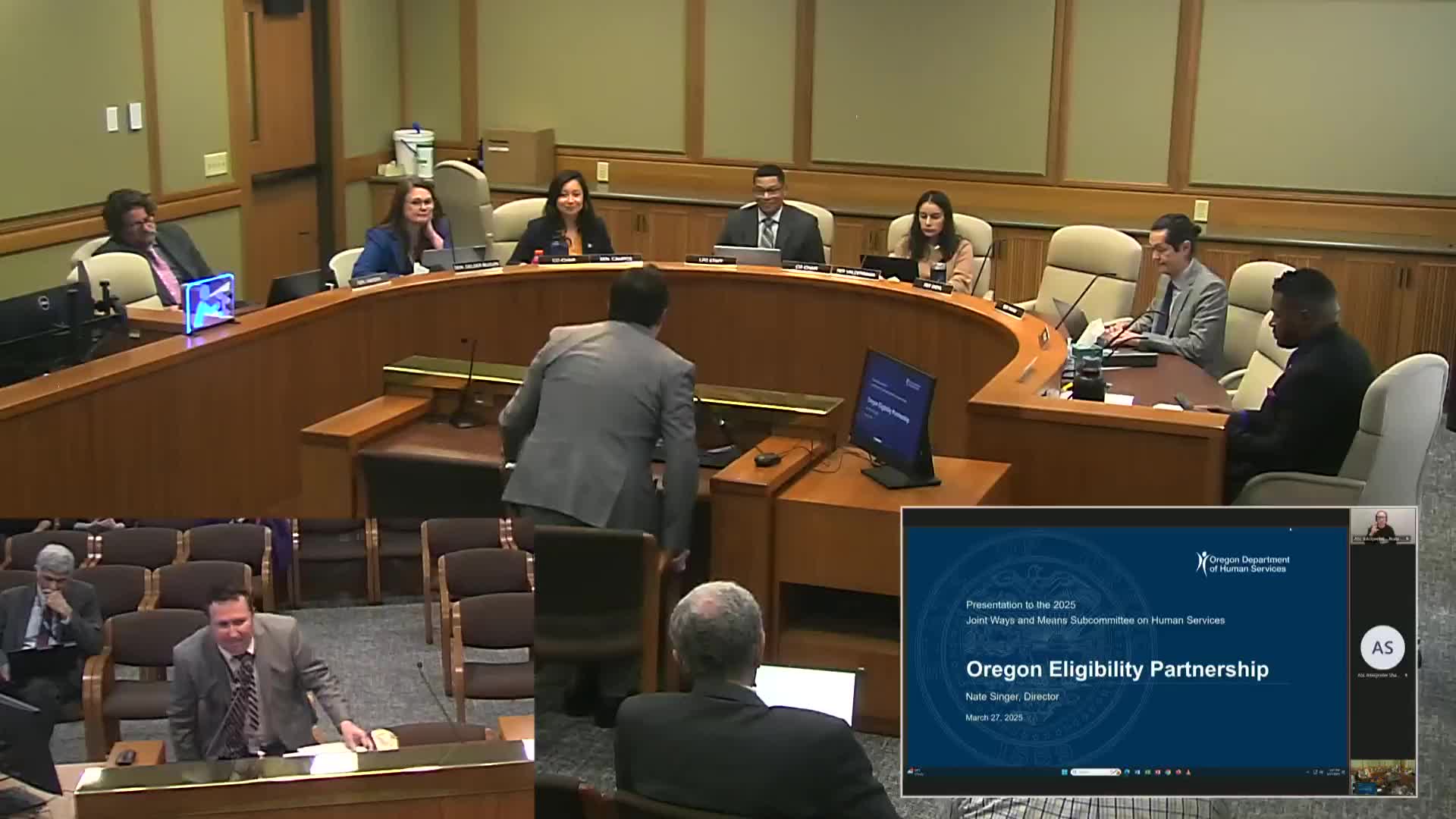
The Oregon Eligibility Partnership (OEP), the consolidated eligibility unit within the Oregon Department of Human Services, told the Joint Ways and Means Subcommittee on Human Services on March 27 that it is operating under a governor-recommended budget of about $952 million for the upcoming biennium and faces continuing workload and timeliness pressures.
OEP Director Nate Singer told the committee the program — created by the Legislature in 2023 to centralize eligibility work for medical, food, cash and childcare benefits — supports eligibility determinations for more than one in three Oregonians. "Our commitment is to be available to them wherever they choose to engage us," Singer said.
OEP presented the committee with detailed program metrics and three policy option packages it asked lawmakers to consider. Singer said OEP is responsible for processing roughly 56,000 new applications per month and more than 60,000 monthly redeterminations. In 2024 the agency approved about 460,000 new applications, denied about 200,000, and received about 1.2 million calls to its single customer service number.
Why it matters: The agency’s capacity to process applications quickly and accurately affects access to medical care, nutrition and childcare for hundreds of thousands of Oregon residents. Committee members pressed OEP on federal performance expectations and how state funding and IT investments support meeting those requirements.
Budget and funding mix
Singer said OEP’s budget request in the governor’s recommended budget is about $952 million, roughly 53% federally funded. He told the committee ODHS’s total recommended budget is just over $22 billion and that OEP represents roughly 4% of that total. Singer characterized about 75% of OEP funding as going to service delivery (front-line eligibility staff), 21% to the state’s primary eligibility IT system and related interfaces, and about 4% to program design (training, hearings and program oversight).
Key operational figures Singer provided include: 2,620 funded OEP positions (plus about 320 county area-agency-on-aging positions), roughly 500 non‑budgeted double-fill positions the agency is currently maintaining, and a staffing mix in which eligibility workers and leads make up the majority of delivery positions. Singer said the agency has reduced non‑budgeted positions since OEP was created (from roughly 930 at formation) and expects additional reductions as recruitment and classification work proceeds.
Major initiatives and IT work
Singer briefed the committee on three policy option packages in the governor’s recommended budget that OEP emphasized: - Federal Data Services Hub match (POP 104): federal interfaces that automate verifications were previously 100% federally funded; the federal match is now 75%, and OEP requested state funds to cover the remaining 25% so automation can continue. Singer said automation enables 62% of medical applications to be processed without worker intervention. - Centralized Abuse Management system (CAM) maintenance (POP 113): Singer said CAM — the repository for abuse and licensing records used by ODHS, the Oregon Health Authority and county area agencies — needs about $2.5 million for maintenance to replace end-of-life components and meet new national security requirements beginning in 2026. - Mainframe modernization: continuing planning and procurement to replace older mainframe systems that still support provider payments and other critical ODHS functions.
Singer highlighted several recent operational improvements funded or enabled during the current biennium: robotic process automation for returned mail (scanning QR codes and prompting secure self-service updates), a newly launched interactive voice response (IVR) capability that lets callers verify identity, check application status and request EBT card replacements without a worker, and numerous system changes (he said about 95,000 hours of system enhancements in the biennium).
Performance measures, timeliness and accuracy
OEP reported it has moved its SNAP timeliness from about 77% at OEP’s formation to roughly 90% in recent weeks, in part through process changes and voluntary overtime. Singer told the committee, "We're going to see if we can hit 95% this month to fulfill their requirements," referring to a U.S. Department of Agriculture Food and Nutrition Services (USDA FNS) timeliness standard that the agency said it is expected to meet by the end of the month.
Singer said OEP is under an official corrective action plan with the federal government for SNAP timeliness but that there was no immediate financial penalty tied to the timeliness metric; the federal oversight can escalate if a state’s performance does not improve. The agency also faces a separate federal accuracy review for SNAP that examines whether benefits were calculated correctly. Singer showed that Oregon’s SNAP error rate was near 22% in 2022 and has been on a downward trajectory since; he attributed the higher rate to pandemic-era waivers that paused interviews and said OEP is implementing additional automated income verification interfaces, targeted case reviews, and system nudges to reduce errors.
Caseload growth and workload model
Singer stressed the scale of demand: OEP serves about 1.57 million Oregonians, he said, including more than 700,000 people on SNAP and substantial growth in Medicaid caseload since 2019 (about 400,000 additional individuals). He told the committee that OEP’s funded staffing represents roughly 56% of the workload model the agency uses to estimate needed staffing, and said eligibility workers are currently funded at about 62% of the modeled need. Singer described this as a primary driver of reliance on non‑budgeted positions and overtime.
Federal match and use of enhanced matching funds
Committee members asked about OEP’s practice of using enhanced federal match for administrative costs. Representative Deal asked whether federal funds originally given for IT had been used to support hiring and whether that was allowed. Singer replied that a 2016 state Medicaid director letter and related rule allow states to claim a higher (75%) federal match for staff costs when eligibility work is performed through an approved system and that OEP submits advanced planning documents annually to justify that use. He cautioned that federal policy could change and that FMAP and administrative match rules remain subject to federal decision-making.
Other programs and outcomes
Singer noted several program outcomes tied to recent work: Summer EBT participation of about 362,000 children in the most recent summer, distributing roughly $43 million in federal benefits; implementation of Oregon’s Basic Health Program to cover people between 138% and 200% of the federal poverty level; and what he described as the highest Medicaid renewal rate in state history during the public health emergency unwinding.
No committee action recorded
The session was an informational hearing on Senate Bill 5526 (the department’s budget bill). The committee did not take any formal votes during the hearing; the chair closed the hearing at its conclusion.
Ending
Singer closed by urging continued legislative support for OEP’s budget and IT investments and by recounting a client encounter he says illustrated the difference timely eligibility decisions can make for families.