Get Full Government Meeting Transcripts, Videos, & Alerts Forever!
Get email alerts on the Committee Votes topic
No spam. Unsubscribe anytime.
Votes at a glance: Health and Government Operations Committee advances a package of health-related bills
Summary
The committee advanced a series of health-related bills on March 27, 2025; most measures passed unanimously or with minimal opposition. Items include veterans notations on IDs, unclaimed veterans' remains procedures, calcium score insurance coverage, mental health terminology updates, and hospital finance measures.
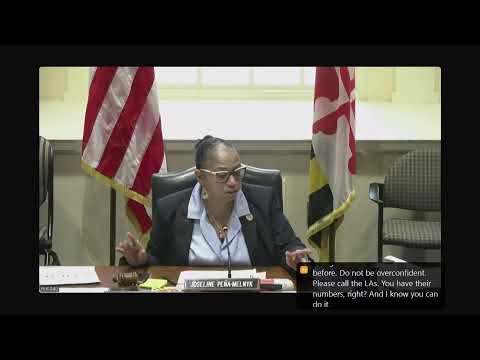
The Health and Government Operations Committee on March 27 advanced a broad set of health-related bills, most by unanimous voice vote or without extended debate. Committee members moved and seconded each bill in sequence; the committee recorded opposition by name on a small number of measures. Below are the bills taken up and the committee’s recorded dispositions.
Votes at a glance
- Senate Bill 48 (Department of General Services identification cards — veteran notation): favorable; committee recorded unanimous passage on voice vote.
- Senate Bill 57 (funeral establishments, crematories and disposition of unclaimed veterans' remains): favorable; committee recorded the bill passed. The Senate vote had been 47–0.
- Senate Bill 60 (Maryland Medical Assistance Program and health insurance — calcium score testing coverage): favorable; passed with named opposition noted (Delegates Shaliga, Chisholm, Morgan, Riley were listed during the vote call as opposing earlier or on related items).
- Senate Bill 67 (Health occupations — board notation of veteran status): favorable; passed unanimously on voice vote.
- Senate Bill 94 (Maryland Medical Assistance Program — maternal mental health remote blood pressure monitoring): favorable; members noted the service is already in place for Medicaid and the bill passed unanimously.
- Senate Bill 163 (Health — update references from "mental hygiene" to "mental health"): favorable; passed unanimously. The bill requires the Maryland Department of Health to update regulations and public-facing materials by July 1, 2027.
- Senate Bill 172 (Maryland Veterans Trust Board membership): favorable; passed unanimously.
- Senate Bill 182 (Maryland Veterans Service Animal Program — eligibility for family members): favorable; passed unanimously.
- Senate Bill 213 (maternal and child health population health improvement fund use): favorable; passed as identical to its cross-file.
- Senate Bill 222 (Cannabis Public Health Advisory Council membership additions): favorable; the bill was amended in subcommittee to add specified executive branch officials and passed unanimously.
- Senate Bill 229 (Health Services Cost Review Commission — repeal of sunset on hospital user fee assessment): favorable; passed after discussion; House vote had been 13–7 previously.
- Senate Bill 371 (State Board of Pharmacy renewal notices), Senate Bill 374 (Counties council screening professional firefighters act), Senate Bill 589 (Opioid Restitution Fund interactive dashboard), Senate Bill 748 (public health — Alzheimer's disease and related dementia provisions), and other bills on the agenda were moved and passed with no recorded opposition on the committee floor.
- Senate Bill 749 (State Board of Dental Examiners — amended to require MDH plan for former federal employees and reciprocity considerations) was considered with a substantial amendment and passed as amended; opposition to the amendment and final bill was recorded from several members including Delegates Olson and Kerr (see separate article for full discussion of that amendment and direction to MDH).
- Senate Bill 981 (hospitals — financial assistance and collection of debt policy): favorable; passed by the committee.
What committee members said
Committee members generally offered brief procedural remarks on most bills and reserved more detailed debate for a handful of measures. Where questions arose, staff and counsel provided clarifying answers about cross-files, fiscal notes, or reporting deadlines. On several items—such as the calcium score coverage measure and the maternal health fund use—delegates asked whether programs were already in place or whether statutory language required changes; staff replied in the affirmative in some instances.
Next steps
Bills that passed the committee will proceed to the House floor for consideration according to legislative scheduling. Members were reminded to pick up folders and be prepared for floor action; staff said committee paperwork for bills voted on that day would be made available to delegates in short order.