Get Full Government Meeting Transcripts, Videos, & Alerts Forever!
Get email alerts on the Social Services Block Grant topic
No spam. Unsubscribe anytime.
Kentucky committees approve 2025 Social Services Block Grant plan after department presentation
Summary
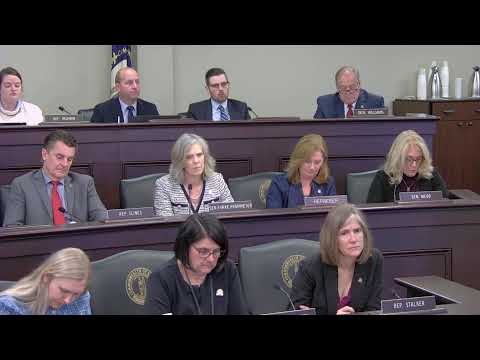
The House and Senate families-and-children committees approved the state'plan for the 2025 Social Services Block Grant following a presentation by the Department for Community Based Services outlining program uses, funding levels and data on adult and child protective services.
Members of the Kentucky House and Senate families-and-children committees voted to approve the 2025 Social Services Block Grant preliminary state plan after a department presentation and questions about funding priorities and program definitions.
The Department for Community Based Services (DCBS) presented the plan and described the grant'funded programs, estimating the federal portion at about $21,000,000 annually and identifying adult protective services, child protective services, home safety services, juvenile services, residential treatment and staff training as covered activities. The committees approved the plan on unanimous voice and roll-call votes in both chambers.
The Social Services Block Grant (SSBG), established by Congress in the Omnibus Budget Reconciliation Act of 1981, is administered in Kentucky by DCBS. Commissioner Lisa Dennis and Executive Advisor Mary Carpenter told members the department uses SSBG funds primarily for staff and staff training and that states set service eligibility and delivery methods to meet program goals.
Dennis said the department has about 5,000 employees and at least one office in every county. On program outcomes and demand, DCBS presented multi-year data showing that of the calls and intakes the department receives, roughly 48,000 met criteria requiring an assessment, about 10,000 were classified as 'services-needed,' and approximately 8,000 resulted in substantiated findings. The presentation also identified the most common maltreatment types: supervision neglect (about 25.3 percent) and physical abuse (about 31.2 percent), which together account for a majority of reported maltreatment types DCBS tracks.
Committee members pressed DCBS on several areas. Senator Herron asked how much of the federal portion goes to juvenile services; Dennis said the federal share for juvenile services is 'a little over $6,000,000.' On the risk that federal funding could be cut, Dennis said, "We have not heard or seen anything at this point in time that ... it would be impacted," and added that the department is monitoring federal developments and would request state funds from the General Assembly if necessary.
Members and DCBS staff also discussed efforts to distinguish poverty-related needs from neglect. DCBS said it has worked with staff and community partners to refine how referrals are screened and how community pathways can provide services to families whose needs do not meet statutory abuse-or-neglect criteria. Mary Carpenter noted the department is tracking referrals that do not meet acceptance criteria to identify opportunities for earlier community-based supports.
The department described ongoing changes to staff training. DCBS is transitioning training administration away from a single university partner toward a broader set of university and provider partners to expand statewide and in-person training capacity. The department also reported an existing pilot of Multi-Systemic Therapy (MST) in three regions (Jefferson, Northern Bluegrass and Central Kentucky) in partnership with Medicaid and local providers; DCBS said MST has produced positive outcomes in pilot sites and the pilot has been extended for two years while the department evaluates costs and potential expansion.
On human trafficking and sextortion concerns, DCBS said it maintains mandatory training for staff and partners with law enforcement on trafficking investigations. The department agreed to provide committee members with trafficking-related data upon request.
The committees recorded formal approvals. In the Senate committee, Senator Funke Froehmeyer moved to approve the 2025 SSBG plan, Senator Webb seconded, and the motion passed on roll call (vote recorded as 11-0). The House committee likewise moved and seconded approval and recorded the plan as approved during the committee's roll call.
The committees adjourned after the votes. The record notes the committees do not anticipate further meetings on this subject this session.