Get Full Government Meeting Transcripts, Videos, & Alerts Forever!
Get email alerts on the School Budget topic
No spam. Unsubscribe anytime.
Lodi Board adopts $94.41 million 2025–26 budget, approves 2% tax levy amid debate over reserves and adequacy
Summary
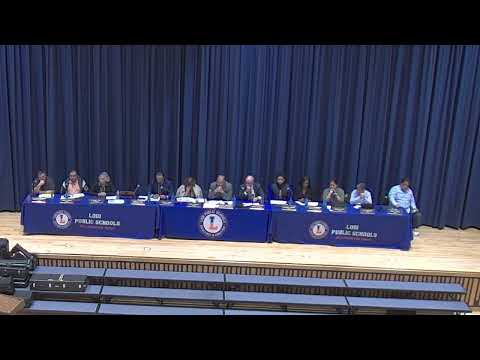
The Lodi Board of Education on March 26 approved a $94,410,446 2025–26 budget with a 2% tax levy increase. The meeting featured extended debate about large reserve balances, a state "adequacy" shortfall the administration says is $4.3 million, and planned capital work funded from reserves.
The Lodi Board of Education on March 26, 2025, approved the district's 2025'26 budget, a $94,410,446 all-funds proposal that includes a proposed 2% increase in the local tax levy to $39,841,424 and a budgeted general-fund balance appropriation of $2,600,000.
Superintendent D'Amico and interim school business administrator Michael Rinderknecht presented the budget at a public hearing and answered questions from board members and residents. Rinderknecht told the board that the district plans a $2,300,000 withdrawal from the capital reserve to fund several capital projects, and that state aid for the district rose this year by about $1,545,000. He also summarized the district's revenue and appropriation totals and said the district's total all-funds budget is $94,410,446.
Why it matters: the board's vote sets next year's spending and the local tax levy that funds schools. Administrators said the budget funds expanded preschool, technology and safety work, and programs for students with greater needs; opponents on the board urged caution, citing large reserve balances and household affordability concerns.
Most important facts first: Rinderknecht told the board the proposed general-fund tax levy is $39,841,424, a $781,204 (2%) increase the administration said equates to $2.21 per month for an average assessed home of $322,722. He also listed planned capital projects paid from capital reserve dollars, including districtwide sign boards ($315,000), window upgrades with ballistic laminate ($247,500), bathroom security upgrades ($124,355), and work at Lincoln School including brick repointing and window replacement ($1,665,000). The board approved the budget by roll call vote: six members voted yes, two voted no and one abstained.
Context and debate: much of the meeting centered on a New Jersey Department of Education (NJDOE) "adequacy" calculation the administration showed to the board. Rinderknecht said the NJDOE's output shows Lodi's proposed general-fund tax levy is roughly $4.3 million below the level the department regards as adequate to provide a "thorough and efficient" education. He explained that the NJDOE formula adjusts a per-pupil base by grade-level weights and student risk factors.
Board members pressed staff on district reserves and prior-year surpluses. Several board members noted the district's capital reserve balance (the business administrator said it was about $14,420,000 at June 30) and asked why the board should increase the tax levy when the district has sizable reserves. Board member Mastro Filippo said he would oppose the budget, stating, "I am going to vote no on a budget that's $24,000,000 in excess," and others urged caution because some residents may face tight household budgets.
Administrators and other board members defended the proposed spending and use of reserves as targeted to student supports and facilities. Superintendent D'Amico emphasized investments in counseling, mental-health supports, technology (continuation of the K'12 Chromebook 1:1 program), expanded preschool (the district's preschool education budget is $4,200,000), and resources for English-language learners and special-education programs. Rinderknecht said some out-of-district tuition costs are large (he noted examples of individual tuitions of $50,000 or more) and that keeping students in-district for certain services reduces those costs.
Votes at a glance: - B1 (Adopt 2025'26 budget as presented): motion mover not specified; second by Mister Cannizzaro. Roll call: Miss Acalia (abstain), Miss Anderson (yes), Mister Bautista (yes), Mister Cannizzaro (yes), Mister LaFranca (yes), Mister Mastro Filippo (no), Mister Ramos (no), Doctor Sima (yes), Miss Cardone (yes). Outcome: approved. - FB1'FB10 (finance/budget appropriation resolutions, including bid awards and capital items): motion by Mister Cannizzaro; second by Miss Acalia. Several resolutions passed in a single roll call. Notable: FB10 (award for a STEM classroom at Thomas Jefferson Middle School) had two abstentions (Mister Mastro Filippo and Mister Ramos) on that specific item; the overall package carried. - P1'P11 (personnel motions including leaves, hires and the extension/appointment of the interim school business administrator/board secretary): motions carried with recorded abstentions, recusals and dissent on some items. The board ratified the appointment/continuation of Michael Rinderknecht as interim school business administrator/board secretary for the 2025'26 contract year (motion text on the record included contract dates, salary of $213,200 prorated, and a clause that the appointment is subject to approval by the Commissioner of Education and the executive county superintendent). Several members said they would vote no or abstain on some personnel items; roll call passed the package overall.
Public comment: more than one resident spoke during the budget hearing and the public-comment period. Omar Lopez, identifying himself as a Lodi resident, said the meeting's long internal debate was "not productive to the Lodi taxpayers" and added, "Someone's going to have to pay for these things." Ximena Ochoa, a homeowner, urged the board to prioritize classroom needs and supports over nonessentials and said families are concerned about affordability.
What the board approved and next steps: by approving the budget, the board set the tax levy and appropriations as presented. Rinderknecht noted the budget had been approved by the executive county superintendent following the board's tentative approval earlier in March. The budget package includes capital work funded from the capital reserve and expanded preschool services using state Preschool Expansion Aid. The business administrator and superintendent said the board will move forward with the listed capital projects and contract awards; some items (for example, contracts and the interim administrator's employment agreement) are subject to required state approvals.
Ending: the board carried the budget and related finance and personnel motions after roughly two hours of public budget discussion and returned to other agenda items. Board members gave mixed closing remarks: some urged fiscal caution and transparency about reserves, while others said delaying projects would risk disadvantaging students or increase out-of-district costs.