Get Full Government Meeting Transcripts, Videos, & Alerts Forever!
Get email alerts on the Consumer Protection Lemon Law topic
No spam. Unsubscribe anytime.
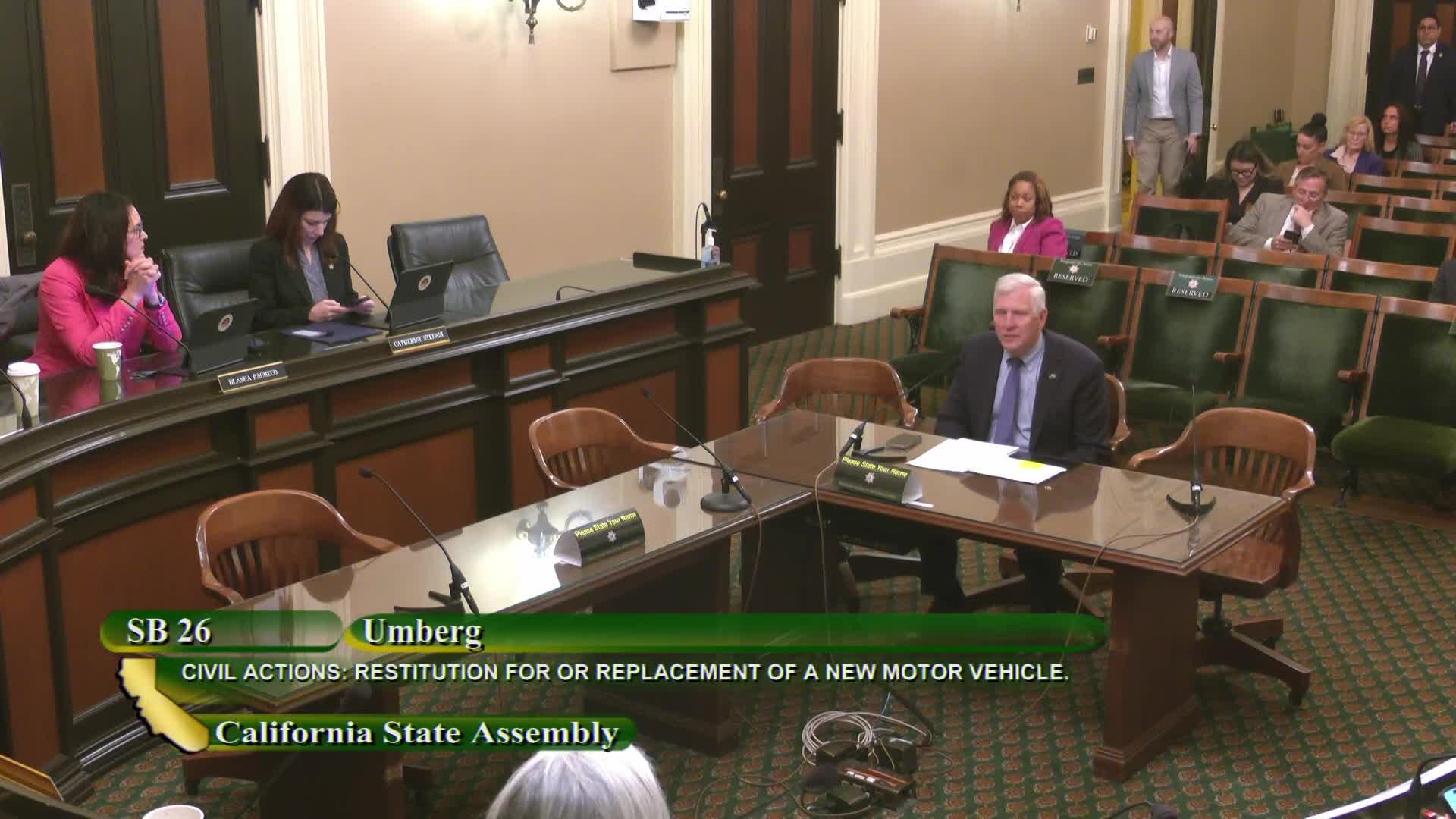
Assembly Judiciary Committee approves SB 26 to allow automakers five-year opt-in to arbitration program
Summary
The California State Assembly Judiciary Committee voted to pass SB 26, a bill that establishes a five-year opt‑in process for automakers to notify the arbitration certification program in the Department of Consumer Affairs and thereby participate in the arbitration procedures tied to prior changes to California’s lemon‑law framework.
The California State Assembly Judiciary Committee voted to pass SB 26, a bill that establishes a five-year opt‑in process for automakers to notify the arbitration certification program in the Department of Consumer Affairs and thereby participate in the arbitration procedures tied to prior changes to California’s lemon‑law framework.
Supporters said SB 26 implements the compromise reached after last year’s changes to AB 1755 and gives manufacturers flexibility while maintaining a path for consumers to seek redress. ‘‘SB 26 … establishes an opt in process, for AB 17 85 giving automakers the necessary option, to balance what is right, for the approaches based on our customer service operations,’’ said Nicolina (Nicole) Hernandez, regional director of state government affairs for Toyota.
The bill was presented to the committee as a follow-on to AB 1755 and the Song‑Beverly Consumer Warranty Act. Senator (Sen.) Tom Umberg, who described the measure as a continuation of prior work, framed the legislation as an effort to expedite discovery and speed resolution of lemon‑law cases by requiring earlier exchange of documents and witness information. ‘‘Originally … Los Angeles Superior Court was up to, in fact, exceeding 10% of all filings were lemon law filings,’’ Umberg said, describing the context that led to the earlier reforms.
Consumer advocates expressed guarded support but pressed the committee on potential harms. Rosemary Shahan, president of Consumers for Auto Reliability and Safety, described the organization’s position as ‘‘soft support’’ and warned the committee about provisions in AB 1755 that remain concerning, including shorter statutes of limitation and repose and rules allowing manufacturers to offset repurchase payments for ‘‘negative equity.’’ She said those features could ‘‘stick a lot of especially low income consumers with unsafe lemons’’ if consumers cannot pay negative equity up front. Shahan also highlighted rising complaints about software issues in modern vehicles.
Several automaker representatives testified in favor of SB 26. Brands and trade representatives who announced support during the hearing included Toyota, General Motors, Rivian, Honda, Hyundai, Lucid, Tesla, Kia, Volkswagen Group and Mercedes. Sabina Tacker of the Consumer Attorneys of California, which cosponsored last year’s AB 1755, also appeared in support and urged members to vote yes.
After public testimony and discussion, the committee moved and approved the bill. The clerk called the roll and multiple members recorded aye votes; the committee chair indicated the motion passed. The committee indicated it expects the bill to be taken up on the Assembly floor Friday if approved further.
The hearing combined expressions of industry support for an opt‑in arrangement with cautions from consumer advocates about remaining changes to lemon‑law procedures. Committee members and the bill’s sponsors said they intend to monitor litigation and consumer outcomes as the revised procedures operate.
Votes at a glance
- SB 26 — Passed in committee (motion carried; committee indicated immediate transmittal and floor consideration anticipated Friday).