
Council introduces rewrite of Sunnyvale ADU rules to reflect recent state laws
Get AI-powered insights, summaries, and transcripts
Sign Up Free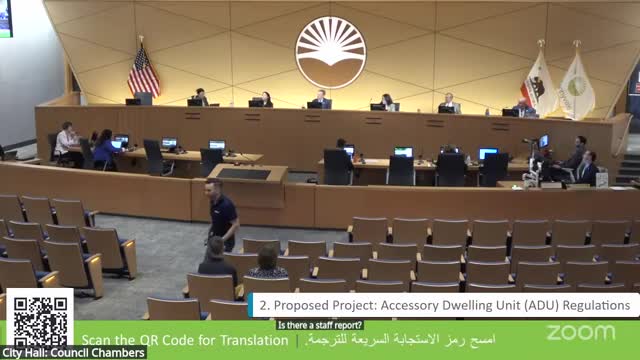
Summary
City staff presented a substantial rewrite of Title 19 zoning rules for accessory dwelling units (ADUs) to align Sunnyvale code with several new state laws, expand some streamline ADU categories, and to clarify definitions, tree‑replacement rules and applicability; council introduced the ordinance on first reading, 7–0.
Astha (senior planner) presented the City Council with a draft ordinance on March 25 that would repeal and readopt chapter 19.79 of the Sunnyvale Municipal Code and amend related zoning definitions to align local ADU rules with state law.
"Accessory dwelling units and junior accessory dwelling units… are considered an essential form of housing by the state," Astha said during her presentation, and she walked council through recent state bills that change ADU treatment and local options.
Staff said the proposed rewrite is intended to (1) ensure compliance with new state laws; (2) improve readability and navigation for applicants; and (3) clarify objective development standards such as setbacks, mechanical equipment and solar analysis. The biggest substantive changes included: - Increased ADU counts: single‑family lots would be allowed up to three ADUs total (up from two under current local code). For existing multifamily properties, detached new‑construction ADUs allowed would increase from two to eight, consistent with state changes. - Streamlining expansion: additional ADU types would be eligible for ministerial (streamlined) review — for example, attached or detached new‑construction ADUs up to 800 square feet on single‑family lots, detached ADUs on multifamily lots regardless of size, and basement ADUs. - Definitions and deed restrictions: the rewrite adds and revises definitions to match state law and expands deed‑restriction language for junior ADUs (JADUs), including prohibitions on separate sale of JADUs from the main residence. - Trees and heritage resources: after consulting the California Department of Housing and Community Development (HCD), staff revised the ordinance so that local tree‑replacement requirements (one 15‑gallon replacement tree per removed protected tree) would apply only to non‑streamline ADUs; staff removed an automatic requirement that resource alteration permits be required for locally designated heritage resources, noting state law allows objective protection for resources on the California Register but not for locally designated resources.
At the conclusion of staff presentation the council voted 7–0 to introduce the ordinance on first reading. Planning Commission had reviewed the draft and recommended the staff‑preferred alternative. Staff said HCD will review the ordinance after adoption and that some state options (for example, allowing separate sale of ADUs under Assembly Bill 1033) were not elected because staff concluded those options could produce administrative complexity or unintended consequences such as parcel‑map requirements and potential encouragement of corporate investment.
Why it matters: ADU rules determine what homeowners and multifamily property owners can build to add rental units or accessory living space. The proposed rewrite both implements state mandates and changes some local allowances (notably unit counts and streamlined categories) that could increase housing supply while clarifying which local protections (for trees and heritage resources) can apply.
Council action: Vice Mayor Selle moved to introduce the ordinance; Council member Mellinger seconded. The council then read the ordinance title and voted 7–0 to introduce the ordinance for a second reading and adoption per the council’s rules; second reading and final adoption will follow the council’s regular ordinance schedule.