Get Full Government Meeting Transcripts, Videos, & Alerts Forever!
Get email alerts on the Reporting Requirements Legislative Auditor topic
No spam. Unsubscribe anytime.
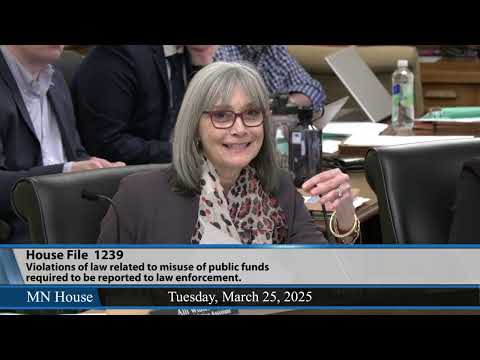
Committee lays over House File 1239 after debate over where suspected misuse should be reported
Summary
A Minnesota House committee laid over House File 1239, a bill that would make reporting requirements to the legislative auditor parallel to those for the state auditor, after members asked for clearer language about which law-enforcement agencies should receive reports.
A Minnesota House committee laid over House File 1239 after members asked for clearer language about which law-enforcement agencies public employees should notify when they find evidence of theft, embezzlement or unlawful use of public funds.
Representative Quam moved the bill, which Legislative Auditor Judy Bridal described as “really, what we think is really simple” and meant to make the requirements for reporting to the legislative auditor consistent with those that apply for reporting to the state auditor. Bridal said the bill mirrors the language in 609.456 and is intended to clarify existing obligations so agencies report suspected misuse promptly to law enforcement rather than waiting for the auditor’s review.
The bill’s core change would align the legislative-auditor reporting standard with the language that currently appears for the state auditor in statute, Bridal said. “When they have evidence of theft, embezzlement, unlawful use of public funds or property, etc., they shall promptly report to law enforcement and shall promptly report in writing to the state auditor,” she read, saying the bill adopts parallel language for the legislative auditor.
Several committee members supported the aim but urged more precise definitions of the phrase “report to law enforcement.” Member Cleburne questioned whether the statute would require notification of a local police department, the Bureau of Criminal Apprehension or another agency. “Does that mean I report to my local Plymouth Police? Who do we report to, right? So should it be the reporting to the BCA?” Cleburne asked, saying the committee should clarify the pathway before advancing the measure.
Bridal said she is constrained by the Government Data Practices Act but that her office typically shares appropriate information directly with law enforcement. She said she has seen “delays in reporting to law enforcement that have been problematic” and that the bill is meant to reduce those delays by making the reporting obligation clearer.
Representative Quam said he would work to ensure the language is consistent across the legislative and state auditors and that he would collaborate with other members on definitions. In the interest of refining the language, the committee laid House File 1239 over for possible inclusion in the policy omnibus bill. Representative Quam closed by saying he looks forward to “an energetic discussion on making government better.”
Next steps: committee staff and the author will work with the legislative auditor and interested members to define the intended law-enforcement reporting pathway and return the bill for further consideration during omnibus negotiations.