Get Full Government Meeting Transcripts, Videos, & Alerts Forever!
Get email alerts on the Emergency Care Emergency Medical Treatment topic
No spam. Unsubscribe anytime.
Committee considers state EMTALA protections and private ‘Safe Harbor’ fund as critics and backers clash
Summary
SB 7 would create state‑level statutes to ensure hospitals provide stabilizing emergency pregnancy care and would authorize a privately funded Safe Harbor account to reduce travel barriers for out‑of‑state patients seeking reproductive and gender‑affirming care.
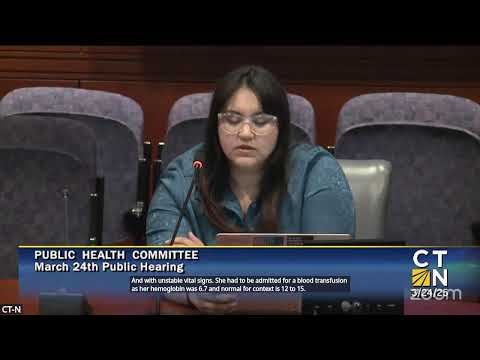
HARTFORD — The Public Health Committee heard hours of testimony March 24 on SB 7, a sweeping public health bill that would create state‑level rules to ensure hospitals provide stabilizing emergency care and would establish a privately funded “Safe Harbor” account to help patients travel to Connecticut for reproductive and gender-affirming care.
Proponents argued the bill addresses gaps left by shifting federal enforcement and the post‑Dobbs landscape. Alma Nunley and Emily Gate, cospecial counsel at the Connecticut Attorney General’s Office, urged the committee to adopt language that would clarify state protections in the event federal enforcement of EMTALA changes. “Rather than wait and see… Connecticut should enact legislation to provide clarity and ensure its residents continue to have protections when they are at their most vulnerable,” Nunley told lawmakers.
Nut graf: The bill merges an array of public‑health measures. It would (a) require hospitals with emergency departments to provide stabilizing care for pregnancy‑related emergencies, consistent with EMTALA; (b) protect providers who give medically accurate information, counseling or referrals; and (c) create a Safe Harbor fund — designed to be privately capitalized and administered by a trust held by the state treasury — to help patients pay travel, lodging and nonmedical costs when care is unavailable in their home states.
Attorney General witnesses asked the committee to add gender identity and expression to a list of protected characteristics and stressed the measure’s narrow emergency focus. “Section 5 through 10 prohibit hospitals from denying stabilizing medical care to a patient suffering a medical emergency,” Nunley said, linking the proposal to national litigation that has raised questions about federal EMTALA enforcement.
Treasurer Erick Russell testified in support of the Safe Harbor fund and said the treasury could administer private donations. “The Safe Harbor Fund would be privately funded,” Russell told the committee. “There would be no state funding credited to these accounts.” He said the treasury’s investment tools and board‑led governance would help the fund deliver travel and logistics assistance to people who cannot otherwise afford to reach Connecticut for time‑sensitive care.
Not all testimony supported the bill. Several public witnesses objected. Pastor Rick Porter and other faith‑based witnesses opposed expansion of abortion access and any state role that they perceived as normalizing or subsidizing out‑of‑state travel for abortion or gender‑affirming care. Others, including some conservative medical witnesses, urged the committee to remove language they said could be interpreted to require providers to participate in non‑emergency services that conflict with their conscience.
Planned Parenthood of Southern New England and reproductive‑rights organizations urged the bill’s passage. “Patients must be able to access medically accurate information and care when they need it,” said Gretchen Raffa of Planned Parenthood. Supporters emphasized the Safe Harbor fund would focus on nonmedical, logistical costs — travel, lodging and child care — and that the statute as drafted would not use general taxpayer resources, a central point of public confusion during the hearing.
Several lawmakers pushed the treasurer and witnesses to clarify language so the fund could not be filled with public appropriations. Treasurer Russell said the bill uses standard account language that could be revised to make the private‑funding intent explicit; he said he would be open to removing the “public contributions” phrase if the committee prefers.
Opponents also raised legal and policy questions about the bill’s provider‑protection provisions and whether the state should override certain hospital policies. Catholic health stakeholders and the Connecticut Catholic Public Affairs Conference testified against parts of the bill, arguing that hospitals governed by religious directives should be allowed to follow their conscience outside of emergency situations.
What’s next: Committee members expressed a desire to work through the differences. Several asked for refined draft language on the Safe Harbor account’s governance and non‑use of taxpayer dollars and for clearer, narrower text protecting emergency‑only care while preserving established hospital discretion on non‑emergency services.
Ending: The hearing underscored the split between the bill’s supporters — who view the proposals as a necessary state‑level safety net in an uncertain federal environment — and opponents — who worry about conscience protections and fiscal clarity. The committee said it will continue deliberations and redrafting ahead of future votes.