Get Full Government Meeting Transcripts, Videos, & Alerts Forever!
Get email alerts on the Infrastructure.bridges topic
No spam. Unsubscribe anytime.
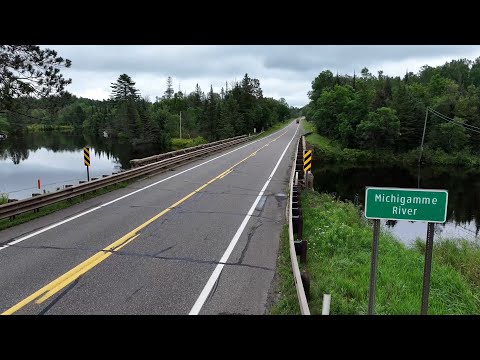
Department representative says 94-year-old M69 bridge over Michigami River needs $10,000,000 replacement, calls for sustained funding
Summary
A department representative described M69, a bridge over the Michigami River built in 1931, as having poor condition ratings across deck, beams and substructure and estimated a $10,000,000 replacement cost, noting the figure is roughly two and a half times the annual local bridge budget and urging sustained funding rather than one-time patches.
A department representative said M69, a bridge over the Michigami River built in 1931, has deteriorated and needs a replacement structure that the department estimates would cost about $10,000,000.
The department representative said the bridge — identified in the meeting transcript as M69 — has poor condition ratings for the deck, the beams and the substructure, and that those ratings mean the structure has “deteriorated to a point where we need to start looking at it more closely,” not that it is immediately unsafe. “When we get poor condition ratings on bridges, that does not mean that the bridge is unsafe,” the staff member said.
The department representative said repair work is difficult and the agency is “really tasked with finding a replacement structure for it and designing that and building it.” The estimated replacement cost of $10,000,000 compares with the department’s stated annual bridge construction and maintenance funding of a little more than $4,000,000, meaning the project would consume roughly two and a half years of that annual budget, the representative said.
Why it matters: the representative emphasized that sustained, predictable funding is needed. “A single shot of money isn’t gonna solve our problems. It’s gonna merely kick the can down the road five or 10 years,” the staff member said. The representative urged monitoring the bridge regularly and obtaining additional engineering opinions where appropriate.
Residents who spoke during the discussion described the bridge as essential to daily life and local industries. Resident (B), identified in the transcript as a resident, said the span is used by people “when you go hunting, when you go fishing, when you’re going to work, when you’re going to the grocery store” and noted the bridge’s importance to timber hauling and trucking. Resident (A) said the bridge has visibly deteriorated over the years and recalled it being “a beautiful bridge” two decades ago.
The discussion in the transcript focused on condition ratings, monitoring, the difficulty of repair work, the scale of the replacement cost and the need for sustained funding rather than short-term fixes. The transcript does not record any formal motion or vote on funding, design or a construction timeline.
Clarifying details from the discussion: the bridge was described as built in 1931 and approximately 94 years old; the department estimated replacement at about $10,000,000; the department’s annual bridge construction and maintenance funding was cited as a little over $4,000,000 per year.
No formal action on funding or a replacement contract appears in the transcript provided. The department representative framed next steps as monitoring the structure, seeking further engineering opinions, and finding sustained funding to design and build a replacement.