Get Full Government Meeting Transcripts, Videos, & Alerts Forever!
Get email alerts on the K 12 Education topic
No spam. Unsubscribe anytime.
Waunakee curriculum committee reviews assessment results; 11th-grade ACT decline noted
Summary
District presenters told the Waunakee Community School District curriculum committee that district ELA index scores rose modestly, math held steady, and 11th-grade ACT scores declined; the committee discussed switching to a digital ACT and administering a local preACT to inform instruction.
The Waunakee Community School District curriculum committee reviewed two years of student assessment results at a committee meeting, hearing that district-level English language arts index scores rose modestly while mathematics was largely flat and 11th-grade ACT performance fell across subjects.
Tim (curriculum committee member and presenter) told the committee the district is framing its work around the board goal “by June 2029, the district and all of our schools will be at the highest performance level on the state accountability report card system, which is significantly exceeds expectations.” He said the presentation uses two years of data to reflect recently updated state cut scores and that the percentages shown are of students tested, not total enrollment, because that aligns with report-card calculations.
The committee heard that results vary by grade and school. Amy (district staff presenter) said the district focused heavily on early-grade reading under state reading legislation known as Act 20, including adopting a new third-grade phonics curriculum and implementing personal reading plans. She said full implementation of such curriculum changes typically takes three to five years.
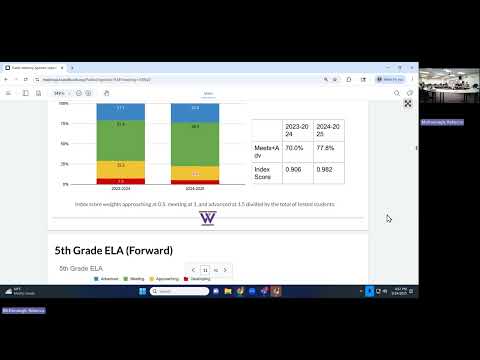
At the district level, presenters summarized: ELA index scores showed modest year‑to‑year gains; mathematics index scores were essentially flat; science results declined largely because of an eleventh‑grade decline on the ACT; and district social‑studies results rose slightly, driven by differences in which grades contribute to the high‑school measure.
Presenters explained how the report‑card calculations are formed. Tim said the presentation includes an “index score” used in accountability calculations: students classified as “approaching” receive a half point, “meets” receive one point and “advanced” 1.5 points; the sum divided by students tested yields the index score. He also noted that about 1 percent of students at each grade take the alternative Dynamic Learning Maps assessment and that only students enrolled for a full academic year (present by the third‑Friday count) factor into accountability measures. Presenters estimated opt‑out rates by grade typically range from about 0.5 percent up to 5–6 percent, and that state releases that include opt‑outs may show slightly lower percentages.
The high school showed mixed results: ninth‑ and tenth‑grade preACT and preACT Secure administrations produced gains, including increases in the “advanced” category, but eleventh‑grade ACT scores declined across content areas. Tim said the district plans to pilot a digital administration of the ACT this year (the ACT is currently administered paper‑and‑pencil at grade 11 in the district) and to give a locally administered preACT at the high school next month for grades 9–11 so teachers can get item‑level analysis and intervene before the statewide exam.
Committee members asked about school‑level differences. Heather (committee member) asked whether report cards are issued for the district or by school; Tim and other presenters confirmed there is both a school report card and a district report card. Committee members also asked about Prairie Elementary’s declines; presenters said they have begun meeting with school leaders to “tease out” whether the cause is cohort differences, curriculum changes, or other factors and will follow up with targeted support. Tim said he had met recently with “Dean and Katie” about supports for Prairie.
Joan (district staff) clarified participation rules for English‑language learners, saying a very recent newcomer in their first year in the country can be exempted from the ELA assessment and that, when families know a child qualifies for that exemption, they frequently opt the child out of mathematics testing as well. Joan said the exemption is available the day of the exam and applies for one year.
Presenters reiterated process and timeline: the Wisconsin Department of Public Instruction (DPI) is scheduled to release statewide assessment data publicly the following day, and preliminary, embargoed accountability report cards for the district’s schools are expected in early October. The preliminary period will include a short inquiry window for districts to raise questions with DPI before the report cards are made public in November. The committee was given calendar dates for upcoming curriculum meetings and told further board updates will follow after the DPI releases.
No substantive policy or regulation changes were proposed or adopted at the meeting; the session consisted of a data briefing, discussion of next steps, and scheduling of future curriculum committee work.