Get Full Government Meeting Transcripts, Videos, & Alerts Forever!
Get email alerts on the School Meals topic
No spam. Unsubscribe anytime.
Mountain View Whisman trustees discuss reusable dishware pilot, ask staff to pilot outsourced dishwashing at Landau’s
Summary
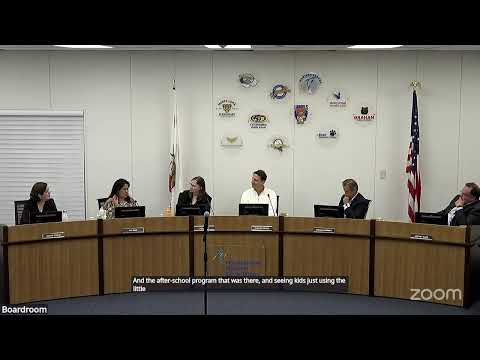
The Mountain View Whisman School District Board of Trustees on Sept. 18 heard a presentation on a pilot to move Landau’s Elementary from single‑use meal service to reusable dishware, and discussed next steps including a limited outsourced pilot and more information on health and operational impacts.
The Mountain View Whisman School District Board of Trustees on Sept. 18 heard a presentation on a pilot to move Landau’s Elementary from single-use meal service to reusable dishware, and discussed next steps including a limited outsourced pilot and more information on health and operational impacts.
Dr. Rebecca Westover, presenting on behalf of district nutrition services, outlined two models: an in-house dishwashing option and an outsourced service. Dr. Westover said in-house conversion would require kitchen modifications (estimated $120,000–$145,000 depending on site), additional staffing (an estimated additional one full‑time 8‑hour employee plus hourly support totaling roughly $90,000 annually for Landau’s), and one-time equipment and cart purchases. She said product donations from a nonprofit called Plastic Free Restaurants could cover about $59,490 of plate/utensil needs.
Dr. Westover summarized the outsourced option as a daily pickup and delivery service (DishJoy is one vendor identified) that would require two sets of dishware at each site, a daily fee of about $0.40 per meal and annual costs of roughly $14,400 for Landau’s. She estimated the district’s first‑year, district‑scaled costs at roughly $117,000 if outsourced, dropping to about $55,000 ongoing; in‑house first‑year costs were estimated around $269,000 with ongoing costs near $80,000–$81,000.
Why it matters: trustees and staff said the district’s child nutrition program operates on thin margins; Dr. Westover noted federal and state reimbursement rates of $3.46 per breakfast and $5.60 per lunch and projected general‑fund contributions rising to an estimated $265,000 in 2026 and $782,000 in 2027 under current assumptions. Trustees framed the pilot against that fiscal context.
Trustees focused on safety, cost offsets and operations. Trustee Evan Conley urged more data on PFAS and other contaminants in single‑use products, saying, “I do not want children using materials that are leaching PFAS into their food.” Trustee Christie Reed asked whether reduced single‑use trash could lower waste‑collection costs; Dr. Westover said staff can request waste‑hauler estimates of reduced bin size or pickup frequency. Trustee Charles DeFazio and others noted volunteer help at Landau’s but warned volunteers may not be reliable at every site and cannot fully replace paid staff. Trustee Lisa Henry asked that the district check warranties and operating condition for donated equipment before relying on it.
Public commenters included parents and a district alumnus who asked the board to ensure transparency on procurement and safety; one caller asked that the district not approve purchase orders prematurely and to follow Board Policy 3312 and public contracting law when moving to a multi‑vendor approach.
Board direction and next steps: trustees did not take a formal vote to adopt either option. Instead the board expressed support for a limited outsourcing pilot at Landau’s if the donated dishware is available and asked staff to: - gather more specific PFAS and product‑safety information for the disposable and reusable items used in the pilot and report back; - obtain formal cost quotes and possible RFP language for an outsourcing partner (DishJoy or similar) and for equipment vendors; - request waste‑hauler estimates on potential trash‑collection savings if single‑use items decline; - consult with Landau’s parent volunteers and school staff about operational plans and volunteer roles; and - explore nonprofit partnerships to reduce staff burden and offset start‑up costs.
Trustees said they preferred an outsourced pilot initially because it requires lower startup cost and provides flexibility if funding or operations change. Dr. Westover and staff said they would return with more precise cost proposals and data at a later meeting.
The discussion also flagged district‑wide constraints: staffing availability for short shifts, the uncertain continuation of federal and state nutrition grants, and the need to preserve core child‑nutrition services while piloting alternatives.
Board members said they wanted the pilot to remain focused and time‑boxed, and emphasized preserving classroom and nutrition funding if costs cannot be offset.
Ending: Trustees directed staff to continue exploration and return with more information; no program commitment or contract award was made at this meeting.