Get Full Government Meeting Transcripts, Videos, & Alerts Forever!
Get email alerts on the Local Public Funds Investment topic
No spam. Unsubscribe anytime.
Committee hears bill to broaden where local governments may deposit and invest public funds; retroactive protections sought
Summary
House Bill 15-23 would let certain local units expand where they place insured certificates of deposit and would retroactively deem some out-of-bound investments lawful back to June 30, 2018; the committee heard extensive testimony and did not move the bill.
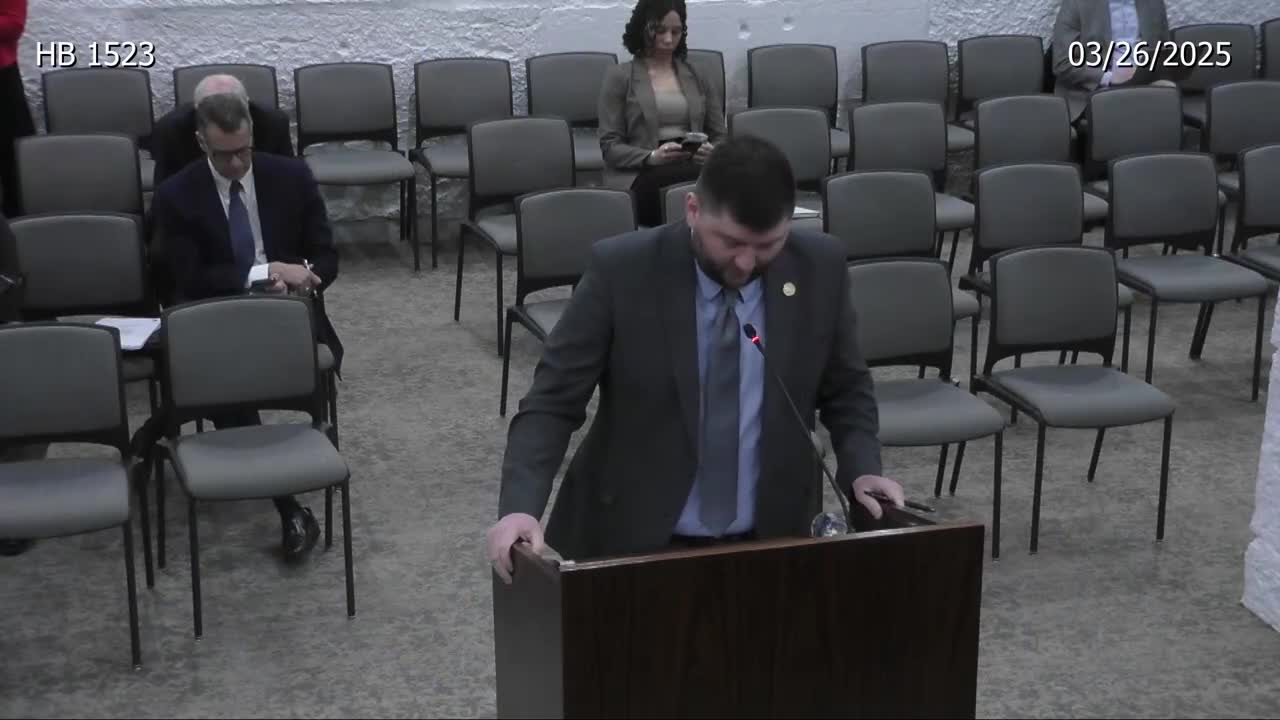
Representative Curt Pierce introduced House Bill 15-23 to allow broader investment options for local units of government, including counties, school corporations and library districts, and to protect some prior investments from audit exceptions.
Pierce told the committee the bill "allows local units of government more flexibility in their investments," explaining that current code limits where units may place public funds and that the bill would let schools and libraries invest in institutions anywhere within their county and allow counties to invest in depositories in contiguous counties. The bill would also deem certain investments made since June 30, 2018 lawful and insured, addressing uncertainty that arose after 2018 guidance and a subsequent attorney general opinion.
Officials from the Treasurer of State's office explained the state's backstop for public deposits. Mike Veil, executive director of the Indiana Board for Depositories in the Treasurer's office, described the board as "the insurer of public funds beyond the FDIC insurance." Veil said the treasurer's fund currently holds about $341,000,000 and the board has bonding authority for an additional roughly $300,000,000; the board will cover public funds up to 100% when a bank fails so long as the deposits are held at approved depositories.
Witnesses from school and library associations, counties, and the banking and credit-union industries testified for and against aspects of the bill. Scott Bowling of the Indiana Association of School Business Officials and Mark Schublak of Baker Tilly / Indiana Library Federation supported the bill and said it would prevent audit exceptions for entities that relied on an earlier interpretation of law. David Bodorf (Association of Benin County) and Jake German (Barnes & Thornburg, representing county commissioners) said many local units historically prioritized local depositories but that the 2018 change created confusion; they emphasized the policy trade-off between securing the best rate for taxpayers and keeping deposits available for local lending and services.
Dax Denton of the Indiana Bankers Association said cities and towns have been exempt from territorial limits for years and can invest statewide; other units currently must solicit bids within their political boundaries and may go statewide if they have no brick-and-mortar depository in their jurisdiction or if only one exists. Denton asked legislators to prioritize local deposits where possible and to avoid creating concentration risks from large, statewide flows of public funds.
Several witnesses and lawmakers raised drafting questions the committee said would require cleanup language. Representative Pierce and committee members noted disagreement about how many entities are affected: Pierce said he had been told "a handful," the treasurer's office referenced 12–14, while other testimony suggested the number could be larger. The bill also includes a contiguous-county provision that some witnesses want broadened to statewide; others urged preserving local banking relationships.
No committee vote was taken; Chairman Baldwin said the bill will likely return with amendments and that the committee would consult with the sponsor before offering changes.