Get Full Government Meeting Transcripts, Videos, & Alerts Forever!
Get email alerts on the Utility Partnerships topic
No spam. Unsubscribe anytime.
Committee approves amendment expanding utility partnership pathway and bars partner cost recovery from ratepayers
Summary
Senate Bill 423 was amended to allow utilities to form partnerships with private capital partners, military installations, universities and others to develop generation projects and to clarify that partner contributions may not be recovered from ratepayers; committee members debated ratepayer risk and the bill passed on a recorded vote.
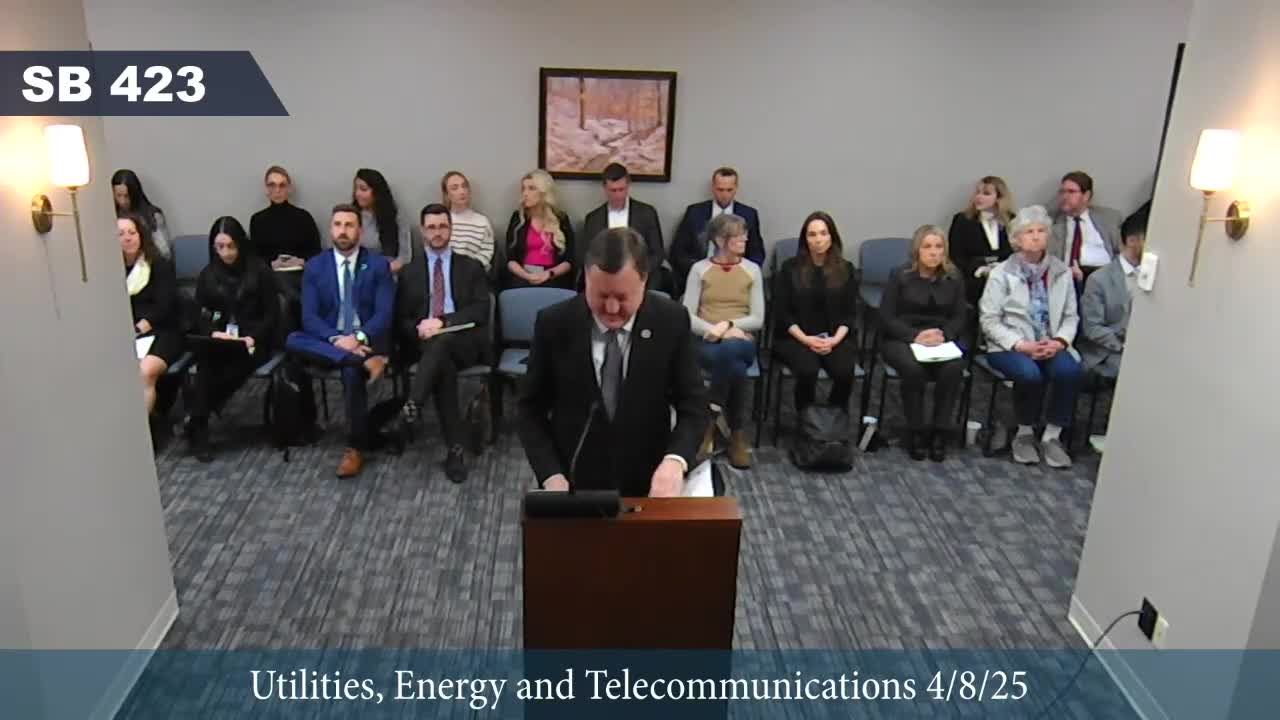
The Utilities, Energy and Telecommunications Committee approved an amendment to Senate Bill 423 that broadens a pilot partnership pathway for eligible utilities and clarifies how partner contributions are treated for rate‑making purposes.
Under the amendment, an eligible utility may partner with another eligible utility, a customer, capital partner, third‑party investor, military installation, a reuse authority, a small modular reactor (SMR) manufacturer, or a state educational institution. The amendment removes a two‑project pilot cap, allowing any utility that wishes to participate to pursue a partnership under the statute. The amendment also states that a utility may not seek recovery from ratepayers for costs that a partner contributes or provides.
Senator Cook, the bill sponsor, described the change as reflecting activity already under way and said the amendment preserves the original intent while preventing double recovery from ratepayers: “if you are a partner, you cannot as a utility then, then try to recover those same costs from the rate payers.” The sponsor and supporters said expanding the pathway responds to private interest and ongoing negotiations occurring faster than the legislative process.
Opponents and some committee members voiced concerns about the expanded scope and the potential for ratepayers to shoulder planning costs if projects do not come to fruition. Representative Pierce said he opposed the bill because it treats nuclear and fossil generation differently than wind and solar and because the amendment widens the potential for projects that might not succeed. Representative Bryant and others raised similar concerns about ratepayer exposure to unproven technologies and planning costs.
The committee passed the amended bill on a roll call recorded in the transcript as 8–4.
Votes at a glance: Senate Bill 423 (as amended) — passed on committee roll call recorded as 8 yes, 4 no.