Get Full Government Meeting Transcripts, Videos, & Alerts Forever!
Get email alerts on the Towing Regulation topic
No spam. Unsubscribe anytime.
Committee approves towing reforms and bans advertising of illegal substances as amendment to SB 73
Summary
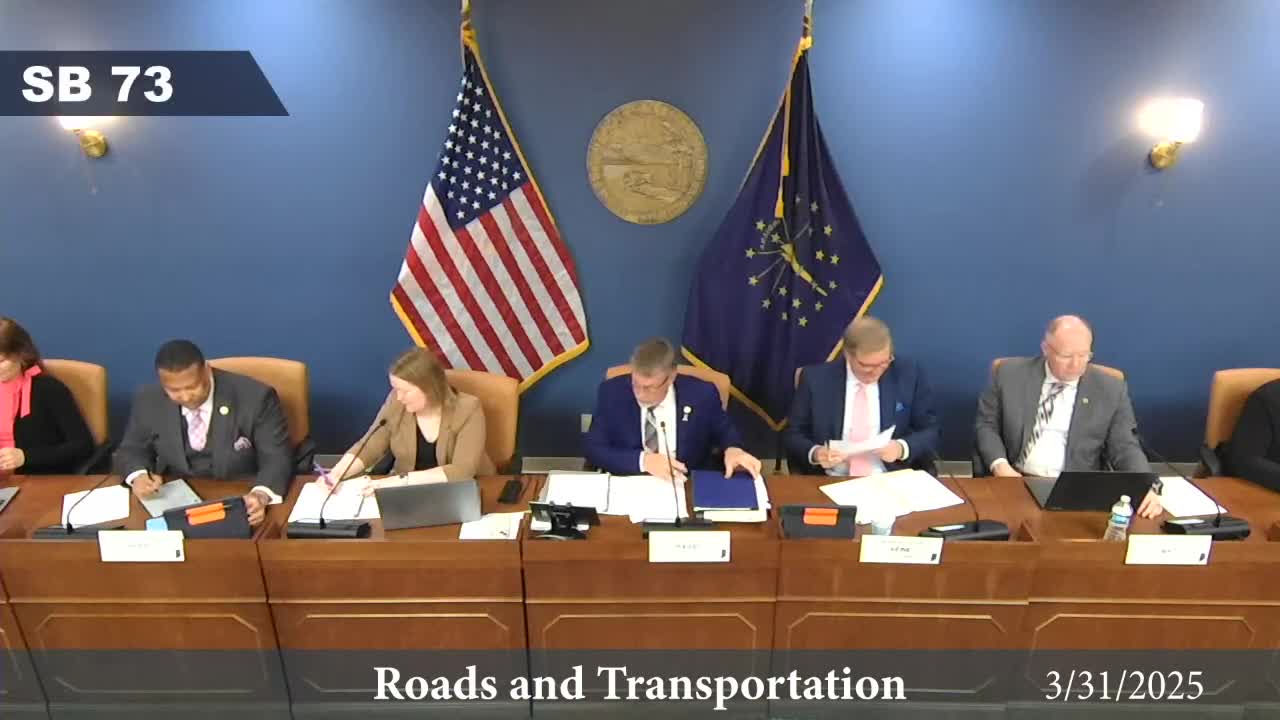
The House Roads and Transportation Committee on March 31 adopted two sponsor amendments to Senate Bill 73 that ban advertising of illegal controlled substances and revise oversight and remedies for predatory towing; the committee passed the measure 12-0.
The House Roads and Transportation Committee voted March 31 to pass Senate Bill 73 as amended, adopting two sponsor amendments that together ban advertising of illegal controlled substances and revise state oversight of predatory towing practices.
Amendment 7 would prohibit advertising an illegal substance as described on Indiana's controlled-substance list — the chair described the amendment as targeting marijuana advertising by billboards, rolling advertising trucks and mailers that promote dispensaries located out of state or outside the jurisdiction. The sponsor said the amendment does not legalize or criminalize substances beyond existing state law but would bar in-state advertising for substances that remain illegal in Indiana.
The committee also adopted Amendment 9, which removes a proposed towing board, creates a carve-out allowing the Attorney General's office to handle business-to-business emergency towing complaints under the Deceptive Consumer Sales Act (DCSA), and sets a bonding and payment structure intended to speed recovery of commercial equipment and freight. The mark-up language discussed in committee calls for a 60% up-front payment to the towing operator and a 40% bond when parties dispute charges; if not resolved, the bond mechanism is intended to preserve funds while a complaint is reviewed.
Supporters said predatory towing is a real problem in Indiana and that the amendment provides a faster, simpler enforcement route than an industry board. Gary Langston of the Indiana Motor Truck Association testified in support and said the language “provides a much better balanced, process for both the trucking industry and the towing industry.” Mark Snodgrass of the Office of the Attorney General said the AG's office supported Amendment 9 and did not expect the additional workload to be problematic, noting the office already handles roughly 10,000 consumer complaints a year and can consult law enforcement rate sheets and industry experts when needed. He said the AG supports harmonizing provisions that bar inspection fees with existing Indiana Code 24-14-9-2.
Towing industry witness Carrie Driscoll, testifying in opposition, said she had concerns that the proposal could expose small and medium tow operators to frivolous complaints and significant short-term revenue interruptions if 60% of revenue had to be withheld for up to 30 days. Driscoll asked for guardrails: clearer thresholds to deter frivolous complaints, more clarity on invoice timing and equipment time-stamping, and authority requirements for release of vehicles and contents. She also urged allowing retrieval of essential personal items without fee, while still permitting charges when a person removes all contents with no intent to retrieve the vehicle.
John Zarich of the Insurance Institute of Indiana asked the committee to clarify that if the matter is not resolved within 30 days the party that sought release would need to file a court complaint to resolve the bond, noting that the bond functions as a court-style guarantee until adjudication.
Committee members said stakeholders had worked on the language for months; the chair and sponsor said they expected to continue refining details as the bill moves forward. The committee adopted both amendments by consent and passed the bill as amended by roll call, 12-0.
What the bill does (as discussed in committee): it (1) prohibits advertising illegal controlled substances in the state (Amendment 7) and (2) moves commercial emergency towing disputes into a DCSA enforcement path with a 60%/40% payment and bond framework, bans certain inspection fees, requires more detailed invoices and gives the AG investigatory tools, including access to rate sheets and the ability to mediate prior to civil action (Amendment 9). Specific statutory text, enforcement timelines and court procedures may be further clarified as stakeholders and the AG's office continue to negotiate language before floor consideration.
The committee reported Senate Bill 73 as amended to the House by a unanimous 12-0 vote.