Get Full Government Meeting Transcripts, Videos, & Alerts Forever!
Get email alerts on the Personal Learning Lab topic
No spam. Unsubscribe anytime.
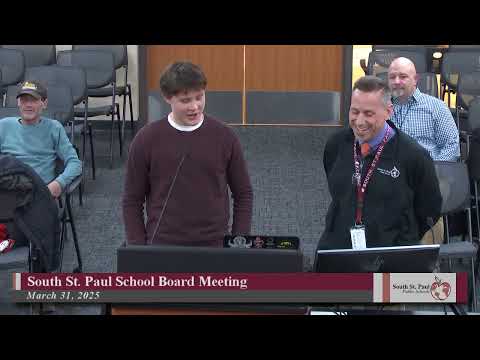
South St. Paul High School presents Personal Learning Lab to board; staff cite credit recovery gains
Summary
Principal Chuck Ochocchi and Personal Learning Lab teacher Don Neihardt presented the board with an overview of the high school’s Personal Learning Lab, a credit-recovery program that lets students make up required coursework during the school day using online platforms and teacher-facilitated supports.
Principal Chuck Ochocchi and Personal Learning Lab teacher Don Neihardt presented the board with an overview of the high school’s Personal Learning Lab, a credit-recovery program that lets students make up required coursework during the school day using online platforms and teacher-facilitated supports.
The program uses Odysseyware for coursework and assessments, Schoology for daily “bell-ringer” activities and reflections, and an Aristotle monitoring tool to help staff maintain academic integrity during tests and quizzes, Ochocchi and Neihardt told the board. Students work on lessons and projects in semi-private workspaces; tests and quizzes are done at visible tables so staff can proctor more easily.
Ochocchi said counselors and administrators assign students to the Personal Learning Lab after assessing credits at the start of each trimester, and staff can add students midterm when new enrollments or deficiencies are identified. Neihardt described the flow of a unit: students take a pretest that determines assignment sets, then complete lessons, projects and quizzes leading to unit tests. To earn a credit in Odysseyware, students must complete 100% of the course material and achieve at least a 60% score, the presenters said.
Enrollment and completion figures provided to the board: staff reported 70 enrollments across trimesters 1 and 2; those were described as "53 individual students and 17 who were in both trimesters, totaling 70." Presenters said 16 of those students were juniors and 54 were seniors, 99 credits had been attempted and 73 credits completed (some completions carried into trimester 3).
Board members asked how students are scheduled into the lab and whether students can work at an individualized pace. Neihardt said the lab operates during one class period for assigned students (the building has five class periods), typically 8–12 students per hour. Pretests and tests must be taken in the lab, but lessons and assignments can be advanced so that students who complete one credit are placed into the next one during the same trimester. Staff noted some variability across hours in student load and said they try to accommodate priority classwork from other teachers when necessary.
Ochocchi and Neihardt described student benefits: students who work long hours outside school or who participate in athletics and activities can recover credits during the school day, enabling them to remain active in co-curricular programs. Presenters also said the lab helps students who transfer from other districts with irregular transcripts to get back on track more quickly. Ochocchi praised Neihardt’s rapport with students and credited the program with helping seniors in danger of not graduating to recover needed credits.
Questions from the board centered on scheduling flexibility and classroom capacity. Neihardt said staff create an open period in students’ schedules for PLL (Personal Learning Lab) and emphasize that it is an actual class (listed on student schedules as PLL). He said students typically work the full class period and may earn multiple credits over a trimester depending on attendance and motivation.
The board did not take formal action on the presentation. Ochocchi and Neihardt said they would answer follow-up questions from board members and continue to provide updates to administration and staff.