Get Full Government Meeting Transcripts, Videos, & Alerts Forever!
Get email alerts on the Building Heights topic
No spam. Unsubscribe anytime.
Commissioners discuss raising residential height limits to 42 feet, seek written proposal and exceptions
Summary
Board discussion covered whether to allow higher residential building heights (staff noted some municipalities already allow 42 feet or higher); commissioners asked staff to draft ordinance language that preserves limits on habitable floors for single‑family homes and allows case‑by‑case exceptions for multifamily/workforce housing.
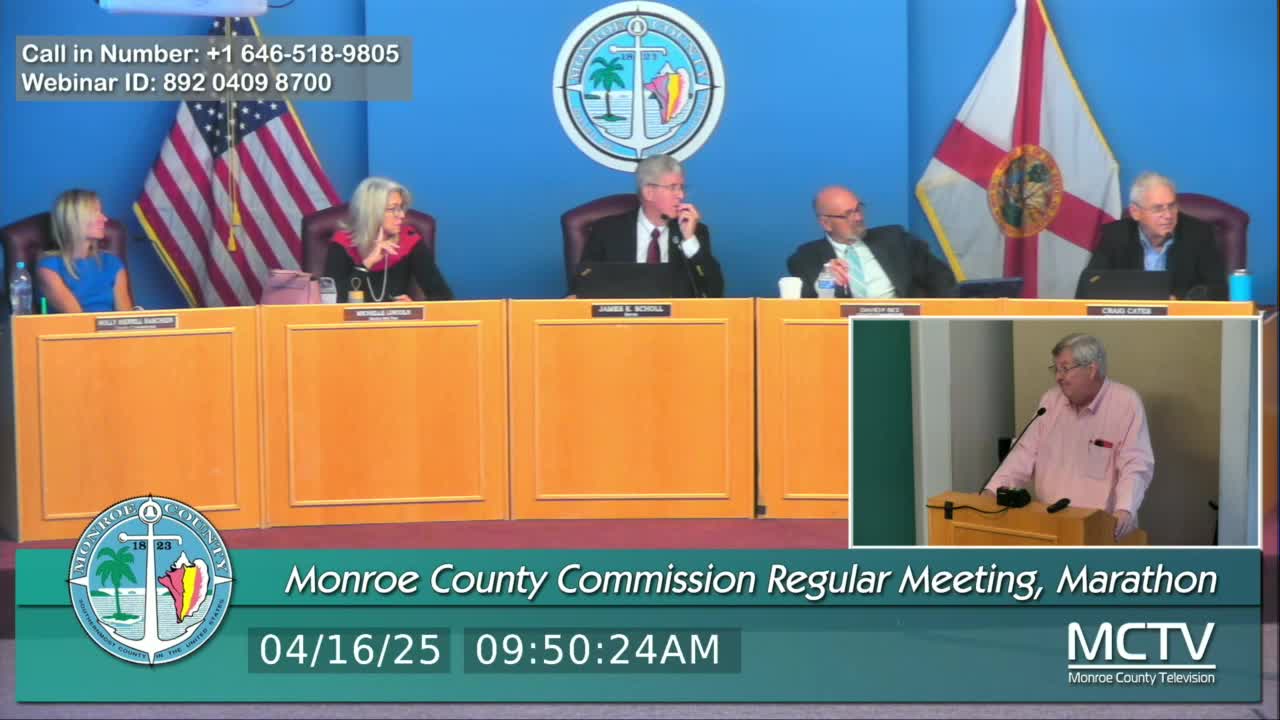
Monroe County commissioners discussed potential changes to the county’s residential building‑height rules at their April 16 meeting, including whether to raise the standard limit for residential structures to 42 feet measured from the crown of the road.
A resident, Tim Swanson, asked commissioners to "look forward 50 years" and said raising heights would give owners flexibility to add additional finishable space when properties are elevated for flood protection. County staff summarized current standards: a general 35‑foot cap for residential structures, an existing local exception that allows up to three additional feet for owners who elevate above required flood elevations, and a retrofit provision that can allow up to 40 feet in limited circumstances.
Staff noted that measurement baseline matters: the county currently allows applicants to measure height from either pre‑construction natural grade or the crown/curb of road; commissioners and staff said measuring from the crown of the road simplifies administration and is consistent with several municipalities.
Several commissioners expressed support for allowing a higher overall residential height ceiling of 42 feet while restricting single‑family homes to a two‑habitable‑floor maximum, and handling multifamily or workforce housing exceptions through a case‑by‑case approval process (for example, a planning‑commission or BOCC review for larger multifamily projects). Commissioners asked staff to draft ordinance changes — including an airport exception for FAA‑driven structures and clarifications on roof‑mounted mechanical equipment and elevator shafts — to return for formal consideration.
Ending: Staff said they would draft language and return with a formal proposal; no ordinance was introduced or adopted on April 16.