Get Full Government Meeting Transcripts, Videos, & Alerts Forever!
Get email alerts on the School Budget topic
No spam. Unsubscribe anytime.
Manassas schools present FY26 budget prioritizing pay increases, alternative‑education pilot and building purchase
Summary
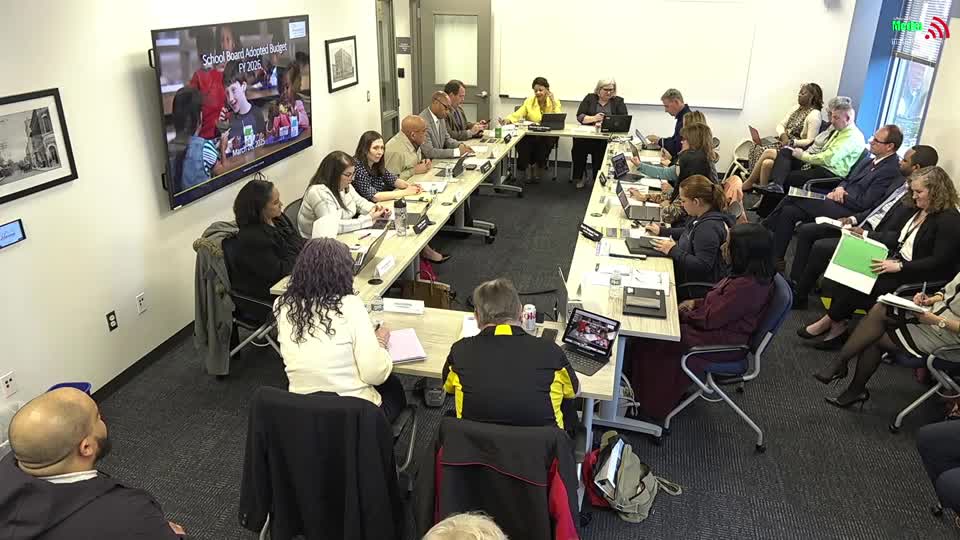
Manassas City Public Schools on March 26 presented its adopted FY26 budget to the Manassas City Council, proposing a $151.4 million operating‑fund plan that prioritizes staff compensation increases, instructional spending and two one‑time fund‑balance requests: purchase of 8700 Centerville Road and a $2.0 million alternative‑education pilot.
Manassas City Public Schools on March 26 presented its adopted FY26 budget to the Manassas City Council, proposing a $151.4 million operating‑fund plan that the school division said focuses on employee compensation, classroom instruction and several one‑time investments.
The school board adopted the budget the night before; Director of Finance Tap Kelly presented the division’s revenue and expenditure picture to the joint meeting. Kelly said the operating fund revenue estimate includes about $84.1 million in state aid, $60.9 million in city contributions and roughly $4.3 million in federal funds, with operating expenditures projected at $146.1 million.
Why it matters: School officials said the FY26 proposal seeks to keep staff pay more competitive in a tight labor market while preserving instruction and addressing growing English‑learner enrollment and free‑meal needs. The plan also asks the council to consider one‑time uses of fund balance for a central office building purchase and a pilot alternative‑education program.
Kelly told the joint session: “As you all know, the Virginia Code mandates that the superintendent of each school prepare a [biennial] balanced budget every year,” and that the budget must be presented to the local governing body. Dr. Jennifer Casada, who framed the budget in the district’s strategic plan, said, “This budget represents intentional choices to support student success.”
Major numbers and priorities - Total operating fund revenue presented: about $151.4 million (state aid ~$84.1M; city ~$60.9M; federal ~$4.3M). - Projected operating fund expenditures: about $146.1 million. - Cost per pupil (cited from a regional guide): about $18,076 per student. - Enrollment cited: 7,689 students; 71% Hispanic; 55% identified as English learners (the division’s slide stacked “active” and “former” EL counts to reach 55%). - Compensation: the budget dedicates roughly $5.2 million of new revenue to compensation, proposes a 5.5% increase on average across staff effective July 1, and adds a longevity step. Kelly said a $1.0 million increase in the employer contribution to health insurance is included. - Strategic investments beyond compensation: about $396,000.
Cuts and uncertainties School staff said they balanced investments by reducing certain items added in FY25. The presentation noted a $1.0 million reduction tied to an outside contractor for expanded intervention services — Kelly said that outside contract was removed and that schools will continue to offer targeted support blocks and after‑school services without the external contract. The presenters warned of lingering uncertainty from the General Assembly and federal funding changes that could affect final state and federal revenue and, potentially, the community eligibility provision (CEP) that currently supports free meals for all students.
Alternative education pilot and use of fund balance The school board presentation lists two proposed one‑time uses of fund balance: purchase of 8700 Centerville Road (current central office rental location) and a one‑time pilot for an alternative education program. Staff described the pilot as a small, intensive program to serve an estimated 40–60 students in grades 5–12 who face barriers to success in large classrooms. The presentation estimated a roughly $2.0 million one‑time cost to start the pilot, with about $1.2 million of that going to salaries for staff who would provide instruction, counseling and social‑work services; staff said ongoing costs would need to be built into future budgets if the program were continued.
On the building purchase, the school board said owning 8700 Centerville Road could reduce rental costs and would allow the district to collect rent from other tenants if portions remain leased. The presentation included an itemized placeholder of about $2.0 million for renovating the third floor to house the alternative education program.
Special programs, central registration and staffing School staff described plans to add ESOL‑certified teachers, reclassify certified nursing assistants, add an alternative education coordinator and create a central registration site to consolidate language assessments and intake for families. Staff emphasized that some added ESOL positions are driven by changes in the state funding model and compliance requirements.
Transportation and fleet Fleet manager Mike Morgan (speaking through staff) said diesel buses remain cheaper to operate and offer scheduling flexibility, while electric buses require longer charging downtime. Council members asked about the quoted cost for an additional diesel bus (about $160,000 cited in the presentation) and whether electric would be “a lot more.”
Questions from council and next steps Council members pressed school staff on details including the composition of the 55% English‑learner figure (staff clarified that the figure includes both active and former EL students and that access test results arrive in June), the timing and uncertainty of federal reimbursements for school meals, and how the alternative education pilot would be staffed and evaluated. School staff and council members acknowledged the pilot is a one‑time request and that future continuation would require further council decisions and funding. Council members also discussed regional competition for teachers (Prince William County and other nearby jurisdictions were cited as market comparators).
Formal actions recorded in this joint session - The school board voted to approve the meeting agenda at the start of the session (motion by Vice Chair Spall; second by Mrs. Breza). Vote: 7‑0. - The school board voted to adjourn at the end of the session (motion by Vice Chair Spall; second by Mrs. Bridget). Vote: 7‑0.
What remains unresolved Staff and board members repeatedly noted that final state and federal numbers were still pending; the Virginia governor’s proposed budget and subsequent General Assembly revisions, plus a VDOE recalculation tool, had been incorporated to date but could change. The CEP and other federal meal funding mechanisms were flagged as an uncertainty that could change per‑student costs and the division’s ability to keep providing free meals to all students.
Officials said the school board will transmit the adopted budget to the council for its consideration in the city’s budget process, and council members said they would review one‑time fund‑balance requests (the Centerville purchase and the alternative‑education pilot) during their own budget markup sessions.