Get Full Government Meeting Transcripts, Videos, & Alerts Forever!
Get email alerts on the Pension Cola topic
No spam. Unsubscribe anytime.
Kalamazoo County commissioners revisit retiree cost‑of‑living options as actuary outlines long‑term costs
Summary
County officials and retirees debated three formulas for a potential pension COLA — 1% annually, 1.5% annually, or 1% every three years — after actuaries and the retirement investment committee presented projected costs and funded‑ratio impacts. No formal change was adopted; commissioners requested more financial detail before a decision.
Kalamazoo County commissioners reopened a months‑long discussion April 15 on whether to adjust monthly pension benefits for retirees, hearing actuarial estimates and testimony from retirement advocates and county financial staff.
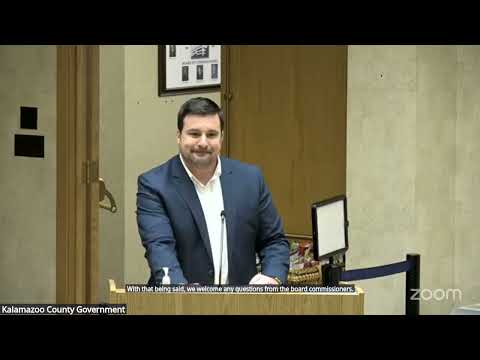
The county’s finance director, Ryan Post, and the retirement investment committee summarized three options under consideration: a 1% annual cost‑of‑living adjustment (COLA), a 1.5% annual COLA, or a 1% COLA every three years. “The 1 percent increase is $900,000 new cost,” Post said when identifying the projected recurring expense of that option. The retirement investment committee’s Bob Salisbury told the board, “The 1% COLA would increase that by 36% or an increase of about $900,000 per year,” and said even smaller periodic increases would raise the county’s annual pension contribution over time.
Why it matters: Kalamazoo County’s pension plan is currently over‑funded by actuarial measures, but commissioners and staff warned that any ongoing COLA decision would create a permanent, embedded cost in future budgets. Finance staff stressed that an additional recurring contribution reduces budget flexibility for other county priorities and becomes part of the annual funding requirement.
What officials said and numbers presented
Post reviewed recent actuarial updates and budget pressures facing the county. He told commissioners the county has received substantial new funding requests in recent budgets and highlighted upcoming operational costs including potential bond debt and new programs such as childcare for employees and housing projects. Post said the county’s most recent actuarial estimate shows the funded ratio declined from 109.8% to 108.2% and that the different COLA scenarios would change the funded ratio: his presentation showed the 1% annual COLA would bring the funded ratio to about 103.5%; a 1.5% annual COLA to about 101.3%; and a 1% every‑three‑years option to about 106.8%.
Bob Salisbury, speaking for the Retirement Investment Committee, repeated projected cost estimates and emphasized that a COLA is not a one‑time expense: “If you provide a COLA, it’s actually going to increase the amount of your annual contribution and that annual contribution will increase on an annual basis. It’s just not a one time cost.” Salisbury and other committee members said the committee’s role is to advise on fiscal impacts, not to recommend a political decision.
Retiree and advocate remarks
Several retirees and former county officials attended and addressed the board. A representative of retiree proponents said their analysis showed a 1% annual COLA would restore a portion of lost purchasing power for many retirees; they favored the 1% annual option over the 1% every three years option as too modest. Retiree representatives also discussed the significant number of retirees who receive relatively small monthly benefits: presenters said about 48% of current monthly annuity recipients receive less than $1,000 per month.
Commissioner reaction and next steps
Vice Chair Taylor said she was sympathetic to retirees’ loss of purchasing power but pressed for clarity on how much the county’s employee benefits fund could absorb before using general fund dollars. Taylor said she favored a review cadence to prevent the issue from being deferred for decades again and stated she supported the option of a 1% COLA every three years as the most fiscally balanced among the choices discussed: “I am in favor of a COLA increase for every 3 years at 1%.” Other commissioners expressed a range of views: some argued for a larger or different approach (including one‑time or prorated lump‑sum payments), while others urged fiscal caution given competing budget needs.
No formal action taken
The board did not adopt a COLA policy at the April 15 meeting. Commissioners asked staff to supply additional detail — including a clearer, year‑by‑year view of the employee benefits fund’s structural surplus and actuarial estimates for any alternative options (including one‑time payments or different scheduling of increases) — so the board can consider the fiscal tradeoffs during the 2026 budget process.
Ending
The board promised to continue the discussion at future budget meetings after receiving the additional actuarial and fund‑balance detail requested. Several commissioners said they want a regular review schedule for retiree benefits so the matter does not lapse for decades between discussions.