Get Full Government Meeting Transcripts, Videos, & Alerts Forever!
Get email alerts on the Tri City Exchange Code Enforcement topic
No spam. Unsubscribe anytime.
Council urges safety plan and staff follow‑up after prolonged Tri City Exchange site‑plan compliance questions
Summary
Residents and staff told the North Ogden City Council on April 8 that Tri City Exchange’s Friday distributions on Washington Boulevard have created pedestrian and traffic safety concerns; council directed staff to work with the operator on a safety plan and to seek a timeline for site‑plan compliance.
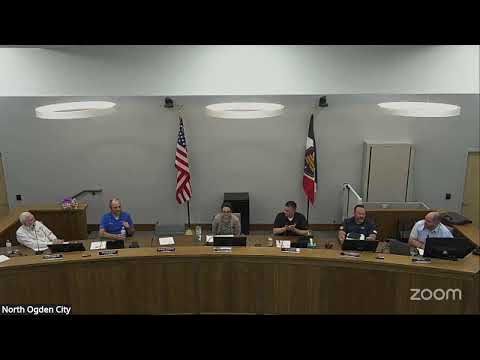
North Ogden City Council members on April 8 spent more than an hour discussing Tri City Exchange — a long‑running food distribution operation — after public comments flagged traffic and pedestrian safety near Washington Boulevard and 2100 North.
Planning director Scott Hess presented a staff timeline dating to 2021 and outlined recurring site‑plan and code issues: lack of hard‑surfaced parking, no formal on‑site stormwater retention, use of refrigerated tractor‑trailers as refrigeration rather than permanent refrigerated buildings, and absence of complete 501(c)(3) documentation on file. Hess said the planning department issued a response letter to an initial 2021 site‑plan application but the operator did not submit a completed application with required revisions.
Several residents told the council they had observed hazardous conditions during Tri City Exchange Friday distribution times, including pedestrians walking in travel lanes and vehicles blocking traffic. Amber Hodges, a North Ogden resident, said pedestrian movement and parked cars on Washington Boulevard have “just about caused several accidents” and asked for law‑enforcement traffic direction during busy Fridays. Another resident, Sandy Cochran, said the location has “far outgrown” its site and raised questions about whether the operation has current business or nonprofit documentation.
Owner/operator Mike Larson addressed the council and the public at length. Larson said Tri City Exchange has been operating about five years and provided licenses he said include state Department of Agriculture and county food handling approvals. He described operational changes he has made — adding bathrooms, reconfiguring parking with cones, using quieter refrigeration units, and working with police on traffic control. Larson said, “We are an active 501(c)(3)” and that the operation serves hundreds to thousands: “1,177 families came last Friday to get food,” he told the council.
Staff and council sought to separate regulatory responsibilities. Hess noted public‑safety issues such as on‑site circulation and parking are relevant to the planning and engineering review and to UDOT because the primary frontage is on a state route; food handling and repacking compliance falls to county and state health authorities; and business‑license questions fall under the city’s business licensing code.
Council members pressed staff on timetables. Council member Watson asked how long the situation has remained unresolved since initial contact in 2021; Hess said the city’s written comments came in 2021 but the application process stalled and that the planning department typically issues red‑line comments and waits for revised materials from applicants. John Call (city administration) said staff could waive a re‑application fee to encourage the operator to resubmit a full site plan.
After discussion the council took several directions: Mayor and council asked staff to work with the operator to develop an immediate safety plan focused on Friday distributions (parking management, cone layout, signage and lot monitoring), to solicit commitments and a timeline for correcting planning issues, and to explore fee waivers for a follow‑up site plan so the applicant can proceed. The council also directed staff to use the Tri City Exchange review as a case study in a broader code‑enforcement discussion.
Hess used the Tri City Exchange example in a larger presentation on code enforcement that followed. He told the council the city is currently reactive — relying on Weber dispatch complaints and community service officers — but staff recommended better use of the city’s iWORK case management portal, aligned department letters that could serve as formal first notices, quarterly code‑enforcement priorities and clearer fee/fine language. Hess told the council proactive enforcement would require additional staffing: “At least one more community service officer,” he said, noting a second or third officer would make the program more robust.
Council discussion produced two key policy directions: (1) Council signaled support for staff to pursue more proactive code enforcement for life‑and‑safety priorities and authorized department heads to begin proactive follow‑up on egregious issues, and (2) council asked staff to include an additional community service officer position for consideration in the coming budget cycle while noting the council must weigh that against overall budget pressures.
Council and staff emphasized the goal is to keep Tri City Exchange operating where feasible while improving safety and regulatory compliance. Hess and Larson agreed to coordinate a safety plan and a timeline for site‑plan submittal; Hess said staff would return to council with status updates.
The council did not order the operation closed and stated the priority is a path to compliance with minimal interruption to distribution of food to residents.